Showing posts with label GBA. Show all posts

Monday, 15 February 2016

Game Review: Harry Potter and the Philosopher's Stone (GBA)


Game: Harry Potter and the Philosopher's Stone
Console: Nintendo Gameboy Advance
Developer: Griptonite Games
Release Date: 15th November 2001

In the unlikely event that you're thinking that I've reviewed this game before, you'd be partially correct, as I've taken a look at the Game Boy Colour and Playstation versions of the game. Excitingly enough though, there are five completely different versions of this game across as many platforms. I've still got to play the PC and Playstation 2 versions of the game, but this is the Game Boy Advance release. While it shares some similarities with the Game Boy Colour version, like the musical themes, sound effects and spell names, it's a very different experience.

The game can best be described as a puzzle platformer loosely based on the film version of the first Harry Potter book. As with the Playstation version of the game, the story skips straight to Hogwarts, giving a storyboard version of the first third of the book. The quests are a strange mix of events from the story, classes where spells are learnt, puzzle platforming dungeons, and fetching the ingredients for a potion for Snape, which seems to span at least half of the game.


Each class attended by players results in a new spell learned, each with a different effect. Flipendo knocks enemies back, and can stun and kill weaker enemies, Alohomora unlocks certain types of locked doors and chests, Avifors transfigures things into birds, and there are even more spells to learn in the later parts of the game. After each class is a dungeon of some kind which utilises the spell that's just been learned.

Inside all of the game's dungeons are enemies; gnomes, snails and pixies mainly each with different attack patterns. Gnomes wander randomly, and attack when within range; unfortunately though the timing is slightly off and it's incredibly frustrating to even get a hit on them. Snails and pixies are a little easier and more predictable, but the most annoying aspect of the game is lack of variety in the enemies that can be found.


The player's health is represented by the lightning bolts in the top left of the screen, and one is taken away for each time the player comes into contact with an enemy. Once all of the player's health has been depleted, they're sent back to the very beginning of the level, despite the fact that many levels are at least 10 to 15 minutes in length when being solved for the first time. Many of the dungeons are irritatingly laid out or disorientating, and being sent back to the start happens far too often.

While the dungeons can be tricky, there's nothing quite as difficult as the Quidditch parts of the game; while the matches don't necessarily need to be won, there are sections of the game which have to be completed on a broomstick that can prove to be difficult to control and to pass. Boss battles too can be frustratingly difficult, but conversely players seem to be overly rewarded for the simplest of tasks, with 50 house points given simply for attending class and learning a spell.


In all, the game lasts around 6 hours, as long as players don't get stuck in any of the dungeons for too long. The final quest in the game which is based around obtaining the Philosopher's Stone, and the chambers protecting it is particularly difficult in places, and seems to share a characteristic with most of the other dungeons in the game in that it's completely tedious and unnecessarily long. The platforming is awkward, the enemies are badly programmed, and there's little enjoyable gameplay to be had.

In terms of following the story of the book and movie, there are points where the game deviates; the importance of Snape's collecting quest is exaggerated and many memorable moments are left out in favour of classes and dungeons which have no relevance to the story. Players who've never seen the movies or read the book will find the game to be a boring and confusing experience, and those who are Harry Potter fans will miss their favourite parts of the story, and find the characters to be less than engaging.


Graphically the game has more detailed sprites than the Game Boy Colour version, though they're not particularly impressive for the console or the time of release. The animations are decent for the time, but any battles with enemies are too shortlived or frustrating to enjoy when compared to the RPG stylings of the Game Boy Colour release. Musically the game shares themes with the GBC too, though in this version there's a little more polyphony for better or worse.

Overall Harry Potter and The Philosopher's Stone for the Game Boy Advance is a less than enjoyable experience as its gameplay can be likened to a frustrating and almost broken puzzle platformer. With such a rich and interesting story to be made into game form, it's a surprise that more of the book wasn't used in planning the quests. Stay away from this game if you can, it suffers from the curse of licensed games.

Rating: 46/100
Grade: D

Monday, 28 September 2015

Game & Watch Gallery Double Header: Game Boy/Advance


Game: Game Boy Gallery
Console: Nintendo Game Boy
Developer: TOSE
Release Date: 27th April 1995

The first game in the Gallery series, but not officially titled "Game and Watch" Gallery, Game Boy Gallery offers players a choice of 5 classic Game and Watch games, with A and B modes and classic/updated sounds for each. While fairly basic, it's a nice way to check out some of the games from the Game and Watch series of handhelds without having to get hold of them. Since all of the games are based on the LCD handhelds, gameplay is fairly simple and limited to the directional buttons in many cases. 

Ball


Ball is a very simple Game and Watch title, and in fact the very first one to be released in April 1980. Players use the left and right buttons to direct a juggler's arms between 3 set on screen positions as he juggles balls in consistent arcs. The ball nearest to the juggler moves faster than the one in the middle, with the one on the outside moving the slowest of the three. This means that players must consider which ball will need to be caught and thrown back up first.

Both game A and B are fairly easy to manage with speed increases being of little challenge overall. The music featured as the updated soundtrack is fairly interesting, with the original sound effects only being triggered each time a ball is caught. The game ends when a ball is dropped and any high scores are registered. 

Vermin


The third Game and Watch handheld to be released was Vermin, which challenged players to move left and right, positioning their hammer over holes where moles are about to pop up, and giving them a whack once they do. On Game A there are 4 spots where the moles can appear and gameplay is fairly slow to start with, and on Game B there are 5 spots where the moles can appear, with an increased gameplay pace. 

While it's nothing technologically spectacular, this feels more like a brain training/multitasking type of game, keeping an eye on the upcoming moles whilst whacking the most recent one to surface. It's more fun than Ball, and has a fun updated soundtrack, with basic sounds if the original soundtrack is selected. 

Flagman


Flagman was the second Game and Watch handheld to be released and is a fairly simple electronic version of Dimmo/Simon Says. In Game A, a pirate holds up 4 different flags relating to the 4 directions of the d-pad. Each time the player gets the sequence correct, a move is added to the end of the sequence. In Game B, there's a fifth and sixth flag that can be added, courtesy of other characters onscreen. 

Unlike Ball and Vermin, this is an example of an electronic game that can easily be played elsewhere, and could had been even at the original time of release in 1980. It's pretty fair to say that this is a less specialised version of that game, and as such the only real addition is the music added in the updated soundtrack.

Manhole


Manhole was the sixth Game and Watch game to be released as a handheld, and challenges players to aid pedestrians in walking over four gaps by bridging them at the correct time. As the game continues, multitasking becomes important, with three or four pedestrians on screen at the same time, requiring a huge amount of multitasking as each pedestrian requires 2 instances of being helped by the player.

Game A is a slower and less complex version, and Game B is faster and more difficult. The updated music for this particular game isn't great, and I much preferred the simple sound effects of the original game. In terms of gameplay, Manhole is pretty fun for a Game and Watch title, but none of the early games show a huge amount of replayability beyond high score chasing.

Cement Factory


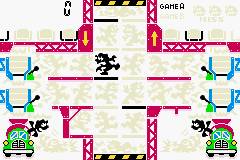
Cement Factory is a later Game and Watch title, which features more complex gameplay than any of the previously mentioned titles and better resembles a video game on the whole. Players move between platforms using the lift, being careful not to fall and lose a life, and pull levers to release cement to a lower level of the factory and ultimately into trucks. If the cement levels builds up too much in any of the four storage tanks, then a life is lost. 

Game B is a faster version of Game A, and compared to the other games on this collection, Cement Factory is the most fun and challenging. It requires players to multitask and pick the correct moment and sequence in which to do tasks. Once three lives are lost, the game is over. 


Overall Game Boy Gallery isn't a particularly technically impressive game, but that's almost to be expected for a collection showcasing technology that was already 15 years old at the time of release and is now approaching 35 years of age. It gives players the chance to play Game & Watch handhelds without having to own the consoles themselves, which can be costly thesedays, and the updated sounds and visual borders (if used with a Super Gameboy on the SNES) are a nice addition.

Rating: 59/100
Grade: D


Game: Game & Watch Gallery Advance
Console: Nintendo Game Boy Advance
Developer: TOSE
Release Date: 28th October 2002

The fourth in the Game and Watch Gallery series, and the first on the Game Boy Advance, Game & Watch Gallery Advance showcases 6 classic Game & Watch titles, each with a classic and modern version, as well as a 2 player or Hard Mode of each. Alongside the games there's a Gallery/Museum option which allows players to unlock and play some other classic Game & Watch titles with the stars they've earned in the main game.

Boxing


Classic Boxing features 2 fighters, with their health bars at the top of the screen and a number representing their total health. Each time a bar is knocked from a fighter's health the total health goes down by one. Each time the bars are depleted, 3 points are knocked from the fighter's health and they're pushed back by one step. If a fighter's health bars are fully depleted whilst against the ropes, then 6 points are taken from his total health. Once the total health reaches 0, the fighter must be knocked down whilst against the ropes for an opponent victory.

While this sounds very technical, the reality of gameplay is literally hammering the punch button. Players needn't even pay attention to the screen to win matches. I managed to fight my way to 20 knock outs without even really trying at all. Whilst the difficulty increases incrementally, 20 KO's is enough to earn 5 stars on the main menu, and isn't a challenge at all.


In modern mode, Boxing features fights against 3 opponents, Wiggler, Boo and Waluigi. Players control Luigi and attempt to land a hit on their opponent and take one of the hearts from their health meter at the top of the screen. Once all 5 hearts are gone, the player whose meter has been depleted falls back against the ropes, and both players meters are refilled. Play resumes and if the player against the ropes loses all their hearts again, they are defeated. If they manage to beat the other boxer then play moves back to the centre of the ring.

Unfortunately, being based on the Game and Watch version, there are only two punches which can be thrown, a high and a low hit. Button mashing seems to be the easiest way to land punches, although different moves seem to work differently depending on the opponent. There's very little challenge to this minigame, and the modernised update only really adds better graphics and different fighters to the mix.

Fire


Fire was the 4th Game & Watch handheld released, and like those before it only featured the right and left directional buttons for input. Players were challenged to save escapees of a building fire and bounce them to an ambulance on stretchers. As the game continues more and more escapees tumble out of the building at an ever increasing rate, meaning that players must multitask and keep their attention on which patient needs bouncing to the ambulance next.

A little challenge is added by the fact that the patients bounce slightly less high on their second ascent, so the timings aren't symmetrical. Game B is a faster and more advanced version of Game A, but other than this there's no real difference. As a game, Fire works well with its simple concept, but can easily become monotonous.


The updated version of Fire features different characters from the Mario series in addition to the different bounce heights of the previous version. Toad is lighter than Yoshi, who is in turn lighter than Donkey Kong Jr. There are also power-up eggs which contain either a score bonus or a bomb, the latter of which must be dropped before it blows up the carriage, waiting to save the escapees of the fire.

Just like the original version, Mode B starts players off with a more complex set of patients to transport. The updated version is one of the more difficult games on the collection, due to the amount of multitasking and judgement needed with the different types of character to be transported. Annoyingly, even with a High Score of 251, the game rated my performance as 1 star out of 5, which I thought was a bit of an insult.

Rain Shower


Rain Shower was a Game and Watch handheld released in August 1983 at a time when Nintendo were releasing one new Game and Watch console a week, While this didn't last long, it's interesting to consider how many things the company must have had their minds on at once during this time frame. The objective of Rain Shower is to stop laundry on the washing line from getting wet by adjusting four separate lines left and right as rain drops fall. In terms of control, players use the d-pad to navigate the onscreen character into place before pressing the action button to swap the position of the laundry, between two presets.

While Rain Shower is a fairly complex game when compared to some of the others, the multitasking feels less enjoyable as its easy to miss a single raindrop headed for the laundry and lose a life, while distracted by another drop. Game B worsens this by starting at a higher difficulty level. I can't honestly say I'm a big fan of this particular Game and Watch as it uses the basic concept of some other Game and Watches (mainly Helmet) in a new setting.


The updated version of Rain Shower doesn't even really fit the name; Bowser throws items down towards characters on swings below, and its Mario's job to move the ropes and protect them from being hit from above. The game suffers the same multitasking issue as the original and if anything is more difficult to keep track of due to the coloured visuals. As time progresses more characters come and sit on a swing, giving Mario an even more complex task to do. The music provided with the updated version is bearable, but the game is less so.

Mario's Cement Factory


Essentially the same as Cement Factory, featured earlier in this review, on the Game Boy Gallery, the classic version of this game plays and feels very similar with slightly updated colour graphics for the industrial setting and equipment.


The updated version of Cement Factory plays very differently to the older versions. While the main concept is the same, Mario is allowed to fall between platforms without consequence as long as he doesn't touch the top or bottom of the screen. This makes the game far easier on the whole, and allows players to focus more on their movements and keeping track of which containers are filling up. As a concept this is probably one of the best games on this cartridge, as there's far more complexity than anything featured so far. Strangely there's no background music featured in either version of the game, which is disappointing even if this does make it easier to hear the "full" sound effect for the containers.

Donkey Kong Jr. 


The original version of Donkey Kong Jr. (which may have been better as an actual Game & Watch handheld) seems to me to be borderline unplayable. With so many outlines for Donkey Kong Jr's positions, it's hard to tell which is the next to progress to, and what options are available. Add this to some difficult obstacles, and you've got a frustrating and confusing game which really needn't be. This seems to be an example of technology holding back the playability of the game, except that as it's been remade on Game Boy Advance, they could clearly have toned the multiple Donkey Kong Jr.'s down a little, and made the route more obvious.


The updated version of Donkey Kong Jr. is far better and allows players to rescue Donkey Kong over a variety of levels (at least 3), with a slowly increasing difficulty curve and a much simpler movement interface whilst retaining the positional movement of the Game and Watch original. The music is also fairly enjoyable, which adds a sense of the experience being much closer to a real video game rather than just an LCD handheld.

Donkey Kong 3


Donkey Kong 3 (at least the Game and Watch version) features Mario and Donkey Kong facing off by filling tanks of water and shooting bubbles at each other, which send what appear to be mice towards the other player. Being hit by a bubble doesn't affect the player, but if one of the mice reaches their side of the screen, then a life is lost. Sucessfully getting a mouse to Donkey Kong's side of the screen results in a points bonus and the positions resetting.

Much like Donkey Kong Jr., the sheer amount of outlines on the screen mean that making sense of what's happening is difficult. The mice also swap around what level they're on constantly, making it anyone's guess where they're going next, and consequently where to shoot.


The updated version of the game fares much better in terms of being able to see what's happening. The mice have been replaced with a fireball and a Boo. Unfortunately these two also move around quite a bit, and the best strategy seems to be completely refilling the water tank and then shooting it all at the middle, assuming one of the two items are in that lane. Overall this one's some fun, though it could definitely have been better.

With all the main games reviewed, I should also mention the fact that there are 9 bonus original Game and Watch games to play. These are unlocked by gaining stars in each of the featured Game and watch games, though it's often difficult to earn any stars due to the high boundaries set by the game. Since you'll need 80 stars to even play the first unlockable bonus Game and Watch, there's little point including them as a feature, since it's fairly obvious that their inclusion is simply to give players a reason to continue playing what appear to be fairly boring choices and revamps from the Game and Watch catalogue.

On the whole, Game and Watch Gallery Advance doesn't seem to have even one title that's completely worth playing; classic or updated. While it's a nice throwback to the handheld consoles, and the updated versions often do improve on the originals, there's no real need to return to what appear to be fairly bland and simple games.

Rating: 60/100
Grade: D

Wednesday, 16 September 2015

Pinball Games Quadruple Header

A while back I posted a Pinball Games Roundup, but since then a few more pinball games have come to my attention. I'll be playing them in chronological order of release;


Game: Pinball Wizard
Console: Amstrad CPC 464
Developer: Sagittarian Software
Release Date: 1985

Pinball video games released in the 8-bit home computer era are never going to be perfect; even NES pinball isn't all that, since it was particularly hard for programmers of the time to code a smooth running pinball table with a good amount of interactive features and ways to score points with the amount of tape/cartridge space available.

Pinball Wizard seemingly chose to have smooth running gameplay over an abundance of feature on the table. The only real point of interest are the Hi/Lo switchers, which change the amount of points awarded for hitting bumpers on either side of the table. The letters at the top which spell Sagittarian give a bonus when they're all illuminated, and other than that the idea is to keep the ball in play for long enough to score points. The user manual says "With practice, scores over 20,000 can easily be achieved!". Which is fair enough, though scoring 1,000 points is hard enough and takes only a minute or so to do.


Graphically the game's choice of colours was limited by the CPC, but still is difficult to look at for too long. The table itself is pretty bare and reminded me of NES Pinball. Sound effects are lacking and there's no real excitement to gameplay. The only real redeeming feature is that the ball speed can be adjusted and the game runs smoothly no matter which speed is selected. It's not enough to make it particularly notable, or enjoyable though.

Rating: 37/100
Grade; E


Game: Dragon's Fury
Console: Sega Mega Drive
Developer: Technosoft
Release Date: 1992

Listen to the game's OST as you read! (it's pretty awesome)

Originally released for the Turbografx 16 as Devil's Crush, Dragon's Fury features pentagrams and other eerie occult themes throughout its main table's three sections, its six bonus tables and the final battle. Gameplay is fast paced and there's lots to do on each section of the table. The overall objective is for players to clear all of the bonus tables in order to face the final battle and beat the game. To reach bonus tables players must clear objectives on the main table, such as transforming the face in the middle from a maiden to a serpent and hitting the ball into the serpent's mouth.

The difficulty level of the game is medium on the main table as its pretty easy to reach bonus tables and have a fulfilling turn, but the difficulty of bonus levels and the final boss are far higher, almost as if they were specifically designed to cut short any attempt to beat the bonus stages. Once all 3 balls have been lost by the player, a final chance is given for an extra ball if players can match the last digits of their score with a bonus counter. This is a nice feature and adds an extra chance around 50% of the time (if players are skilled at stopping the bonus counter).


Graphically the game features dark and eerie colours throughout its levels, with some brighter visuals in its bonus levels. There's a lot of occult iconography and monsters on the main table, with an array of different characters making up the bonus level bosses. Musically the game is great and the scene is definitely set by the fast paced horror/classical influenced soundtrack. The sound effects are minimal and take second place to the music in the mix, which allows players to enjoy the soundtrack.

Overall Dragon's Fury is a lot of fun as a pinball game on the Mega Drive, if a little frustrating to actually progress in. The table is particularly interesting and its bonus tables are fun, if a little small compared to the main table. The theme of the game is probably its main draw, but it works well as a pinball game and has something to offer both casual and more serious players.

Rating: 73/100
Grade: C


Game: Crüe Ball
Console: Sega Mega Drive
Developer: Electronic Arts
Release Date: 1992

Listen to the game's OST as you read!

The band Motley Cr
üe and pinball don't seem like the most natural combination, but somehow EA were inspired to make a pinball game based off the band. Players work their way through 9 "volume levels" which change the layout of the table, and relative difficulty. The game features many themed elements such as knocking down the words Rock and Roll, or Headbanger for bonus points, and in later levels there are guitar amps which can be knocked down also.

The game features three songs by Motley Crüe, as well as music for each of the 9 volume levels. with the soundtrack composed by Brian L. Schmidt who wrote music for Mutant League Football as well as a few other Mega Drive games. The gameplay is fast paced and particularly easy on the first volume level, allowing players to get acquainted with the feel of the game. In some levels, the ball bounces back up into play if it falls down the edge of the table, unlike many other pinball games. Another interesting feature is the choice to use 4 balls instead of the usual 3. 


Graphically the game is bright and interesting, featuring an electronic theme alongside the musical one. The table has plenty to do, as it's split up into 3 sections, and the middle section changes with each volume increase. Progression to higher volume levels is fairly easy and the game only gets harder from around volume level 5. Musically the game features many high energy tracks to accompany gameplay, and this works well to deliver an exciting experience for gamers.

Overall Crüe Ball offers a fun and engaging pinball experience, even for those who aren't particularly skilled at pinball games. The band's endorsement could be a selling point for fans, but the gameplay is a far bigger aspect for me. There's some fun bonus levels to be accessed and the controls are particularly responsive. 

Rating: 80/100
Grade: B


Game: Pokémon Pinball: Ruby & Sapphire
Console: Nintendo Game Boy Advance
Developer: Jupiter Coporation
Release Date: 26th August 2003

The second game in the Pokémon Pinball series, the Ruby and Sapphire edition adds many Pokémon from the 2nd and 3rd generation to bring the overall total up to 201 catchable Pokémon. The concept and many features of the table are much the same as the first game, but with better graphics, overall gameplay and pinball physics, this game is an improvement in almost every sense. Players choose from the Ruby table or the Sapphire table at the beginning of the game, and normal or slow ball speed. The main objective of tables is to catch Pokémon by initiating one of the many catching bumpers on the table. An example of these would be hitting a Cyndaquil 4 times until an egg falls down from above and hatches, or getting your Pokéball inside a Wailmer.  

On both tables there's a mart at which to buy items, and bonus games which earn players points and coins once completed. Players can catch up to a maximum of 3 Pokémon in any one area (displayed at the centre of the table) before needing to hit the travel bumper 3 times and launch the Pokéball into the travel hole to move onto a new area and begin catching more Pokémon. The aim of the game overall is to fill the Pokédex and own one of each Pokémon in the game. 


Graphically the game features bright and cartoon style graphics as we've come to expect from the Pokémon franchise. The animations and movement of sprites and the Pokéball itself are on par with the rest of the Pokémon series, and unlike the first game, the ball physics are a lot more predictable. The music featured in the game fits well with the rest of the Pokémon series, and is a good accompaniment to gameplay.

Overall Pokémon Pinball: Ruby & Sapphire is an improvement on almost every aspect of the original game, and has far more replayability thanks to this. The tables have an array of features and things to do, and for any Pokémon fan, there should be more than enough excitement.

Rating: 80/100
Grade: B

Friday, 27 February 2015

Game Review: Rhythm Tengoku (JP)


Game: Rhythm Tengoku
Console: Game Boy Advance
Developer: J.P. Room
Release Date: 3rd August 2006

Have you ever loved a game so much that you've decided to import the first game in the series, despite the fact it's entirely in Japanese? If so then you'll know the sort of love I have for the Rhythm Heaven series. So far I've reviewed Rhythm Heaven for the DS, and Rhythm Heaven Fever for the Wii. While there's an instalment coming out on 3DS, I'm yet to own that system, and it's not out yet, so I looked to the East for some more rhythm based minigame fun.

As the first game in the series, Rhythm Tengoku set the precedent with many of the features that are included in later games such as Rhythm Toys, Endless Minigame bonuses, Medals for Superb ranks on songs, and the chance to get a 'Perfect' grade. Also included on this game, but not others in the series are drum lessons, with the chance to drum to many of the game's songs once the game is beaten.


There are 48 rhythm minigames featured in total, arranged into 8 sets of 6. Each set of 6 games contains 5 regular games and 1 remix, unlocked when all 5 regular games are cleared. As the player progresses through the game, more difficult versions of previous minigames are unlocked, meaning that the total number of unique minigames lies somewhere around 20. While this may not seem a lot, it's more than enough to keep the level of entertainment high.

Compared to other games in the Rhythm Heaven series, minigames in general seem to be somewhat easier to clear, but far harder to get a 'Superb' rank on. There are certain games where one missed step will be enough to stop players getting a Superb. A few of the minigames also seem a little short when compared to those of later games, though none of the games are short enough to be ruined by their length.


For those that have played other games in the series, there are some familiar faces, and it's fun to see the origins of some of the series' characters. It's a little disappointing that more of the characters from the original game weren't used later in the series, as there are some great minigames and concepts featured.

The bonus games and rhythm toys are great fun as always, though a little harder to work out in Japanese. I was able to get through most of the game without needing to concentrate too much on the language barrier. As I recall only two minigames presented a challenge of this kind; one was a call and response type clapping game where the instructions appeared karaoke style onscreen in Japanese, and the other involved a call of "Left" or "Right" before button input, which meant I had to listen carefully to what was said.


Graphically the game shares its cutesy style with the games that came after it and the simple style works well with the capabilities of the Game Boy Advance. Even in Japanese the game is easy to use and understand on the whole, especially for fans of the series. Musically the game is excellent, as might be expected of a musical rhythm game. While there aren't as many standout tunes/games as on Rhythm Heaven for DS, there's still some highly enjoyable tracks.

Overall Rhythm Tengoku seems to me to be the next logical step for fans of the series that have exhausted the DS and Wii games and are looking for some new fun. While not quite as polished (or easy) as the other games, this instalment has some classic moments, characters and minigames to enjoy.

Rating: 87/100
Grade: B

Tuesday, 1 April 2014

Cartridge Review: 100 in 1 (GBA - UYE 10001)


Game: 100 in 1
Console: Game Boy Advance
Publisher: ?????
Release Date: ?????

So a while ago, I picked up this cartridge wondering what could be better than 100 games for the Game Boy Advance on a single cartridge. Surely classics such as Superstar Saga and Pokemon games awaited me. Having looked online for information regarding the cartridge, the internet didn't have any clue as to who made this cartridge, what it had on it, or why it even exists. I took a look at the titles on the cartridge, and most seem to be NES roms, but there were a few which weren't that caught my eye;

Pokemon Gold


Ah, who could forget Pokemon Gold? An absolutely classic platformer where players guide Pikachu through "Velbt", past penguins, mosquitos, bullet bills and Easter Island heads. Some might call me a cheat for using the "Press start to make pikachu invincible and move through the scenery with the directional buttons" glitch, but I still had to fight the two bosses to complete the game and reach the classic end screen which traps you forever in the woods after winning.

Pockemon Silver


Just as classic as Pokemon Gold was its counterpart, Pockemon Silver. Allowing you to don a frog suit and hop about mushroom filled levels in an effort to find keys, it's a shame that the cutscenes and instructions were entirely in Japanese as the Western audience were unable to understand the plot. From what I can tell you're trapped in a dream, feeding sweets to animals so that they'll eat you and become your clothing. Another wonderful idea from Game Freak!

Pockemon Yellow


It seems like just yesterday when it was announced that Pockemon Yellow would be a crossover between the Looney Tunes and Pokemon franchises. It was this bold decision that turned the game from an average platformer into a true classic. Being able to turn into Bugs Bunny at will really enhances the gameplay experience, and Pikachu's new sprite is ahead of its time. The core gameplay mechanic of collecting carrots and avoiding enemies is riveting and unique.

Pockemon Blue


Similarly, many players were surprised when Pockemon Blue was announced to be a crossover with the Wacky Races series. Some players were put off by the complete lack of Pokemon within the game, but personally I find the change up refreshing. With an excellent cameo from Mr. Resetti of Animal Crossing fame, this brings back fond childhood memories.

Pockemon Green


The perfect Pokemon game for kids of all ages, Pockemon Green allows you to guide a shiny Clefairy through Mario like platforming stages whilst avoiding enemies and collecting cakes and treats. With no real difficulty and almost bearable music this is a great title with which to introduce new fans of the series. As this is the final Pokemon game on the cartridge, I'm keen to see what else is in store.

Mario & Luigi


The Mario and Luigi series has had some classic titles including Superstar Saga and Partners in Time, but it's important not to forget its origins. With a sibling rivalry dating back to when they were young, Mario and Luigi documents a time when Mario's allergy to his brother was so severe that a single touch from him could cause death. Collecting the mushrooms around the level which work just like hayfever tablets, is the way to win here.

Mario Missing


If you've ever wanted to play a slightly broken version of Mario is Missing! on the NES then this really is the game for you. Not only are you unable to converse with anyone who walks past, there's hardly any of those pesky Koopas about to trouble you with collecting the artifacts and rescuing Mario. This means you can sit back and enjoy a nice rest whilst exploring the town, just like Luigi would want you to.

Tetris


Tetris is an absolute classic but there's no denying that everyone is sick and tired of the music that accompanies it, and that some people are just far too good at it. So what better way to improve tetris than to not include its most famous tune on the soundtrack and to reverse the down and rotate buttons so that it becomes almost unplayable to anyone who has played the regular version of the game. This is the sort of game that keeps a series fresh.

Bomber Mario


Jobs are scarce in the Mushroom Kingdom. Mainly because Mario keeps taking them all; he's been a plumber, a boxing referee, a carpenter, a chef and a doctor, but now its gone a step too far. Taking Bomberman's highly skilled position as a planned destruction engineer to blow up goombas in a far more violent fashion than usual makes you wonder just what Mario won't do...

Maria Sister


Mario and Luigi's lesser known little sister Maria makes an appearance in this game, aspiring to be just like her big brother by clearing out the pipes of New York. I guess when Mario vacates a job, there's always someone there to take it back. Unfortunately Maria didn't seem to make it out of the sewers as she hasn't been in any recent Mario titles.

Rabbit and Rope


Rabbit and Rope is a curious game where you appear to play as a small child who is robbing a house of everything valuable. Other small girls attempt to stop you, but as long as you can avoid them then your criminal activities may continue. Some may call this the inspiration for the Grand Theft Auto franchise.

Warehn 18


Everyone's favourite piece of communist propaganda is back, in the form of Warehouse No. 18. In this game you'll learn that hard work benefits everyone and that capitalism is a flawed concept. Also what sounds like a very short clip of Ob-La-Di Ob-La-Da plays when you push a crate into place. My favourite moment of the game however, is the level complete screen which attempts to give the user a seizure.

Donald Magic


There's one final game I'd like to include in this review; Donald Magic. It's essentially Burger Time, but with everyone's favourite corporately branded clown instead of Peter Pepper. This is such an exciting change-up to gameplay and makes for hours of replayability. Unfortunately the only burger included in the game seems to be the Big Mac, which is a little disappointing.

Summary;

As can be plainly seen this cartridge includes some of the best rare gems from the NES era, available to play on GBA for probably the first time. I was seriously blown away by the quality of some of these games. Best. Multicart. Ever.