Sunday, 13 October 2013

Classic Handheld Games Review: Tetris and Breakout


Game: Tetris
Console: Nintendo Game Boy
Developer: Nintendo
Release Date: 28th September 1990

As a launch title for the original Game Boy in America and Europe, Tetris helped to popularise Nintendo's handheld console by going on to sell over 35 million copies. The game is well known worldwide and has had several different versions across various consoles including a Sega Mega Drive version which recently appeared on eBay for a whopping $1,000,000 without any takers.

From the options menu you're given the choice of either 1 or 2 player mode (2 player requiring a link cable between 2 Game Boys, both with copies of the game). Once you've chosen single player, there are 2 modes of play (the first being regular tetris play, and the second giving a total of lines to be cleared for a high score). When playing these modes there's a choice of 3 different pieces of music or if you'd prefer, silence.


I doubt there's much need for me to explain the basic gameplay of tetris, other than saying that the game is about stacking blocks of various shapes so that they fill lines and disappear. With such a simple principle to the game, there's not much more to gameplay than attempting to play for as long as possible in order to get a high score. As the number of lines that a player has cleared increases, so does the speed of the falling blocks.

Graphically the game isn't much to look at although you wouldn't expect it to be. The blocks are easy to see and identify and that's all they really need to be with gameplay as it is. Musically, the game features the classic Tetris jingle in addition to 2 other songs of slightly lesser notability. Overall despite technological and graphical advances, this is still the defining version of the game as there's not much to change; it's basically perfect as is. The only thing letting it down is its simplicity.

Rating: 82/100
Grade: B


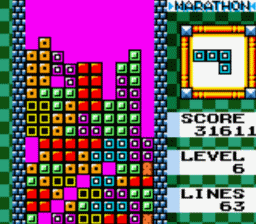
Game: Tetris DX
Console: Nintendo Game Boy Colour
Developer: Nintendo
Release Date: 1st July 1999

With new modes, saved player profiles and more included in this update which was released almost 10 years after the original, not much has changed gameplay-wise but the most noticeable difference is that the game is in colour. From the title screen onwards there's many brightly coloured boxes and shapes which appear throughout the game and its menus.

After choosing one player mode there are four options for play, twice as many as the original game. Marathon is the recognisible classic variant of Tetris, Ultra challenges the player to accrue as many points as possible in a 3 minute time period, 40 Lines is a race against time to clear 40 lines from the screen with the high score being the shortest time, and V.S. Com mode pits the player against varying difficulties of computer opponent in a head on battle.


Gameplay is fast and colourful, working in exactly the same way as the original game. The new modes provide extra fun, and high scores can be saved via the cartridges internal battery. The controls themselves feel just a little smoother than the original version in places although not by much. For the most part the two games are one and the same.

Graphically the main difference is in colour, which does help to differentiate and identify the varied types of block occasionally. The music featured in the game is catchy and generally funk based, without a rendition of the classic theme. While this may disappoint some players, I'm glad that new themes were written as it would have been very easy to fall back on just the classic accompaniment. Overall both games are Tetris, but this has some new and colourful options.

Rating: 84/100
Grade: B


Game: Super Breakout
Console: Nintendo Game Boy Colour
Developer: Morning Star Interactive
Release Date: December 1998

The third and final classic in this review unfortunately didn't fare as well in its transition to handheld console. Anyone who's played Breakout before will know that it's basically Pong against a wall of breakable blocks instead of an opponent. You're given a limited number of balls with which to break the pattern of blocks before you, and in a lot of versions there's various powerups such as larger paddles and multiball.

In this version for Game Boy Colour, however there seems to be a few problems. For a start within seconds of starting a level, the ball gets up enough speed to easily escape your paddle and cost you a life, the paddle gets smaller as you break more blocks which increases the difficulty and there are no powerups in the game whatsoever. Lives don't reset between levels and you're lucky to reach the 2nd one with the way things are.


With five game modes you'd think there might be a little more fun, however even the multiball of Cavity mode, and the double paddle gameplay of Double mode fall flat due to the gameplay problems. Progressive mode features blocks that move toward you which hardly helps matters, and Practice mode is just Normal mode with 5 more lives. As no game is likely to last more than a minute of so, whatever mode is selected it's sort of irrelevant as to which mode is more fun anyway.

Graphically the game almost could have been on the Atari, the Game Boy Colour could and did do a whole lot better than this in other games. Although its as simple concept wise as Tetris, this just seems way more lazy on the graphical side of things. Another disappointment is that there's no music in the game whatsoever. Just a choice of block breaking sound effects, none of which are particularly impressive and make you wonder why you even get to choose. Overall this game's not even deserving of being in the same review as Tetris.

Rating: 13/100
Grade: F

Wednesday, 9 October 2013

Collection Review: Capcom Classics Collection Vol. 2 Part 3


Game: Street Fighter
Console: Arcade
Developer: Capcom
Release Date: 1987

With limited home versions on the Turbografx, Commodore and Atari ST, the best known version of the first game in the Street Fighter series was the arcade one. The series didn't get much attention until the second installment, however and in a way you can see why when playing this. For a start, only Ryu is playable in One Player mode with Ken joining him in multiplayer, the fighting seems very basic and jerky and although the graphics are good for the time, the backgrounds don't move particularly smoothly either.

In the game, you fight two opponents per country in a total of five countries. Only a few of these opponents ever appear again in the Street Fighter series, and they all have the same voice clips after the fight upon winning or losing. The reason Street Fighter II was so successful was because it stood out from other fighting games as a class above. Unfortunately this game doesn't do that as well as its sequel.


In terms of difficulty, enemies seem to do more damage with their attacks than you are able to do with yours. This is somewhat irritating in "normal" mode, and perhaps something you'd expect to find on harder difficulties. It just doesn't feel like a fair fight when an opponent can beat you in 4 moves, yet you need to hit them 10 times to win. Overall it's a messy fighting experience at best and its only real value is for those wanting to see the origins of the series.

Rating: 32/100                                                                                Status: Gave Up
Grade: E                                                                                         Continues: N/A


Game: Strider
Console: Arcade
Developer: Capcom
Release Date: 1990

If you've read my Strider II review for Master System, you'll know that Strider was a game series that featured a protagonist with a sword and climbing hooks who could scale walls and flip to higher heights than conventional adventurers. The original arcade game features the main character making his way through 5 different levels to save the Earth. With just a sword attack to defend himself, the player must play their routes carefully through the levels.

The gameplay is generally enjoyable, with elements of platforming and exploration coming together with the storyline to see the player fighting off robotic and human enemies. It's also possible to aquire robots which fight on your side, against the enemy. Sometimes it's not overly clear where you're supposed to go, and there are some hard moments here and there, but generally the difficulty is better than most in this collection.


The graphics are very impressive, much better than those of the scaled down Master System version of Strider II. All of the enemies and levels have interesting designs and this compliments the level design of the game also. Musically there's an action style soundtrack which fits well with the game. There are a lot of good ideas in the game, mixed in with some more questionable features. Overall it's worth checking out for sure.

Rating: 62/100                                                                                Status: On Final Level
Grade: C                                                                                         Continues: 25


Game: Super Street Fighter II
Console: Arcade
Developer: Capcom
Release Date: 1993

One of the most disappointing inclusions on the collection, Super Street Fighter II features great graphics, smooth gameplay and all 16 of the characters from the arcade version. The problem is that even on the easiest difficulty, it's hard to win a round, let alone an entire fight. I'm aware that arcade versions of fighting games are usually harder so as to make more money off paying customers but there's literally no fun in constantly getting beaten up.

With the home console versions of this game I was able to make it to the end, so I don't think it's a problem with my skill level. At least in those versions there was gameplay beyond hoping to win both rounds of the opening fight. Unfortunately this rather taints the experience and while others may argue that it's an arcade perfect port of the game, I'd have given up on trying to win a fight if this was in an arcade, personally.


As I mentioned graphically the game is stunning and much better than the home console versions, the music too is spot on and if it weren't for the difficulty, the fighting would also be smoother and more enjoyable than any home version. Unfortunately there's no escaping this negative side to the game, and so its score must reflect that.

Rating: 30/100                                                                                Status: 2nd Fight
Grade: E                                                                                         Continues: 10


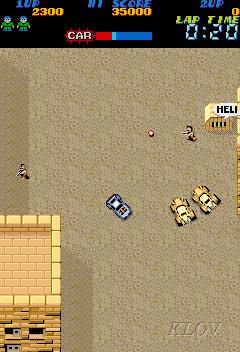
Game: The Speed Rumbler
Console: Arcade
Developer: Capcom
Release Date: 1986

The Speed Rumbler is a shooting/driving game set in a futuristic society where vigilantes with cars and guns rule the streets, and you're tasked with making your way through these violent towns and rescuing innocents from captivity. There are 7 locations that you're expected to clear of enemies, and you're given just over 20 minutes to do so. Every time you die, 5 seconds is added onto your time and yo're not allowed to take over 4 minutes in any one area. Personally I think having both of these time limits is somewhat silly because if you adhere to the 4 minute rule, you'll adhere to the overall limit. The only situation it prevents is getting near to the end and then running out of time, which is suppose could be annoying. 

The main issue with the game is that the control is confusing, if not downright terrible. Sometimes pressing left will steer the car left, other times its forward and I can't seem to work out any pattern to this. Enemy cars are increasingly persistant in crashing into you and damaging your car so that it blows up and you're forced to start from a checkpoint. Added to this, most things take a couple of shots from you to destroy meaning that you either attempt to speed through levels taking damage, or go slowly and run out of time. Overall the concept is good, but the execution leaves so much to be desired that the game is hardly fun to play at all. 

Rating: 11/100                                                                                Status: Level 5
Grade: F                                                                                         Continues: 21


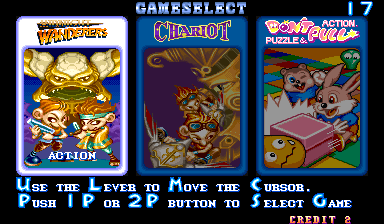
Game: Three Wonders
Console: Arcade
Developer: Capcom
Release Date: 1991

With three games in one, Three Wonders is like a collection, within a collection. There's Midnight Wanderers: Quest for the Chariot which is a platforming shooter, Chariot: Adventure to the Sky which is a space shoot 'em up sequel to the first game and Don't Pull which seems to be an entirely unrelated puzzle game. While it's odd to have two directly related games next to a completely different one, they're all of good quality and make for one of the gems of this collection. 


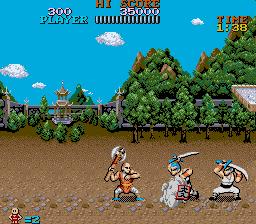
Midnight Wanderers features a quest through 5 areas where the protagonist, Lou fights various enemies based on various astrological features, to get the chariot for defeating Gaia. Stylistically the game looks a lot like Rayman for PS1 in its earlier stages, which shows how good the graphics are for 1991. While still more difficult than conventional platformers, the game is easier than a lot of others featured on the collection and features a much more conventional difficulty curve throughout the game.

Chariot: Adventure Through The Sky is the best shoot 'em up on the compilation, featuring a range of powerups, bosses based on signs of the Zodiac and a much more sane level of difficulty than the other games. It features the same characters as and some themes from Midnight Wanderers, as it's a direct sequel. The only real downside of the game is that you're forced to fight each boss one after another before the final boss, but this is a feature in other games I've reviewed also (House of the Dead, Streets of Rage). Overall though it's a very enjoyable shoot 'em up with an interesting astronomical theme. 


Don't Pull is a fairly fun puzzle game where you play as a rabbit, crushing enemies with blocks that you push into them. There are 20 levels in total, and it gets a little repetitive but on the whole the gameplay works well and it features some good ideas. What's strange about this game is it's inclusion on Three Wonders, since the other two games feature the same characters, and ideas in different styles of gameplay where this is strikingly different.

Overall Three Wonders has some great gameplay and graphics featured in its three titles, and a good variety of ideas, enemies and things to do. The first two games have more lasting appeal than Don't Pull, but that's not to say it isn't a good inclusion so much as a weird one. Musically, all three of the games feature an impressive amount of good tunes and sound effects. I'd reccomend playing all three games, since they're some of the best on the collection.

Rating: 72/100                                                                                Status: Completed
Grade: C                                                                                        Continues: 57 (all 3)


Game: Tiger Road
Console: Arcade
Developer: Capcom
Release Date: 1987

Tiger Road is a run-of-the-mill challenging sidescrolling Fighter/Platformer. There's lots of enemies and obstacles on screen at any one time and gameplay usually goes something like this: If you move you get hit by something, and if you don't move you get hit by something. The main way of progressing through levels is usually to wave your sword about whilst pressing right and hope that your character has enough energy to get to the end of that room, so that when the game restarts you at a checkpoint, you're at the next one. Otherwise there's not much hope of getting anywhere. 

There are some levels which have slightly better ideas than just moving left to right, but unfortunately the number of enemies and awkward controls make it difficult to enjoy these. Being swarmed with enemies whilst trying to make a difficult jump doesn't seem like the most fun you could be having. There's 4 stages in the game, but I got stuck in each one of them, and restarted in the next. 


Graphically, the game's not all that with graphics slightly better than that of 3rd generation consoles. The in-game music is alright, but the sound effects and voices leave a lot to be desired. Overall it's pretty average for the collection, it's playable until you get stuck somewhere and the difficulty means that's pretty often. There's not really much reason for anyone to play this thesedays, as something like Revenge of Shinobi far outclasses it in the same genre. 

Rating: 15/100                                                                                Status: Played
Grade: F                                                                                        Continues: 15


Game: Varth: Operation Thunderstorm
Console: Arcade
Developer: Capcom
Release Date: 1992

Another game in the vein of the 1942 series, Varth stands out by featuring a defense system which includes pods circling the player that deflect enemy fire, thus making the game somewhat easier. The levels are also shorter, but there are more in the game overall (a total of 30). The game seems to focus more on skill and dodging attacks whilst shooting enemies rather than the blind all-out action of some of the other games in this style on the collection. This means that there's a better difficulty curve throughout the game also. 

Graphically the game is impressive to a degree, although having been released in 1992 it's not far off the systems of that time. Gameplay is generally fun and I only had to continue around once per level in playing. There's a small array of powerups and special moves that the player is able to use to their advantage, but after a little while repeating enemies, and gameplay style leads to the game being somewhat repetitive. Overall though, it's a slower paced shoot 'em up which lends itself better to western audiences and those looking for an enjoyable game on the collection.

Rating: 60/100                                                                                Status: Level 10
Grade: D                                                                                        Continues: 10

So with that, I've played all 20 of the games on the Capcom Classics Collection Vol. 2. With an average rating of 50.6 out of 100, it's fair to say that they're a mixed bunch ranging from failed ideas for new types of arcade games to quality beat 'em ups. In total I used 432 continues, which is approximately 1296 lives or the equivalent of 144 cats. There's no doubt that Capcom's arcade games were pretty difficult on the whole, and this collection won't really appeal to anyone who dislikes losing.

Overall as a compilation, the games you'd think would be impressive (SSFII, Street Fighter etc.) are somewhat of a disappointment, and games never released in Europe or outside of arcades seem to be hidden gems (Captain Commando, The King Of Dragons). It's got some decent titles, worth owning since they're not available anywhere else, but anyone expecting a large amount of variety in the 20 games will find a large amount of Beat 'Em Ups, Shoot 'Em Ups and fantasy themed platformers.


The collection also features bonus tips, music and art for all of the games featured which is unlockable through completing certain in-game objectives. As well as being an incentive to try every game it gives the opportunity for the player to learn more about it. Other bonus features include a tutorial on Super Street Fighter II, a Capcom quiz in the style of Quiz and Dragons and the credits for the game.

Although I don't include collections such as this in my overall game rankings due to the fact that they're hard to rate against other single games, I will give this a score which will appear on the video game collection ranking table.

Rating: 75/100

Tuesday, 8 October 2013

Commodore Plus/4 Games Review #5

I haven't done one of these in a while, but there's still 9 Commodore Plus/4 games to go before I've reviewed everything I have, so it's time for part 5.


Game: Street Olympics
Console: Commodore Plus/4
Developer: Patrick Strassen
Release Date: 1984

The box art for Street Olympics features a man in a hat, jumping neighbourhood walls with a brick in his hand. This isn't quite what you get to do in the actual game, however. There's four events; Sprinting, Jogging, Jumping and Throwing. Sprinting and Jogging are basically the same thing, just with different distances; you're required to either mash the ? and shift keys on the Commodore or jog a joystick left and right as fast as possible. Eitherway it's pretty easy to beat the preset high scores, and this type of gameplay is still around in athletics games today.

Jumping is just another name for hurdles as to clear what look like little brick obstructions in the road. This is done by pressing the fire button (which makes joystick gameplay harder), whilst wiggling to run. Throwing seems to be rather broken on this game. The player runs up to the line to throw whatever sporting equipment they've got, and a box comes up to set an angle of throw, but nothing ever happens, no matter what you press and the item is dropped, resulting in no score.

Graphically, what there is on the game isn't bad for the Commodore, you can pretty much tell what everything is, and most of the gameplay works pretty well. There's some fun to be had with the game but it's not something you need to replay as there's very limited options as to what you can do.

Rating: 18/100
Grade: F


Game: Suicide Run
Console: Commodore Plus/4
Developer: John Shay
Release Date: 1985

Suicide Run is a side scrolling space shooter where the player controls a ship with the ability to move up and down, as well as fire missiles and drop bombs. As you fly through the level there are various obstacles which you need to avoid, and as you do so your score goes up. The ship that you're piloting is only able to fire once every 5 seconds or so, so the player must judge where will be best to aim for the maximum chance of getting past the asteroids, rockets and other obstacles in their path.


Graphically the game is pretty unimpressive, the game is windowed with a brown border inside which the sprites are small and difficult to identify properly. The colours chosen make it hard to see the player's ship and some of the obstacles too. and the terrain looks generally jagged. The sound effects are reminiscent of the Atari 2600 with a lot more noise than actual desired sounds. Overall it plays like an arcade scrolling shooter with poor graphics and basic gameplay.

Rating: 20/100
Grade: F


Game: Gunlaw
Console: Commodore Plus/4
Developer: Mastertronic
Release Date: 1987

Gunlaw challenges the player to get as far up the screen as possible whilst avoiding fire from enemy soldiers and navigating the tough terrain of the desert type area they've been dropped in. You can move in four directions, as well as shoot in them. One shot to an enemy soldier will kill them, and similarly one shot from an enemy solider will kill you. The problem with the gameplay is that due to the way the player is displayed on the screen, there's a blank border around them. If you walk into a rock ahead of you, you won't be able to progress but you also won't be able to see what's blocking you from doing so.

This means that the enemy soliders are at an advantage, which is a problem when there's already far too many of them about on the screen. Another problem with the gameplay is that when you tap a direction, you instantly walk in it, making close combat harder. Any time an enemy soldier is near you, shooting them requires moving away and then back toward them whilst pressing the fire button, otherwise you walk into them and die.


Graphically there's some decent parts to the game, the trees and pools of water are probably the best landscape features. The blank areas around the player's sprite are somewhat of an issue as things disappear around the player a lot of the time. Soundwise there's only effects for shooting and dying, both of which are pretty similar and are very basic. Overall it's best played more like a Metal Gear Solid game than a shooter, as stealth can prove more useful than outright power.

Rating: 21/100
Grade: F


Game: Legionnaire
Console: Commodore Plus/4
Developer: Anco
Release Date: 1986

Released a year earlier than Gunlaw, this game has a very similar concept. You play as a solider who must make it to the top of the screen and then eliminate any enemy soldiers there to clear the level. You can move and shoot, as in Gunlaw but the controls feel tighter and generally it's a more enjoyable game. There's less enemies on the screen and the problem with disappearing objects has been lessened, although you'll still get stuck on things every now and then.


Graphically the environment is more detailed than Gunlaw, but the sprites are less detailed (although still recognisable as soldiers). Soundwise it features a better range of sound effects also. Once the player is at the top of the screen, and has shot all of the enemies, you're told that the area is clean, and you may move on. The difficulty is easier than that of Gunlaw which means overall it's a better game.

Rating: 26/100
Grade: F

Monday, 7 October 2013

Series Review: F Zero


Game: F Zero
Console: Super Nintendo Entertainment System
Developer: Nintendo
Release Date: 13th August 1991

Racing at speeds of over 700 km/h in futuristic environments, F Zero brings a high speed kick to racing games on SNES. With 20 racers competing on track as well as other traffic, 15 different circuits and 4 difficulty modes, it's an impressive game for the time. Unfortunately there's only 4 different vehicles available to the player, with slightly different stats between them. These are controlled by 4 different characters from the series, the most famous of which is Captain Falcon.

There's 3 different championships to complete, initially with 3 difficulty levels available. Once they're completed in expert mode, master mode for each championship is unlocked, to give more replayability. With Championship and Practice modes being the only two available, there's no 2 player support or any other kind of races featured on the first installment in the series.


The gameplay is fast paced, with sharp turns and fast straights featuring on every track. The controls make it fairly easy to get around most tracks as long as you use the brakes before sharper turns. Hitting other vehicles or the edges of the tracks will send you in a completely random direction about half of the time which can make winning races a little harder. There's also a power meter which is depleted when your vehicle hits the barriers, or other obstacles. Instant race losses are featured too, in some of the harder difficulty levels it's possible to fall short of jumps and get a game over.

Graphically the game is vibrant and bright, and pretty good for the early 16 bit era. There's no a great amount of detail on the other cars or backgrounds to the tracks, but with the speed of the game as it is, that's almost to be expected. Musically the game is good, featuring a host of catchy background music for each track and good sound effects.


Overall the game was a good start to the series with some classic tracks and music. The lack of two player mode and limited amount of championships did affect the replay value of the game somewhat, and makes me wonder what it could have been with a few tweaks. Other than this though the only real bad point is the loss of control when hit by rival cars. Sometimes it's unavoidable and gets frustrating when it costs you a race that you were winning.

Rating: 75/100
Grade: B


Game: F Zero X
Console: Nintendo 64
Developer: Nintendo
Release Date: 6th November 1998

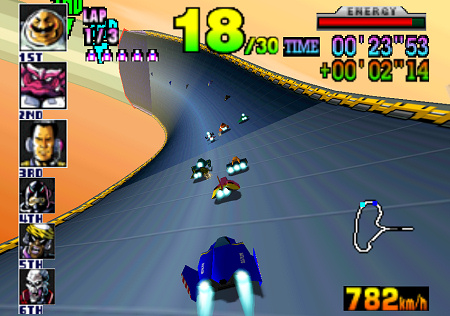
7 years after the first game in the series came F-Zero X, a 3D installment of the racing series with higher speeds, 30 vehicles on track at one time, 30 preset tracks as well as a mode which generates random tracks, a two player mode and more. With an almost comic-based style for the menu and character select screen, and a rock based soundtrack it's quite an update stylistically as well as in terms of gameplay.

The main mode is still Grand Prix mode, with 4 difficulty settings, 6 races in each grand prix and 4 preset race series as well as "X" mode which randomises the track for each race. There's steep learning curve in this mode, and you'll need to beat the grand prix on all of the different difficulties to unlock all of the vehicles and content in the game. Just like the first game you're given an Energy meter which reduces with damage, but this time boosting also depletes the meter.


With thirty different racers on track at any one time, the races in grand prix mode can get a little crowded at times, but overall it adds to the fun. Every racer earns points for their finishing position in the race, up to 100pts for first place and these are kept track of throughout Grand Prix mode. This is an improvement from the first game which only had target finishing positions in order to complete a Grand Prix. In later difficulty levels the AI can appear to be incredibly hard to beat, making it more difficult to finish 1st.

Other modes in the game include a much needed two player mode, time trial and practice modes, and a death race mode, which sees the player attempt to take out the other 29 racers. Unfortunately this isn't as fun as it sounds because taking out that amount of other vehicles is pretty monotonous, not to mention that it's difficult to not accidentally fall off the track in the time it'll take you to complete even one round of this mode.


Graphically the game isn't particularly detailed; both the tracks and vehicles are lacking anything besides their polygonal shapes. This doesn't detract from the gameplay, but with 30 vehicles to choose from, it can make them seem pretty samey. Other than that it's nice to see the franchise move into 3D, as the racing feels even faster. The soundtrack for the game features some rock versions of songs from the original as well as some new rockier songs; overall it's good in places and a little weird at other points.

As a sequel F Zero X is pretty impressive, featuring not only a much wider range of choice in vehicles, tracks, modes and characters but also taking elements from the first game and improving them. Graphical improvments and a slightly less steep learning curve are the only things I can think of to make this game better, otherwise its a true N64 classic.

Rating: 84/100
Grade: B


Game: F Zero: Maximum Velocity
Console: Nintendo Gameboy Advance
Developer: Nintendo
Release Date: 22nd June 2001

The first of three portable F Zero games on the Gameboy Advance, Maximum Velocity features gameplay more akin to that of the SNES installment than the N64 sequel with a return to Mode 7 graphical techniques and 2 dimensional vehicles. There are 5 races to each Grand Prix, with 4 classes to choose from, for a total of 20 tracks featured. 4 vehicles are unlocked from the start, with a further 4 unlockable by winning races, although this is the only game not to feature Captain Falcon.

With the return to the SNES style of gameplay comes the problem of losing control when hitting anything with your vehicle. Also as your energy meter depletes, you slow down considerably when compared to other games in the series, further hampering your chances of finishing the race in the required position. This added to the fact you have to press the L and R buttons to boost, which can be difficult whilst trying to steer makes for less enjoyable gameplay than in previous installments.


Graphically the game looks arguably worse than the SNES version, although I'd say its about even. The racers themselves have better a better 3D effect than in the first game, but the scenery around the tracks is pixellated and undetailed. Musically, Maximum Velocity isn't as good as the other games in the series, but it's bearable; there's some decent tracks in amongst the generally forgettable majority of the soundtrack.

Overall this feels like a scaled down version of the SNES title, 10 years after its release. The tracks are less enjoyable, the music and feel less classic, and there's hardly any improvements from it. Multiplayer is possible, however you need another GBA and copy of the game to link up and play. As with a lot of handheld installments of home console games, F Zero Maximum Velocity disappoints somewhat.

Rating: 61/100
Grade: D

At this point, I was going to do a review of F Zero GX, the Gamecube installment to the series, however as the disk won't read, that's it for now!

Friday, 4 October 2013

Series Review: Army Men


Game: Army Men: Sarge's Heroes
Console: Nintendo 64
Developer: 3DO
Release Date: 30th September 1999

Teaching the children of the late 90s that it's alright to kill people as long as they're a different colour to you and your friends, Army Men: Sarge's Heroes tells the tale of plastic armies in combat. You play as a soldier in the Bravo platoon (coloured green) and your greatest enemies are the tan coloured soldiers who are scattered across every level and will attempt to kill you on sight. The overarching story of the game involves the leader of the tan army "General Plastro" and portals to the real world.

In each level you're given 1 or 2 objectives to complete in order to progress. There's no checkpoints, so even if one objective is completed, the game resets to the beginning when you die. This wouldn't be such a problem if the game was easy but the controls alone add several levels of difficulty. Most of the time in levels your best bet is to attempt to kill all of the tan soldiers and hope that it makes all of the objectives easier to complete.


There's no lock on control for shooting in the game; if you see an enemy you have two choices. Either you shoot your weapon without aiming properly, firing in the direction you're facing (which works surprisingly well most of the time), or you can aim and target more precisely. The problem with these options is that the precise targeting is very slow, moving the crosshairs can seem to take forever and the shooting without aiming is impeded by the movement controls which are also pretty shocking.

For a combat game this is incredibly disappointing as moving yourself around the map and aiming/shooting your weapons are the main gameplay elements. There's a good selection of weapons in the game but usually too many are featured in each level and you have to spend a while cycling through the weapons to find the one you want, not to mention that most suffer from the aforementioned aiming issues.


Graphically, the game is fairly disappointing even when taking its release date into account. The characters themselves seem to be plastic so as to avoid adding detail to them, vehicles and buildings are incredibly blocks and low resolution at points, and a lot of the maps feel like barren wastelands. The music in-game is forgettable at best, with an unispiring soundtrack that seems to come under the category of "general action type music".

Overall the game seems like a rather frustrating mess with missions made much more difficult due to control issues, graphics which could have been better, a boring soundtrack and a convoluted yet generic storyline. I admit that it's probably difficult to think up interesting things to happen to little plastic men, but with a few changes this could have been much more playable. Perhaps it's just the fact that Goldeneye 007 was on the N64 that makes this feel way below par.

Rating: 43/100
Grade: E


Game: Army Men: Major Malfunction
Console: Sony Playstation 2
Developer: Team17
Release Date: 4th August 2006

With 15 different installments across all platforms to the Army Men series in the 7 years between these two games, there were quite a few gameplay changes between the two, not to mention a change of developer and publisher. The series as a whole has been widely criticised for the large amount of titles and a perceived decline in quality as time has progressed. I did wonder whether this game was going to be worse than Sarge's Heroes, but with Team17 as developers this time surely it could only get better.

The game starts off with a long tutorial which is sort of irritating if you like to get straight into gameplay, but there's a fair amount to learn also so it's necessary. After this, missions all around a house begin, starting in a shed, and moving through the kitchen, basement, and garden to name just a few areas of combat. The first thing to note is how cutscene heavy the missions are. Once you've cleared the enemies in one area, a short cutscene of the next area you're supposed to go to will play as if it wasn't obvious enough that you have to keep moving forwards.


Another aspect of the game that can get annoying is the constant radio contact from the commanding officer who tells you what to do. Not only does it sound like he's speaking in Simlish most of the time, he's in contact far too much with obvious information. The gameplay itself isn't too bad; generally you're shooting your way through enemies to get somewhere, to achieve an obvjective. Where the game does fall down somewhat is the camera angles and aiming. There's parts of the game where the camera changes, flipping the controls without any notice which can cause you to fall from a height and lose the level in the blink of an eye. Even when you're not losing levels because of the camera, there's still plenty of walking into walls and enemies because you can't see where you're headed.

As for the aiming controls there's a lock on feature in this game which is an improvement from Sarge's Heroes, but when enemies move or you roll sideways it resets itself and you're not targeted at the enemy anymore. In places with multiple enemies this can be a nightmare as targeting the one you want takes far too long, and you're likely to get hit by the frankly dopey AI if you're not moving all over the place whilst aiming. Quantity seems to reign over quality when it comes to enemies in the game; plenty of them spawn, so much so that it gets tiresome, but none of them are ever really that challenging unless the camera/aiming system cause you problems.


Graphically the game is said to be the best in the series, which makes you wonder how much worse it can really get. While the graphics aren't terrible, I'd expect more for 2006 and there's moments where things clip through eachother or don't quite look right. Musically there's some nice stuff which throws back to other Team17 games like Stunt GP, but there's also a lot of boring and forgettable tracks on here too.

With 30 missions to complete, it seems like there's a decent amount to do in the game, but a lot of the missions are short and almost all of them have a very small map with lots of going back and forth. There's some nice changes of pace with turret shooting levels, and the overall concept does work on the whole. It's fun to play as a toy solider throughout a house, despite the problems with the game. Ultimately though it's not something I found compelling as a game, as there was poor narrative and programming throughout. A better game than the N64 installment, but you'd hope so with the PS2 being a whole console generation later.

Rating: 58/100
Grade: D

Wednesday, 2 October 2013

Series Review: Stuntman

Game: Stuntman
Console: Sony Playstation 2
Developer: Reflections Interactive
Release Date: 23nd June 2002

From the same developer/publisher team as the Driver series comes Stuntman, a game where you're tasked with performing stunts for films as a professional stunt driver. Most of the gameplay focuses on stunt driving for movies where you have to complete a string of individual objectives for a scene in the film, usually finishing with a big finish at the end, involving a new type of ramp/special stunt. Inbetween films there are stunt shows at the arena which require the same basic skills as the movies but are shorter and sometimes based entirely around one difficult stunt, rather than a series of them.

Whilst performing the objectives in both the movies and the stunt arena, there's a meter in the top left showing the percentage of the objectives that remain, and that have been passed/failed. There's a target percentage for each level below which the player will have to retry the sequence to complete it. The levels are also timed, which adds to the difficulty of the sequences as there is little room for error.


In each film there's 5 scenes or stunt sequences which need shooting. Each of them will consist of driving one of the vehicles through a course, guided by the voice of the director and icons onscreen and doing the required stunts at the correct time. The game is quite specific about how the stunts are done and it can be hard to nail parts of more difficult sequences. A lot of the scenes are also quite long, containing 3 or 4 difficult big stunts in addition to passing other vehicles and hitting parts of the scenery.

The main problem with the gameplay is that more often than not when attempting a particular scene, it'll take a good 5-10 tries to get used to what's required of you, and then actually pull it all off in one run. It ends up being very narrow hit-or-miss type gameplay, where anything less than perfect can ruin your chances of passing a sequence entirely.


There's not too much in the way of other modes featured in the game; Arena Mode allows you to place your own ramps and stunt equipment to perform whatever string of stunts you have in mind, but other than this the main fun of the game is unlocking all of the films featured in the game. Once filming is complete on a movie, you'll get to see a trailer with parts of your driving in it.

Graphically the game is pretty simple, it's not revolutionary but it reminds me of the style of Driv3r, especially the vehicles. Explosions and effects are pretty average also, which is a shame for a game based on movie stunts and action sequences. Musically there's a variety of tracks that play in the background, most of which are in the style of the movie you're currently shooting. Following the general trend there's nothing mind blowing, but it does fit with the style of the game.


Overall the game feels rather restricted in what you're allowed to do whilst shooting for a film. If you pull off a cool stunt that's not on the director's plan of action then it's not appreciated. Most of the game is spent trying to perfect one run so that you can move onto the next film or scene. In a lot of ways this isn't even realistic since there'd be multiple shots instead of just one complete run at the sequence.

This isn't to say that Stuntman isn't a fun game though; the controls are generally good as long as you're not airbourne, the stunt recognition is usually accurate and you do get a real sense of having done well when watching the trailers for a film you've just helped complete. The biggest problem with the game is the way that it scores sequences, since a few slips or an unplanned stunt can literally ruin a take.

Rating: 63/100
Grade: C


Game: Stuntman Ignition
Console: Sony Playstation 2
Developer: THQ
Release Date: 28th August 2007

Five years after the release of the first game came a sequel for PS2, PS3, Xbox 360 and Wii. Stuntman Ignition features a concept resembling that of the original game with an updated scoring system for each scene, more game mode choices, and updated graphics. The main mode once again sees the player completing vehicular stunts for use in films, tv adverts and stunt shows. As the player earns more stars on each sequence, they unlock the other films as well as achievements and badges. 

Scrapping the old system, Ignition uses points to decide how well players do on each sequence, using a multiplier to encourage the stringing together of stunts throughout the scene. If a player can keep the string going (a stunt must be done every 2 seconds, or the multiplier resets) then they'll get a 5 star rank for the scene. There are "director" stunts which must be done throughout the scene; failure to pull these off will result in a strike, 5 of which mean that the scene needs re-shooting. The advantage to this is that if a player accidentally misses a "director" stunt, but instead pulls off something different, they're not penalised, but in fact rewarded. 


The game features a larger variety of vehicles (including a hovercraft), and stunts than the first installment with a more freeform feel to scenes although they still have to follow a guideline. Also new is a change of director with each film, which gives added realism as they all have different personalities and ways of working. The films themselves feature an interesting variety of genres and there's some references to jobs in the original game. 

Other modes in the game include Arena Mode for building your own stunts, a sort of puzzle mode based on Arena Mode where you're asked to figure out to how to pull of a sequence of stunts by placing ramps and objects in the Arena, and a Multiplayer Stunt Race type mode which is fairly fun, although it doesn't work quite as well as the singer player career mode.


Graphically the game is more impressive than the first installment of the series, with better looking textures, explosions, vehicles and objects. The music is also impressive with far more of an action feel whilst shooting scenes. The handling of the cars remains fairly similar, but has improved a little which compliments the improved gameplay mechanics for a more enjoyable game as a whole. 

Overall Stuntman: Ignition is like a tweaked version of the original which makes the game much more fun and irons out a lot of it's faults. It's easier for a start and doesn't expect you to be able to pull off every stunt perfectly, and although the sequences still feel very narrow in terms of what you're asked to do, there's a much larger degree of freedom than in the first game. 

Rating: 76/100
Grade: B