Monday, 28 September 2015

Game & Watch Gallery Double Header: Game Boy/Advance


Game: Game Boy Gallery
Console: Nintendo Game Boy
Developer: TOSE
Release Date: 27th April 1995

The first game in the Gallery series, but not officially titled "Game and Watch" Gallery, Game Boy Gallery offers players a choice of 5 classic Game and Watch games, with A and B modes and classic/updated sounds for each. While fairly basic, it's a nice way to check out some of the games from the Game and Watch series of handhelds without having to get hold of them. Since all of the games are based on the LCD handhelds, gameplay is fairly simple and limited to the directional buttons in many cases. 

Ball


Ball is a very simple Game and Watch title, and in fact the very first one to be released in April 1980. Players use the left and right buttons to direct a juggler's arms between 3 set on screen positions as he juggles balls in consistent arcs. The ball nearest to the juggler moves faster than the one in the middle, with the one on the outside moving the slowest of the three. This means that players must consider which ball will need to be caught and thrown back up first.

Both game A and B are fairly easy to manage with speed increases being of little challenge overall. The music featured as the updated soundtrack is fairly interesting, with the original sound effects only being triggered each time a ball is caught. The game ends when a ball is dropped and any high scores are registered. 

Vermin


The third Game and Watch handheld to be released was Vermin, which challenged players to move left and right, positioning their hammer over holes where moles are about to pop up, and giving them a whack once they do. On Game A there are 4 spots where the moles can appear and gameplay is fairly slow to start with, and on Game B there are 5 spots where the moles can appear, with an increased gameplay pace. 

While it's nothing technologically spectacular, this feels more like a brain training/multitasking type of game, keeping an eye on the upcoming moles whilst whacking the most recent one to surface. It's more fun than Ball, and has a fun updated soundtrack, with basic sounds if the original soundtrack is selected. 

Flagman


Flagman was the second Game and Watch handheld to be released and is a fairly simple electronic version of Dimmo/Simon Says. In Game A, a pirate holds up 4 different flags relating to the 4 directions of the d-pad. Each time the player gets the sequence correct, a move is added to the end of the sequence. In Game B, there's a fifth and sixth flag that can be added, courtesy of other characters onscreen. 

Unlike Ball and Vermin, this is an example of an electronic game that can easily be played elsewhere, and could had been even at the original time of release in 1980. It's pretty fair to say that this is a less specialised version of that game, and as such the only real addition is the music added in the updated soundtrack.

Manhole


Manhole was the sixth Game and Watch game to be released as a handheld, and challenges players to aid pedestrians in walking over four gaps by bridging them at the correct time. As the game continues, multitasking becomes important, with three or four pedestrians on screen at the same time, requiring a huge amount of multitasking as each pedestrian requires 2 instances of being helped by the player.

Game A is a slower and less complex version, and Game B is faster and more difficult. The updated music for this particular game isn't great, and I much preferred the simple sound effects of the original game. In terms of gameplay, Manhole is pretty fun for a Game and Watch title, but none of the early games show a huge amount of replayability beyond high score chasing.

Cement Factory


Cement Factory is a later Game and Watch title, which features more complex gameplay than any of the previously mentioned titles and better resembles a video game on the whole. Players move between platforms using the lift, being careful not to fall and lose a life, and pull levers to release cement to a lower level of the factory and ultimately into trucks. If the cement levels builds up too much in any of the four storage tanks, then a life is lost. 

Game B is a faster version of Game A, and compared to the other games on this collection, Cement Factory is the most fun and challenging. It requires players to multitask and pick the correct moment and sequence in which to do tasks. Once three lives are lost, the game is over. 


Overall Game Boy Gallery isn't a particularly technically impressive game, but that's almost to be expected for a collection showcasing technology that was already 15 years old at the time of release and is now approaching 35 years of age. It gives players the chance to play Game & Watch handhelds without having to own the consoles themselves, which can be costly thesedays, and the updated sounds and visual borders (if used with a Super Gameboy on the SNES) are a nice addition.

Rating: 59/100
Grade: D


Game: Game & Watch Gallery Advance
Console: Nintendo Game Boy Advance
Developer: TOSE
Release Date: 28th October 2002

The fourth in the Game and Watch Gallery series, and the first on the Game Boy Advance, Game & Watch Gallery Advance showcases 6 classic Game & Watch titles, each with a classic and modern version, as well as a 2 player or Hard Mode of each. Alongside the games there's a Gallery/Museum option which allows players to unlock and play some other classic Game & Watch titles with the stars they've earned in the main game.

Boxing


Classic Boxing features 2 fighters, with their health bars at the top of the screen and a number representing their total health. Each time a bar is knocked from a fighter's health the total health goes down by one. Each time the bars are depleted, 3 points are knocked from the fighter's health and they're pushed back by one step. If a fighter's health bars are fully depleted whilst against the ropes, then 6 points are taken from his total health. Once the total health reaches 0, the fighter must be knocked down whilst against the ropes for an opponent victory.

While this sounds very technical, the reality of gameplay is literally hammering the punch button. Players needn't even pay attention to the screen to win matches. I managed to fight my way to 20 knock outs without even really trying at all. Whilst the difficulty increases incrementally, 20 KO's is enough to earn 5 stars on the main menu, and isn't a challenge at all.


In modern mode, Boxing features fights against 3 opponents, Wiggler, Boo and Waluigi. Players control Luigi and attempt to land a hit on their opponent and take one of the hearts from their health meter at the top of the screen. Once all 5 hearts are gone, the player whose meter has been depleted falls back against the ropes, and both players meters are refilled. Play resumes and if the player against the ropes loses all their hearts again, they are defeated. If they manage to beat the other boxer then play moves back to the centre of the ring.

Unfortunately, being based on the Game and Watch version, there are only two punches which can be thrown, a high and a low hit. Button mashing seems to be the easiest way to land punches, although different moves seem to work differently depending on the opponent. There's very little challenge to this minigame, and the modernised update only really adds better graphics and different fighters to the mix.

Fire


Fire was the 4th Game & Watch handheld released, and like those before it only featured the right and left directional buttons for input. Players were challenged to save escapees of a building fire and bounce them to an ambulance on stretchers. As the game continues more and more escapees tumble out of the building at an ever increasing rate, meaning that players must multitask and keep their attention on which patient needs bouncing to the ambulance next.

A little challenge is added by the fact that the patients bounce slightly less high on their second ascent, so the timings aren't symmetrical. Game B is a faster and more advanced version of Game A, but other than this there's no real difference. As a game, Fire works well with its simple concept, but can easily become monotonous.


The updated version of Fire features different characters from the Mario series in addition to the different bounce heights of the previous version. Toad is lighter than Yoshi, who is in turn lighter than Donkey Kong Jr. There are also power-up eggs which contain either a score bonus or a bomb, the latter of which must be dropped before it blows up the carriage, waiting to save the escapees of the fire.

Just like the original version, Mode B starts players off with a more complex set of patients to transport. The updated version is one of the more difficult games on the collection, due to the amount of multitasking and judgement needed with the different types of character to be transported. Annoyingly, even with a High Score of 251, the game rated my performance as 1 star out of 5, which I thought was a bit of an insult.

Rain Shower


Rain Shower was a Game and Watch handheld released in August 1983 at a time when Nintendo were releasing one new Game and Watch console a week, While this didn't last long, it's interesting to consider how many things the company must have had their minds on at once during this time frame. The objective of Rain Shower is to stop laundry on the washing line from getting wet by adjusting four separate lines left and right as rain drops fall. In terms of control, players use the d-pad to navigate the onscreen character into place before pressing the action button to swap the position of the laundry, between two presets.

While Rain Shower is a fairly complex game when compared to some of the others, the multitasking feels less enjoyable as its easy to miss a single raindrop headed for the laundry and lose a life, while distracted by another drop. Game B worsens this by starting at a higher difficulty level. I can't honestly say I'm a big fan of this particular Game and Watch as it uses the basic concept of some other Game and Watches (mainly Helmet) in a new setting.


The updated version of Rain Shower doesn't even really fit the name; Bowser throws items down towards characters on swings below, and its Mario's job to move the ropes and protect them from being hit from above. The game suffers the same multitasking issue as the original and if anything is more difficult to keep track of due to the coloured visuals. As time progresses more characters come and sit on a swing, giving Mario an even more complex task to do. The music provided with the updated version is bearable, but the game is less so.

Mario's Cement Factory
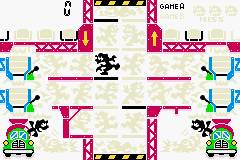

Essentially the same as Cement Factory, featured earlier in this review, on the Game Boy Gallery, the classic version of this game plays and feels very similar with slightly updated colour graphics for the industrial setting and equipment.


The updated version of Cement Factory plays very differently to the older versions. While the main concept is the same, Mario is allowed to fall between platforms without consequence as long as he doesn't touch the top or bottom of the screen. This makes the game far easier on the whole, and allows players to focus more on their movements and keeping track of which containers are filling up. As a concept this is probably one of the best games on this cartridge, as there's far more complexity than anything featured so far. Strangely there's no background music featured in either version of the game, which is disappointing even if this does make it easier to hear the "full" sound effect for the containers.

Donkey Kong Jr. 


The original version of Donkey Kong Jr. (which may have been better as an actual Game & Watch handheld) seems to me to be borderline unplayable. With so many outlines for Donkey Kong Jr's positions, it's hard to tell which is the next to progress to, and what options are available. Add this to some difficult obstacles, and you've got a frustrating and confusing game which really needn't be. This seems to be an example of technology holding back the playability of the game, except that as it's been remade on Game Boy Advance, they could clearly have toned the multiple Donkey Kong Jr.'s down a little, and made the route more obvious.


The updated version of Donkey Kong Jr. is far better and allows players to rescue Donkey Kong over a variety of levels (at least 3), with a slowly increasing difficulty curve and a much simpler movement interface whilst retaining the positional movement of the Game and Watch original. The music is also fairly enjoyable, which adds a sense of the experience being much closer to a real video game rather than just an LCD handheld.

Donkey Kong 3


Donkey Kong 3 (at least the Game and Watch version) features Mario and Donkey Kong facing off by filling tanks of water and shooting bubbles at each other, which send what appear to be mice towards the other player. Being hit by a bubble doesn't affect the player, but if one of the mice reaches their side of the screen, then a life is lost. Sucessfully getting a mouse to Donkey Kong's side of the screen results in a points bonus and the positions resetting.

Much like Donkey Kong Jr., the sheer amount of outlines on the screen mean that making sense of what's happening is difficult. The mice also swap around what level they're on constantly, making it anyone's guess where they're going next, and consequently where to shoot.


The updated version of the game fares much better in terms of being able to see what's happening. The mice have been replaced with a fireball and a Boo. Unfortunately these two also move around quite a bit, and the best strategy seems to be completely refilling the water tank and then shooting it all at the middle, assuming one of the two items are in that lane. Overall this one's some fun, though it could definitely have been better.

With all the main games reviewed, I should also mention the fact that there are 9 bonus original Game and Watch games to play. These are unlocked by gaining stars in each of the featured Game and watch games, though it's often difficult to earn any stars due to the high boundaries set by the game. Since you'll need 80 stars to even play the first unlockable bonus Game and Watch, there's little point including them as a feature, since it's fairly obvious that their inclusion is simply to give players a reason to continue playing what appear to be fairly boring choices and revamps from the Game and Watch catalogue.

On the whole, Game and Watch Gallery Advance doesn't seem to have even one title that's completely worth playing; classic or updated. While it's a nice throwback to the handheld consoles, and the updated versions often do improve on the originals, there's no real need to return to what appear to be fairly bland and simple games.

Rating: 60/100
Grade: D

Thursday, 24 September 2015

Game Review: World Of Illusion Starring Mickey Mouse and Donald Duck


Game: World Of Illusion Starring Mickey Mouse and Donald Duck
Console: Sega Mega Drive
Developer: Sega
Release Date: 1992

While Disney games are usually of high quality on the Mega Drive, I never seem to be particularly motivated to give them a go. However, once this had been recommended to me as a friend's fondest Mega Drive memory there was far more reason to try it out. World of Illusion is the sequel to Castle of Illusion and the first in the Illusion game series not to have a Master System/Game Gear port. The game offers single or two player mode, with a few differences between the two as players make their way through the World of Illusion, collecting magical spells to aid Donald and Mickey's escape.

The intro to the game explains that the two main characters have found a box, belonging to an evil magician who sends Donald and Mickey to the World of Illusion. Each level has several sections before its boss battle, after which a new magical skill is learned. The magical skills are appropriate to each area of the map, for example conjuring air bubbles allows players to breathe underwater, and a magic carpet allows for travel through the clouds.


Both Mickey and Donald have the exact same single attack which is their only real line of defense against the various enemies that appear in the game. A sheet is spread from the attacking character, and some magic dust is produced either damaging or stunning the enemy depending on how far away Mickey or Donald is from them. Any other contact with enemies will damage the player and reduce their life meter in the top left of the screen which consists of cards, to go along with the general magic theme in the game. Scattered throughout levels are sweets and cakes which can replenish player's health after being damaged.

The levels featured in the game have a variety of themes, though they're based more on outdoor areas like forest, sky, mountain and underwater than actual themes. The only level with a strong theme outside of this is the final level which has somewhat of an Alice in Wonderland feel to it. In single player mode the game is fairly uninteresting, with easy levels and very little innovation for a platform game of the time. With 2 players, there's some co-operative parts to levels which an enhance the fun a little, but the game is still incredibly easy to beat if you have around an hour to spare.


Graphically the game exudes the Disney style in its visuals and is probably one of the best looking Disney games on the Mega Drive. There's some memorable touches in some levels such as jumping on staplers to get a height boost or the piano in the sky (pictured above) which gives out power-ups. Soundwise the game isn't overly memorable, but the music provided fits well with the visuals and Disney theme.

Overall World of Illusion can be fun if you have a friend to complete it with, and a little time to spare, but as a Mega Drive game it's nothing particularly spectacular or boundary-pushing. The visuals and overall gameplay are enjoyable, but without any real challenge as far as beating the final boss of the game goes, there's little replay value or real variation in the game.

Rating: 70/100
Grade: C

Sunday, 20 September 2015

Mega Drive Double Header: Columns and Blockout


Game: Columns
Console: Sega Mega Drive
Developer: Sega
Release Date: 29th June 1990

Listen to the game OST as you read! (for the Nostalgia)

Sega's answer to Tetris, Columns was one of many puzzle games released after the former became a phenomenon in gaming. Many of these puzzle games were fairly unremarkable, simple clones or low quality attempts at emulating the gameplay of Tetris, however Columns was interesting in that it's pretty different to Tetris in a lot of aspects and due to being produced directly by Sega, where many of the other games came from less reputable game makers (although the original concept was merely purchased by Sega, rather than being developed).

Columns features gems, combinations of three of which must be placed on a grid, and colour matched in order to get rid of lines of 3 or more of the same colour either horizontally, vertically or diagonally. Strangely for a game of this type, the gems given to players can only be placed vertically, so many strategic options cannot be explored. What seems to be particularly difficult is clearing the board back down without the use of super gems which eliminate all of a single colour from the board and appear periodically.


There are two game modes included; Arcade and Flash. Arcade mode lets players start with a blank grid, and build from Level 0, 5 or 10 (the latter two give a points bonus for a more difficult start). As player score increases, the level will increase over time and play ends only when the gems reach the top of the board. The music becomes more frantic as the gems pile up towards the top of the screen, but overall gameplay only speeds up as time progresses, rather than any other kind of progression.

Flash mode starts players with a goal gem trapped at the bottom of the grid, and an adjustable number of rows of gems on top. Players must attempt to get down to the trapped gem and match it in a 3 or more gem combination to win the round, and register a time. There are far more selectable options in Flash mode, and even the music can be changed.


Graphically Columns is very simple, its backgrounds and grid are fairly understated and contrast with the bright colours of the gems. The overall theme seems to be Greek, with the title screen, and song titles bearing many hallmarks of Greece. Musically the game is enjoyable, with some memorable tracks, although more thematic than tuneful.

Overall as a puzzle game, Columns comes up a little short despite its two modes and various options. Not being able to rotate blocks of gems means that strategizing is fairly one dimensional and the most I've ever been able to play of Columns before giving it a rest is about 5 games in a row. It lacks real replayability and it's not something addictive enough to be worth getting good at. While classic, it's important to recognise the game's glaring shortcomings.

Rating: 60/100
Grade: D


Game: Blockout
Console: Sega Mega Drive
Developer: California Dreams
Release Date: 1991

Have you ever wished you could play Tetris in 3 dimensions? Tired of average Tetris rip offs like Tetrisphere that seem almost there but not quite? Well now your wishes have been granted! Or they were in 1991, with the release of Blockout. While it doesn't only feature the standard tetrominoes, Blockout allows players to drop Tetris style pieces into a 3D pit, and rotate them around all 3 axis. Once an entire layer is covered with pieces, it's removed but any gaps can't be filled with sneaky rotation as they can in regular Tetris, so there's a lot more thinking to be done.

With a concept like this, it'd be easy to overcomplicate the screen and mechanics of letting players know which pieces are on which level. Luckily Blockout features a very simply designed game screen with the pit in the centre and colour coded levels which appear both on the chart at the side and on the blocks in the pit as they're dropped. Black signifies the bottom of the pit, with red, orange, yellow, green, light and dark blue signifying the next 6 layers upwards. In a standard game there are 12 layers to the pit, so the colours simply repeat as the pieces get closer.


There are three main game modes; standard which features a 12x5x5 pit, and only flat shapes. This is the optimal experience in my view, and will challenge fans of Tetris to think three dimensionally about their block placing. While it may look complex at first, and the 3 axis button rotation takes some getting used to, once playing the game soon becomes addictive. I was able to have a good long game on my first attempt and will definitely be playing more of this mode in the future.

The other two modes featured in the game are a little different; 3D mode gives players a 12x3x3 pit to place shapes which can span 3 dimensions into. Because these are harder to plan for, this game gets advanced pretty quickly, and with limited pit space, it can be difficult. Lastly there's the most difficult mode which has a larger pit in which to place the most complex shapes the game can muster. These modes might be interesting for masters of the game, but I much prefer the Flat mode. Users are also able to set a custom mode by choosing the size of their pit and the block types which fall.


Graphically the game is simple in presentation with gridlines to help players guide their pieces in each dimension within the pit. The colours too are simple, but very helpful when it comes to illustrating which level each piece is on. There's no music to accompany gameplay which is a shame, but silence seems to aid concentration on the game, so maybe that's what they were going for.

Overall this game seems to get a lot of undeserved bad reviews, stating 3D Tetris simply doesn't work or isn't fun, but I'd disagree entirely; this is the best version of 3D Tetris you're likely to ever see. Anything more graphically complex would be distracting, and the addition of a few extra pieces helps out when in a 3 dimensional pinch. I'm not sure what anyone who dislikes this game, but still wishes for a better 3D version of Tetris is hoping for; this is a great brain workout.

Rating: 74/100
Grade: B

Wednesday, 16 September 2015

Pinball Games Quadruple Header

A while back I posted a Pinball Games Roundup, but since then a few more pinball games have come to my attention. I'll be playing them in chronological order of release;


Game: Pinball Wizard
Console: Amstrad CPC 464
Developer: Sagittarian Software
Release Date: 1985

Pinball video games released in the 8-bit home computer era are never going to be perfect; even NES pinball isn't all that, since it was particularly hard for programmers of the time to code a smooth running pinball table with a good amount of interactive features and ways to score points with the amount of tape/cartridge space available.

Pinball Wizard seemingly chose to have smooth running gameplay over an abundance of feature on the table. The only real point of interest are the Hi/Lo switchers, which change the amount of points awarded for hitting bumpers on either side of the table. The letters at the top which spell Sagittarian give a bonus when they're all illuminated, and other than that the idea is to keep the ball in play for long enough to score points. The user manual says "With practice, scores over 20,000 can easily be achieved!". Which is fair enough, though scoring 1,000 points is hard enough and takes only a minute or so to do.


Graphically the game's choice of colours was limited by the CPC, but still is difficult to look at for too long. The table itself is pretty bare and reminded me of NES Pinball. Sound effects are lacking and there's no real excitement to gameplay. The only real redeeming feature is that the ball speed can be adjusted and the game runs smoothly no matter which speed is selected. It's not enough to make it particularly notable, or enjoyable though.

Rating: 37/100
Grade; E


Game: Dragon's Fury
Console: Sega Mega Drive
Developer: Technosoft
Release Date: 1992

Listen to the game's OST as you read! (it's pretty awesome)

Originally released for the Turbografx 16 as Devil's Crush, Dragon's Fury features pentagrams and other eerie occult themes throughout its main table's three sections, its six bonus tables and the final battle. Gameplay is fast paced and there's lots to do on each section of the table. The overall objective is for players to clear all of the bonus tables in order to face the final battle and beat the game. To reach bonus tables players must clear objectives on the main table, such as transforming the face in the middle from a maiden to a serpent and hitting the ball into the serpent's mouth.

The difficulty level of the game is medium on the main table as its pretty easy to reach bonus tables and have a fulfilling turn, but the difficulty of bonus levels and the final boss are far higher, almost as if they were specifically designed to cut short any attempt to beat the bonus stages. Once all 3 balls have been lost by the player, a final chance is given for an extra ball if players can match the last digits of their score with a bonus counter. This is a nice feature and adds an extra chance around 50% of the time (if players are skilled at stopping the bonus counter).


Graphically the game features dark and eerie colours throughout its levels, with some brighter visuals in its bonus levels. There's a lot of occult iconography and monsters on the main table, with an array of different characters making up the bonus level bosses. Musically the game is great and the scene is definitely set by the fast paced horror/classical influenced soundtrack. The sound effects are minimal and take second place to the music in the mix, which allows players to enjoy the soundtrack.

Overall Dragon's Fury is a lot of fun as a pinball game on the Mega Drive, if a little frustrating to actually progress in. The table is particularly interesting and its bonus tables are fun, if a little small compared to the main table. The theme of the game is probably its main draw, but it works well as a pinball game and has something to offer both casual and more serious players.

Rating: 73/100
Grade: C


Game: Crüe Ball
Console: Sega Mega Drive
Developer: Electronic Arts
Release Date: 1992

Listen to the game's OST as you read!

The band Motley Cr
üe and pinball don't seem like the most natural combination, but somehow EA were inspired to make a pinball game based off the band. Players work their way through 9 "volume levels" which change the layout of the table, and relative difficulty. The game features many themed elements such as knocking down the words Rock and Roll, or Headbanger for bonus points, and in later levels there are guitar amps which can be knocked down also.

The game features three songs by Motley Crüe, as well as music for each of the 9 volume levels. with the soundtrack composed by Brian L. Schmidt who wrote music for Mutant League Football as well as a few other Mega Drive games. The gameplay is fast paced and particularly easy on the first volume level, allowing players to get acquainted with the feel of the game. In some levels, the ball bounces back up into play if it falls down the edge of the table, unlike many other pinball games. Another interesting feature is the choice to use 4 balls instead of the usual 3. 


Graphically the game is bright and interesting, featuring an electronic theme alongside the musical one. The table has plenty to do, as it's split up into 3 sections, and the middle section changes with each volume increase. Progression to higher volume levels is fairly easy and the game only gets harder from around volume level 5. Musically the game features many high energy tracks to accompany gameplay, and this works well to deliver an exciting experience for gamers.

Overall Crüe Ball offers a fun and engaging pinball experience, even for those who aren't particularly skilled at pinball games. The band's endorsement could be a selling point for fans, but the gameplay is a far bigger aspect for me. There's some fun bonus levels to be accessed and the controls are particularly responsive. 

Rating: 80/100
Grade: B


Game: Pokémon Pinball: Ruby & Sapphire
Console: Nintendo Game Boy Advance
Developer: Jupiter Coporation
Release Date: 26th August 2003

The second game in the Pokémon Pinball series, the Ruby and Sapphire edition adds many Pokémon from the 2nd and 3rd generation to bring the overall total up to 201 catchable Pokémon. The concept and many features of the table are much the same as the first game, but with better graphics, overall gameplay and pinball physics, this game is an improvement in almost every sense. Players choose from the Ruby table or the Sapphire table at the beginning of the game, and normal or slow ball speed. The main objective of tables is to catch Pokémon by initiating one of the many catching bumpers on the table. An example of these would be hitting a Cyndaquil 4 times until an egg falls down from above and hatches, or getting your Pokéball inside a Wailmer.  

On both tables there's a mart at which to buy items, and bonus games which earn players points and coins once completed. Players can catch up to a maximum of 3 Pokémon in any one area (displayed at the centre of the table) before needing to hit the travel bumper 3 times and launch the Pokéball into the travel hole to move onto a new area and begin catching more Pokémon. The aim of the game overall is to fill the Pokédex and own one of each Pokémon in the game. 


Graphically the game features bright and cartoon style graphics as we've come to expect from the Pokémon franchise. The animations and movement of sprites and the Pokéball itself are on par with the rest of the Pokémon series, and unlike the first game, the ball physics are a lot more predictable. The music featured in the game fits well with the rest of the Pokémon series, and is a good accompaniment to gameplay.

Overall Pokémon Pinball: Ruby & Sapphire is an improvement on almost every aspect of the original game, and has far more replayability thanks to this. The tables have an array of features and things to do, and for any Pokémon fan, there should be more than enough excitement.

Rating: 80/100
Grade: B

Saturday, 12 September 2015

Arcade Collection Review: Atari Anthology Part 2

In case you missed Part one of this review, which was posted back in May, I'm taking a look at the arcade games included on the Atari Anthology collection for PS2.

Liberator


Game: Liberator
Console: Arcade
Developer: Atari
Release Date: 1982

Liberator is a moderately fun space shooter style arcade game which tasks players with destroying enemy bases located on planets at the centre of the screen. With their four ships in each corner, players must find and shoot at the bases, whilst also defending against enemy missiles and ships emanating from the bases themselves.

The gameplay is fairly fast paced and is fairly challenging from the start, as even with a shield option, to block incoming fire it's pretty easy to accidentally lose allied ships whilst concentrating on another part of the screen. Multitasking is the best option, despite what the advice between levels indicates (this tells you only to focus on hitting the bases) and a combination of shooting bases, missiles and ships whilst strategically using the shield often proves best for game progression.


Visually, the game's planets are the most enjoyable feature with many different colours and features playing host the game's enemy bases. At times the game screen can become a little hectic with many ships, missiles, shots and explosions happening at once, but the player's targeting reticle is usually easy enough to spot. As for sound effects, they're pretty standard for the time and don't really stand out as good or bad.

Overall Liberator is the sort of game that's worth a play for it's concept and place in arcade history, but won't make it into the very best arcade game lists due to the difficulty in progression after a while, and overall simplicity and repetition after a while. Another factor that contributes to the game's forgetability is the sheer amount of space shooters released in the era.

Rating: 70/100
Grade: C

Lunar Lander


Game: Lunar Lander
Console: Arcade
Developer: Atari
Release Date: 1979

Another early game in Atari's lineup, Lunar Lander holds fun for players even in the modern day, as they're tasked with landing a ship on precarious mountain peaks with a limited amount of fuel, and control over the ship's thrusters to set its horizontal and vertical speed. On this collection, the ship's rotation is controlled by the left analog stick, and the thrusters are controlled with the right analog stick.

There are several landing zones to choose from in each level, with different difficulty multipliers. Players must choose which landing zone to go for and plan ahead if they want to make a successful landing without their ship exploding. Points are deducted for hard landings, and there's a maximum of 50 points available for a great landing, multiplied by the difficulty multiplier. There's also four different types of ship, each with different settings for rotation, gravity and thrust, for experienced players.


Graphically the game is simple, but easy to understand; the screen zooms in when players are close to landing to make things easier to see, but this is the only effect used in conjunction with the otherwise simple vector graphics. Soundwise there's only the sound of the thruster to keep players company which conveys the loneliness of space, but isn't ideal.

Overall Lunar Lander has a great concept and is still a lot of fun to play today, if only for a little while. This is one of Atari's classics and one of the best games of the time (granted there weren't too many games around). It's one of the earliest depictions of a physics engine of sorts, and probably inspired many later games in the "feel" of outer space, control wise.

Rating: 74/100
Grade: B

Major Havoc


Game: Major Havoc
Console: Arcade
Developer: Atari
Release Date: 1983

Major Havoc is one of the most interesting Atari arcade games in that it borrows elements from many other Atari games in order to provide a minigame style experience. Firstly players are shown a space ship control screen with Breakout at the side, allowing them to play for a short while (or until they lose) before cutting to a Space Invaders/Galaga esque minigame where oncoming enemies must be shot at.

 Once all enemies are cleared, the game enters a Lunar Lander type segment where the ship must be guided to its docking bay, and lastly there's a maze style segment where players must place a bomb to blow up a reactor, without running out of oxygen as they explore. Once this has been completed, players escape the maze and the whole process begins again, with more difficulty.


Major Havoc is fairly unique in this aspect of mashing many different types of game together to form an adventure of sorts, and could even be considered a forerunner to some of the more varied gameplay types we see from video games in the modern day. Unfortunately it doesn't expand much on the gameplay types it offers; all of the segments bar the maze are fairly short, and have little impact on the overall game.

Graphically the game is fairly simple for the time, with mostly vector graphics and effects. The visual aspect of the game is perhaps the worst part, on par only with the sound effects and music as far more basic than the gameplay ideas on display. Nonetheless it's good for some fun and though the difficulty does increase at a rather quick pace after the first level, repeated plays will improve player's familiarity with the game and allow them to get even further.

Rating: 65/100
Grade: C

Missile Command


Game: Missile Command
Console: Arcade
Developer: Atari
Release Date: 1980

Missile Command is a fairly well known classic arcade game, even if it isn't in the most well known category of titles. Players are tasked with defending their cities, at the bottom of the screen from incoming bombs, with 3 missile launch points. Players choose where their missile will explode but must calculate the time it'll take to get in place and thus do the intended damage. Each missile has a small blast radius which will explode anything inside of it.

As the levels of the game progress, more bombs rain down from the sky and other spaceships and aircraft add to the number of incoming explosive devices. Extra cities (lives, essentially) can be earned for scoring points, and bonuses are awarded for having cities left at the end of each round, as well as any spare ammo.


Graphically the game is simple but does a great job of conveying its concept. If a player's missile pad gets hit, then it will be inactive for the remainder of the round, only to be restocked once the next round begins. This means that players must focus on protecting both their cities and missile launch pads. As for sound effects the game is a little lacking, but since it's from 1980 I suppose we can let it off.

Overall the gameplay and concept of judging the timing and placement of each missile adds a real fun factor to the game, and once players have a little experience in playing, it's fairly addictive. This definitely deserves a place in arcade history as it's something that is fresh and innovative, while pushing the technological limits of gameplay.

Rating: 74/100
Grade: B

Pong


Even in today's modern world, you'd probably struggle to find someone who wasn't aware of the arcade game, Pong. It's one of the earliest arcade video games and the first sports arcade game, and though very simple in its design, it inspired a myriad of Pong home consoles which flooded the market and caused the video game crash of 1977. 

The game itself plays incredibly simply; players move their paddles up or down to deflect the ball, and once the ball is missed by either player, a point is scored. Although there were many variations in game type on later versions and home consoles, the original Pong cabinet only offered the regular variation of play.


While I'm not a fan of rating video games on their impact on the industry or indeed their nostalgic value, Pong was an incredibly important part of gaming history, and impressive for the technical limitations of 1972. Although playing alone isn't too much fun, Pong with a friend can still be an enjoyable activity today, if only for its simplicity and ease of play. Overall it was a great arcade game and forerunner to many later machines.

Rating: 65/100
Grade: C

Red Baron


Game: Red Baron
Console: Arcade
Developer: Atari
Release Date: 1980

Red Baron simulates airbourne dogfights in World War I, with planes and landbased enemies to shoot at, all in a vector graphic style. The game plays similarly to an airborne version of Battlezone, except that the movement is much faster and smoother overall. There's only one way to attack; shooting the plane's gun at each type of enemy that appears, but for all its simplicity the game works well. 

Interestingly Red Baron features adaptable difficulty, which attempts to average out game length based on the last 32 plays. This means that players who are new to the game may well get more of a chance than with other machines of the era. Similarly, players who are very good at the game might find the difficulty ramped up from the start. There are pros and cons to using this sort of a system with an arcade machine, but it's interesting technology nonetheless.


Graphically the game isn't much to look at, but the sound effects are pretty good, and thanks to the overall smoothness of turning and firing, it feels as if Red Baron could easily be the workings inside a far more visually impressive game. Thanks to this, there's a certain Tron like feel of being inside the inner workings of a game to playing, despite the fact that this is literally all there is to it.

Rating: 70/100
Grade: C

Super Breakout


Game: Super Breakout
Console: Arcade
Developer: Atari
Release Date: 1978

It's a little hard to review this particular arcade game from a PS2 collection, or anything without an analog rotary control. Pong wasn't too difficult to operate without analog control as the original machine had, but Super Breakout, at least on the Atari Anthology collection seems to have a vendetta against players. It served balls at the least convenient location to where I was, allowed the ball to pass through my paddle a few times and generally made it hell to even play. This said, I'll attempt to give my thoughts on the game as a whole anyway, even if it doesn't get an overall review score, since it may be unfair on the actual arcade game.

Breakout feels to me almost an expansion of the Pong concept, a single player version even. While it can be fun for a while, I've never played a version that's grabbed my attention or made even hitting the ball easy. I'm sure that given a rotary arcade controller, this would change, but Breakout seems like one of those games that hasn't aged particularly well at all. It's almost harder to get someone excited about the concept of slowly breaking a wall to pieces brick by brick than watching paint dry on one. Anyway there's plenty of Breakout games on the 2600 side of this collection so you can expect some proper reviews there.

Tempest


Game: Tempest
Console: Arcade
Developer: Atari
Release Date: 1980

Tempest is another example of Atari's arcade brilliance; bright colours, a simple and scalable concept, both in terms of levels and difficulty, and the classic arcade feel of a vague space concept. Players can move around the outside of various different shapes, attacking enemies which are making their way up towards players. There are different types of enemies, which can cause players to lose a life in a few different ways, and learning how to avoid contact with many of them is the key to success in the game.

When the player is on a part of the level's shape, that whole section lights up, to better illustrate where the player's shots will affect. The onscreen action can get pretty crazy at times, with many enemies and shots on the screen at once, but this also adds a fast paced action feel to the game. The many different shapes featured in the game's levels make it instantly recognisible, and it's a great used of the vector style.


Tempest is definitely worth a go, if you're looking for classic arcade games to play; it's most similar to Black Widow in terms of Atari's output, but there's vast differences which mean that both have their individual merits. While this is most certainly a game of the era (there's not a lot you could do to improve it thesedays), it's a fun relic of the arcade days.

Rating: 74/100
Grade: B

Warlords


Game: Warlords
Console: Arcade
Developer: Atari
Release Date: 1980

This final game on the arcade side of this Atari collection is Warlords, a sort of 4 player version of Pong, with each player defending themselves via a breakable wall, in each corner. The winner is the last one standing, as being hit by the ball spells defeat. There are some strategic elements at play in this game; players can choose to target a certain opponent or gap in enemy defenses, and with multiple human players it's obviously possible to team up against the AI.


Overall this is one of the best expansions of an Atari game that exists as often there's not much development from one version to the next. While games tend to be short, it's almost endlessly replayable, especially with friends and despite the fairly basic graphics and awful awful high score/game over music, I'd say it was one of the better Atari arcade games of the mid era.

Rating: 63/100
Grade: C

In the next part of this collection review, I'll be taking a look at some of the Atari 2600 games included on the disc!

Tuesday, 8 September 2015

Game Review: Teenage Mutant Ninja Turtles IV: Turtles In Time


Game: Teenage Mutant Ninja Turtles IV: Turtles In Time
Console: Super Nintendo Entertainment System
Developer: Konami
Release Date: 19th November 1992

The first TMNT game on the SNES, Turtles in Time followed 3 NES titles in the series (one of which wasn't released in Europe). Nonetheless Konami still chose to add a IV to the game's title, which probably confused a player or two back in the day. I previously reviewed the first TMNT game on NES as well as this game's Mega Drive counterpart; Hyperstone Heist. The former is a pretty terrible game, with a horrifying difficulty curve, and frustrating controls, the latter came out after Turtles In Time, but is in a very similar style.

As a beat 'em up, the game allows up to 2 players to take on hordes of Foot Soldiers from the foot clan, who have a variety of moves and attacks, as well as bosses such as Slash, Rat King, Krang and Shredder. After making their way through to the Technodrome, the turtles are sent back in time, and make their way from 25 billion BC to 2100 AD, with several stops along with way to fight baddies, before finally returning to the Technodrome to defeat Super Shredder. In total there are 10 levels in the game, though the final level is simply a boss fight, and 2 of the levels are bonus stages which are shorter than regular stages.


All 4 turtles are selectable from the beginning, and have different stats and attacks, thanks to their different weapon choices. Controlwise, players have the option of using regular attacks, special attacks, and jumping attacks, as well as some combination moves such as throwing enemies at the screen (a necessary technique to beat Shredder in the first half of the game). Gameplay feels natural and fun for a beat 'em up, one of the best I've ever experienced in fact; the game is a lot of fun with a friend especially.

While there's not a great amount of variety in the enemies featured throughout the game, each level and time period has new features which keep things fresh. For example, on the pirate ship level in the 1500s there are planks which must be avoided by players, as when stepped on they spring up and cause damage. The prehistoric level features pterodactyls which drop egg bombs, and the futuristic levels feature killer robots. Despite this, the main enemies in each level are members of the Foot Clan who have inexplicably also been sent back in time.


In addition to the regular moves discussed earlier, players can also pick up power ups which allow them to damage enemies with a spin move, as well as pizzas which restore full health. Extra lives are available when certain score milestones are reached, and can be helpful for players wanting to complete the game in one sitting. While it's not particularly difficult, many of the bosses take a little figuring out, but luckily players are allowed to select how many lives they wish to start with (up to 7), as well as a difficulty level which affects the amount of continues given (Easy gives 3, Medium 4, and Hard 5).

The options menu also offers 12 different control schemes for the game, swapping the jump, attack and special attack buttons around in almost every imaginable combination, which is a major plus. One of the most impressive features of the game is the attention to detail; fire hydrants can be hit in order to blast water at opponents, enemy bombs can be used strategically to damage opponents and there's no friendly fire, meaning 2 players can go crazy without worrying about damaging each other. My only complaint is that the special attack takes health to complete, I'd much rather a limited number of uses.


Graphically the game looks great and comes with the option to colour the turtles as they are in the cartoon, or the comics. Everything is bright and vibrant and the levels vary nicely; there's a bonus level that looks as if it might have come straight out of F-Zero, which is interesting. Musically too the game excels with plenty of memorable and motivational tunes to kick some Foot Clan butt.

Overall Turtles In Time is fairly close to the perfect Beat 'Em Up in my book; a fairly large variety of levels which can be completed in a single intense sitting, with or without a friend, plenty of adjustable options, great visuals and a kickass soundtrack. The game also manages to capture the humour and mood of the Teenage Mutant Ninja Turtles with various soundclips and cartoon-like touches.

Rating: 88/100
Grade: A

Friday, 4 September 2015

3DS eShop Sega Double Header: 3D Altered Beast and 3D Space Harrier


Game: 3D Altered Beast
Console: Nintendo 3DS
Developer: M2
Release Date: 5th December 2013

While I haven't reviewed the original Altered Beast on Mega Drive, this review might be the perfect opportunity to discuss its faults and why 3D Altered Beast isn't much better. As one of the earliest Mega Drive games, Altered Beast is often included in Mega Drive collections and cited by fans as one of the classics. It's true that the graphics are fairly impressive for the time and the soundtrack is admittedly awesome, but it's the core gameplay that really lets this title down.

Players take on the role of a resurrected Roman centurion who has "risen from his grave" in order to save Athena. He must make his way through 5 demon infested levels to finally fight Neff and ensure her safe return. Throughout the levels, players can collect power ups, two of which will enhance their attack strength, while the third transforms their centurion into a half man, half beast monstrosity with special attacks.


The fighting featured in the game is lacklustre, with poor hit detection and many frustrating moments of being hit in impossible situations. The levels are short and the bosses a strange combination of easy, yet frustrating in their attack pattern. With just three lives and no continues to make it through the entire game, turns tend to be rather short with no real incentive to make another attempt at completing the game; Athena can save herself.

The only real difference between the original Mega Drive version and this 3D remake is that players can choose a random form for each level instead of the preset power-ups, however this can make progression difficult as some levels are tailored to specific form. M2 could have improved the game and revamped its fighting system for a much better experience, but instead we're left with a direct port of a boring and wholly average game. The rating below will count for the Mega Drive version only in my all time ranking as these are essentially the same game.

Rating: 46/100
Grade: D


Game: 3D Space Harrier
Console: Nintendo 3DS
Developer: M2
Release date: 28th November 2013

Space Harrier is a forgotten Sega classic that came to arcades and home console in the 80s. With a
3-D version on the Master System as part of an early 3D series, it's surprising that M2 didn't choose to port the Master System version of the game in some ways, however the arcade version is far superior. Players make their way through 16 levels, avoiding obstacles flying through the air at them, and attempting to shoot down all manner of surreal creatures, objects and bosses.

The game's progressive difficulty level is just right and allows players to get a feel for the game and build their skills before throwing incredibly cluttered sequences of obstacles in their way. The gameplay is simple but intuitive and works well with the overall pace of the game. The visuals are bright and almost psychadelic in many places. Though not much has been altered in terms of core gameplay, there wasn't much that needed changing from the arcade original.


Players are also allowed to customise the game options to raise or lower the difficulty level and number of continues available. Some of the optional features, such as cabinet tilt and the range of movement for players depend on the individual playing, but it's nice that they're there to fiddle with. The 3D effect is good and adds depth and clarity to moving around with so many objects on screen to dodge at once.

The fact that this game came out just a week before 3D Altered Beast shows that M2 have the capacity to release awesome ports of Sega's arcade titles, with a range of options to help players get through the harder stages. It makes almost no sense that the two titles should be given such different sets of options for gameplay customisation. The overall experience is an enjoyable one, especially for those who haven't had the chance to play the arcade version of Space Harrier. Hopefully M2 will be able to bring the Mega Drive sequel, Space Harrier II to the 3DS before too long.

Rating: 73/100
Grade: C

Monday, 31 August 2015

3DS eShop Sega Double Header: 3D Streets of Rage and 3D Outrun


Game: 3D Streets Of Rage
Console: Nintendo 3DS
Developer: M2
Release Date: 19th December 2013

This is the first in a series of reviews exploring M2's series of 3DS ports, of classic Mega Drive games. Some games have simply been ported over to the handheld console with few changes, but there are others which have received important improvements and upgrades on the original games. 3D Streets of Rage hasn't had much added to it from the original game, save for a "Fists of Death" mode, allowing players to defeat enemies in a single punch.

My thoughts on the original Streets Of Rage can be found here, and are still applicable to this game as a whole. The addition of 3D is nice, and compliments the game's style and overall aesthetic. While the 3DS's 4 button scheme doesn't allow for a perfect translation of the Mega Drive's 3 button layout, the Y, B, and A buttons make do. The fact that gameplay is as enjoyable as ever is mostly thanks to the timelessness of the concept, but this port allows those who weren't previously able to enjoy Streets of Rage to discover the first game in the trilogy.

Since the game isn't markedly different to its Mega Drive counterpart, I won't be adding a rating into my all time rankings, or grading it any differently to the original Streets of Rage review, but I'd definitely recommend giving it a go whether you have or haven't played a game from the series!

Rating: 92/100
Grade: A


Game: 3D Outrun
Console: Nintendo 3DS
Developer: M2
Release Date: 12th March 2015

A far newer game in M2's series of ports to the 3DS, 3D Outrun features far more changes from its original game than 3D Streets of Rage. In special mode, players can choose to upgrade their vehicle through reaching each goal stage in any run. There are four vehicle upgrades available which make a noticeable difference to the vehicle's speed, handling, recovery time and off road ability. Reaching all 5 goal stages unlocks arcade mode which runs the game at 30fps (instead of its regular 60fps) with minimal pop-in to emulate the original arcade cabinets of the game.

Players can set their time and difficulty options according to their skill, and choose between new and old course modes for a total of 30 differing stages across the entire game. There's also two brand new tracks alongside the three classic tunes offered by the original Outrun, and all 5 choices are excellent and fit wonderfully with the gameplay. While 3D Streets of Rage was merely ported to the 3DS in all its glory, 3D Outrun keeps the excellence of its original game, but piles new features on top, to keep experienced players interested. If only all ports of classic games were this good!

Rating: 87/100
Grade: B