Showing posts with label CP/4. Show all posts

Tuesday, 22 October 2013

Console Review: Commodore Plus/4

Console: Plus/4
By: Commodore
Release Date: 1984

Discontinued a year after it was released, nicknamed the Minus/60 in America and not really designed for gaming at all, you might think that the Commodore Plus/4 makes for a pretty uninspiring console. After all, it included word processing and spreadsheet software, and had no sprite capability for video games. It was intended as a replacement for the Commodore 64, however being almost completely incompatible with most peripherals and software for the system, it represented a significant financial investment. While the price was lowered to near-ridiculous levels at the end of its production, there was no doubt that it never really took off as a home computer or video games console.

In terms of its technical specifications, it surpasses the Commodore 64 with a faster processing speed, more ROM and RAM available to programs and more colours. The only areas it seems to be lacking in is sound and sprite capability, which obviously are rather useful when it comes to video games. The real problem for the Commodore Plus/4, however was that it was released alongside the Commodore 16, which was essentially a less powerful version of the Plus/4. While the Commodore 16 games were compatible with the Plus/4, most games produced were intended for the power of the Commodore 16, since it was the cheapest option of the new models available.

As the Plus/4 didn't get a whole lot of dedicated games, it missed out on titles which used its superior processing power. As a result, most of the Plus/4 game library is made up of Commodore 16 games which are compatible with it and the few games that were made specifically for the console suffer from its lack of specialization in gaming specs. After all this, you might wonder why I'd want to play or even own what is essentially a home computer that can play a few games designed for a lesser home computer, but I think games on these systems show an important step in gaming between Atari's 2600 games and the arrival of the NES.
(Bandits at Zero - 1987)
The games for the Commodore 16 and Plus/4 came on cassette tapes which contained the data to load into the system's memory. Once this had been done, the tape's job was done, and unlike disks or cartridges could be taken out and put away while the player continued to play the game. The downside of this however was that the system first had to search for the data on the tape to be loaded, tell the system to do so, and then wait for the game to load before being able to play. In the best case, this takes around 5 minutes and some games I've played have taken even longer.

The datasette module which comes with the Plus/4 is used to load the data from the cassettes into the memory of the console. Aside from the slow load times and outdated nature of cassette tapes as a whole, it's not the worst way to store games although obviously there are risks such as contact with magnets which come into play with tapes. To save high scores players had to insert their own high score tape in to the machine when prompted and then record data onto it.

(Games on a tape? I couldn't believe it at first either)
The Commodore Plus/4 games that I own play mostly like arcade games with lives and simple goals to complete for each level, bu there were also text adventures and flight simulators released for the console. With a keyboard and/or joystick to control gameplay there were various control options for games, especially with the keyboard. As the joystick only features one button it's comparable to the Atari 2600 joystick although I personally prefer the movement of the Plus/4 one. As such most games with joystick control feature a single action for the button and movement with the joystick.

While the graphics are basic for most if not all original releases on the Plus/4, it has been proven in recent years that the system was capable of so much more in the right hands. Obviously the game developers at the time had no concept of the sort of graphics we see on today's systems, but with an continued underground popularity combined with the recent surge of interest in retro gaming, there continue to be games released for the system in some form. Making better use of the processing power and limited graphical capabilities, the more recent games for the Plus/4 would have blown minds back in 1985.

(Sabrewolf - 2012)
Counting games released for the Commodore 16 as Plus/4 releases, the best games of the time seem to be well executed arcade conversions or something that gives a clever edge to the usually basic and uninspiring games of the console. The best Plus/4 game I've played so far for the console, Ace: Combat Simulator had so many elements which were ahead of its time, that it stood out from the rest of the titles I had played as being more substantial both in gameplay and as a whole. My current top 10 for the console looks like this:

1. Ace: Combat Simulator
2. Exorcist
3. Spectipede
4. Petals of Doom
5. Spore
6. Treasure Island
7. Icicle Works
8. Space Sweep + Invaders
9. Fire Ant
10. Magician's Curse

All of these games displayed some sort of element that reminded me of a later game which had built upon it. There were good ideas and execution before there was really the console power to pull them off. I do intend to get more Plus/4 titles, both emulating and buying so this may be updated as I go along. 

(ACE Combat Simulator - 64kb version) 
On the whole, the Plus/4 isn't really as bad of a console as it may appear. Whilst most of its game library is simplified so as to also play on the Commodore 16, there are some truly interesting titles to be experienced as well as a sample of the worst that the gaming world had to offer at the time also. It's important to remember that the video game crash of 1983 was still having an effect on the market until at least 1987 when the NES restored faith in the industry. The generally low scores that the games for the system have received on this blog are a product of their simple nature and attempting to compare the increased complexity and programming of modern games.

For a console not really intended to be used for gaming, without sprite capability, I'd say that the Commodore Plus/4 does pretty well. Hopefully I'll be able to check out more modern games that people have developed for it too in the near future.

Saturday, 19 October 2013

Commodore Plus/4 Games Review #6

Game: Fire Ant
Console: Commodore Plus/4
Developer: Commodore
Release Date: 1984

In Fire Ant, you play as the last surviving ant of a colony whose mission it is to rescue the queen ant from scorpions. You have to negotiate 6 chambers with locked doors, keys and obstacles to reach the end. The eggs which scorpions lay are your only food supply and must be eaten to keep your strength up. It's somewhat of an odd concept on the face of it; scorpions and ants aren't usual enemies as far as I'm aware but the game works decently as an exploration based puzzle idea. In some chambers there are special powers which clear a way for you to progress.


Graphically the game is fairly primitive (although it was release in 1984 so I can cut it some slack) and objects are only as detailed as they need to be to recognise what they represent. The walking sound effect can be irritating after a while of playing but most of the other effects are bearable. Gameplay revolves around getting keys to unlock doors and avoiding scorpions, mainly. Overall it's fun for a little while, although simple.

Rating: 29/100
Grade: F

Game: Icicle Works
Console: Commodore Plus/4
Developer: Commodore
Release Date: 1985

Icicle Works is a puzzle type game with a Christmas theme, in which you play as Santa, dodging snowballs and collecting presents in order to make a vehicle in which to escape levels. Once you've collected enough presents, the rest turn to bonuses on screen and you're allowed to exit the level through one of the doors which lead to other levels. As you progress more and more parts are needed for each vehicle and the level designs get harder.


Graphically the game has a simple style which retains the winter theme with both the colour scheme and scoring font. If a player loses a life, the screen turns to snowballs before resetting. There's music throughout the game which is a nice change from most Commodore titles, and it's bearable. Overall it's a fun little puzzler that gets pretty hard in the end and can frustrate, but retains a high level of playability for a Commodore Plus/4 title.

Rating: 31/100
Grade: E


Game: Crazy Golf
Console: Commodore Plus/4
Developer: Mr. Micro
Release Date: 1984

Pretty much scraping the bottom of the gaming barrel, Crazy Golf for the Commodore Plus/4 is perhaps the most frustrating sports game ever created. To hit the ball you have to select from 8 compass directions with left/right, and the power you want to impart on the ball with up/down. Invariably the ball will go either way too far, or stop far too soon, and it's very difficult to even putt the ball once, let alone finish one round. There's no real way to aim shots so that they go into the hole, most of the game is guesswork.


Graphically I'm not even sure what's going on in this game: the ball is a small yellow dot, the hole is a white circle and the rest of the course is a mystery. Whatever the squiggles and boxes represent, they act like impenetrable walls that the ball must be guided around. Save for the odd bleep, the game is devoid of music, and fairly boring. Overall this is one of the worst titles for the system in my opinion as it borders on unplayable.

Rating: 3/100
Grade: F


Game: Mayhem
Console: Commodore Plus/4
Developer: Mr. Micro
Release Date: 1984

In Mayhem you play as a space captain, transporting a ship full of "Blibbles" to a new planet which actually has room for them (unlike their home planet, according to the game manual). There's a problem though; the Blibbles are attempting to escape from the cargo bay, and are headed for sure destruction as they move toward the transporter ray. Your task is to save them by trapping them before they vaporise themselves into oblivion. Once 10 have been let through to the transporter, you've lost the game.


Graphically the game is rather basic; that white thing in the bottom left is a Blibble and you're represented by the reticule in top centre of the screen. The crate in the top left can be dragged to anywhere on the screen, and if it touches a Blibble then they're saved from a nasty fate. The sound effects for the game can best be described as noise, and are probably its worst aspect. Other than the soundtrack, the game's fairly fun for as long as you can stand to stop Blibbles from killing themselves.

Rating: 22/100
Grade:  F


Game: Ace: Air Combat Emulator
Console: Commodore Plus/4
Developer: Cascade Games
Year: 1985

Possibly the most advanced game on the Commodore Plus/4, Ace: Air Combat Emulator plays a lot like later flying games, such a Afterburner and G-LOC, but makes use of both the keyboard and joystick to control the plane. The player can choose what sort of targets they'd like to destroy from planes, ships, or ground targets as well as a combination of those. The main aim of gameplay is to destroy all enemy forces onscreen.


The graphics are fairly basic, but for a flying game they're just as good as other early titles. Impressively the game plays just like later flight simulators, with roll and pitch indicators, altitude and the freedom to move anywhere you want to on the map. It may sound like I'm getting excited over things that are pretty much standard nowadays, but for a Commodore Plus/4 game this is extremely impressive. Overall this is possibly the best Commodore game I've played; not only is it enjoyable, but it feels like it has ideas way ahead of its time.

Rating: 62/100
Grade: C

So there we are, that's all the Commodore Plus/4 games I currently own. I do plan to buy some more at some point but until then, watch out for my review of the system itself coming up very soon.

Tuesday, 8 October 2013

Commodore Plus/4 Games Review #5

I haven't done one of these in a while, but there's still 9 Commodore Plus/4 games to go before I've reviewed everything I have, so it's time for part 5.


Game: Street Olympics
Console: Commodore Plus/4
Developer: Patrick Strassen
Release Date: 1984

The box art for Street Olympics features a man in a hat, jumping neighbourhood walls with a brick in his hand. This isn't quite what you get to do in the actual game, however. There's four events; Sprinting, Jogging, Jumping and Throwing. Sprinting and Jogging are basically the same thing, just with different distances; you're required to either mash the ? and shift keys on the Commodore or jog a joystick left and right as fast as possible. Eitherway it's pretty easy to beat the preset high scores, and this type of gameplay is still around in athletics games today.

Jumping is just another name for hurdles as to clear what look like little brick obstructions in the road. This is done by pressing the fire button (which makes joystick gameplay harder), whilst wiggling to run. Throwing seems to be rather broken on this game. The player runs up to the line to throw whatever sporting equipment they've got, and a box comes up to set an angle of throw, but nothing ever happens, no matter what you press and the item is dropped, resulting in no score.

Graphically, what there is on the game isn't bad for the Commodore, you can pretty much tell what everything is, and most of the gameplay works pretty well. There's some fun to be had with the game but it's not something you need to replay as there's very limited options as to what you can do.

Rating: 18/100
Grade: F


Game: Suicide Run
Console: Commodore Plus/4
Developer: John Shay
Release Date: 1985

Suicide Run is a side scrolling space shooter where the player controls a ship with the ability to move up and down, as well as fire missiles and drop bombs. As you fly through the level there are various obstacles which you need to avoid, and as you do so your score goes up. The ship that you're piloting is only able to fire once every 5 seconds or so, so the player must judge where will be best to aim for the maximum chance of getting past the asteroids, rockets and other obstacles in their path.


Graphically the game is pretty unimpressive, the game is windowed with a brown border inside which the sprites are small and difficult to identify properly. The colours chosen make it hard to see the player's ship and some of the obstacles too. and the terrain looks generally jagged. The sound effects are reminiscent of the Atari 2600 with a lot more noise than actual desired sounds. Overall it plays like an arcade scrolling shooter with poor graphics and basic gameplay.

Rating: 20/100
Grade: F


Game: Gunlaw
Console: Commodore Plus/4
Developer: Mastertronic
Release Date: 1987

Gunlaw challenges the player to get as far up the screen as possible whilst avoiding fire from enemy soldiers and navigating the tough terrain of the desert type area they've been dropped in. You can move in four directions, as well as shoot in them. One shot to an enemy soldier will kill them, and similarly one shot from an enemy solider will kill you. The problem with the gameplay is that due to the way the player is displayed on the screen, there's a blank border around them. If you walk into a rock ahead of you, you won't be able to progress but you also won't be able to see what's blocking you from doing so.

This means that the enemy soliders are at an advantage, which is a problem when there's already far too many of them about on the screen. Another problem with the gameplay is that when you tap a direction, you instantly walk in it, making close combat harder. Any time an enemy soldier is near you, shooting them requires moving away and then back toward them whilst pressing the fire button, otherwise you walk into them and die.


Graphically there's some decent parts to the game, the trees and pools of water are probably the best landscape features. The blank areas around the player's sprite are somewhat of an issue as things disappear around the player a lot of the time. Soundwise there's only effects for shooting and dying, both of which are pretty similar and are very basic. Overall it's best played more like a Metal Gear Solid game than a shooter, as stealth can prove more useful than outright power.

Rating: 21/100
Grade: F


Game: Legionnaire
Console: Commodore Plus/4
Developer: Anco
Release Date: 1986

Released a year earlier than Gunlaw, this game has a very similar concept. You play as a solider who must make it to the top of the screen and then eliminate any enemy soldiers there to clear the level. You can move and shoot, as in Gunlaw but the controls feel tighter and generally it's a more enjoyable game. There's less enemies on the screen and the problem with disappearing objects has been lessened, although you'll still get stuck on things every now and then.


Graphically the environment is more detailed than Gunlaw, but the sprites are less detailed (although still recognisable as soldiers). Soundwise it features a better range of sound effects also. Once the player is at the top of the screen, and has shot all of the enemies, you're told that the area is clean, and you may move on. The difficulty is easier than that of Gunlaw which means overall it's a better game.

Rating: 26/100
Grade: F

Monday, 29 July 2013

Commodore Plus/4 Games Review #4


Game: Spectipede
Console: Commdore Plus/4
Developer: Tony Kelly
Release Date: 1985

Spectipede is an arcade type shooter, where the player takes control of a ship attempting to bring down the spectipede (a creature which roams about the levels with several sections) and its spidery comrades in order to advance to the next level. Bonus ships are given for every 10,000 points and all enemy targets have assigned point values, to be gained by the player if destroyed.

The player is allowed to move in the four basic directions around the playing area, with the spectipede moving diagonally and the spiders moving horizontally and vertically. There's also an enemy ship, which when hit will send a beam back at the player at high velocity. The player dies if hit by a spider, the ship or its beam, or the spectipede itself at any point.


Gameplay is fairly entertaining with basic but enjoyable and responsive controls, and animation. It's easy to move around and avoid being hit by enemies but the pace of gameplay is so quick that its hard to know where is safe to hide. As the levels progress, not much changes in terms of the level layout save for more spiders and sections on the body of the spectipede.

Soundwise, there's basic sound effects and the explosion sound when you lose a life is more akin to the destruction of a small planet than your ship. Graphically the game is kept very simple and although its easy to tell what is what due to the colours used, its not the most advanced game of the time by any means.

Rating: 41/100
Grade: E


Game: Treasure Island
Console: Commodore Plus/4
Developer: Commodore
Release Date: 1985

Treasure Island is more playable than most Commodore Plus/4 games in the sense that there's multiple screens to explore, and enemies to kill with cutlasses (although oddly all killing is done via throwing of cutlasses rather than any stabbing with them). The player's aim is to collect all of the treasure without having too many cutlasses pierce their flesh.

Although it has some fairly advanced features for a Commodore Plus/4 game, the actual gameplay remains simple and with some rather unfortunate cutlass walking animations (look them up) the game seems more like an old timey joke than something that's particularly enjoyable. I can see how it'd have entertained compared to the selection of games on the Commodore though.


Graphically it's fairly impressive for the system, looking almost like something the NES might have tried to show you. The humorous implication of the player's cutlass walk aside, the animation is also fairly well done. Soundwise there's not a lot to go on, besides a little theme tune on the title screen and some sound effects, but they're really not that special eitherway.

Overall I'd rate arcade type games on Commodore higher since they retain greater replay value today, and although this was a great effort at the time, it still gives about 5-10 minutes of interest before it gets repetitive. I'd recommend this game if you're looking out for Commodore titles, but I don't actually know of anyone who is.

Rating: 33/100
Grade: E


Game: The Magician's Curse
Console: Commodore Plus/4
Developer: Gremlin Graphics
Release Date: 1986

The Magician's Curse is a sort of epic adventure quest game, set within the constraints of Commodore Plus/4 software. With 48 screens including forests, streams, cottages, a church and a graveyard, there's plenty of exploring to do, and to complete the game the player must collect seven talismans whilst avoiding the attacks of bats and apples falling from trees.

The game is fairly exciting for a while, the player can find a key to unlock a house with powerups inside, and there's items scattered, including the talismans needed to complete the game. The player is able to walk around and jump, but that is the extent of their actions. Although the game attempts to make the playable area feel big, the repetition does interfere with that perception a little, as far as I can see.


Graphically, the game is only just above something that you could draw yourself in Microsoft Paint, and although this is a game for the Commodore Plus/4 and not a later system, it's still fair to say that its not the best looking game that was around in 1986. Soundwise there's not a lot of great effects, being damaged sounds a lot more painful than it looks, and there's no real musical accompaniment either.

Overall with some practice the game is fairly easy to complete although its not the most interesting thing to be doing. It's more fun than Treasure Island for adventuring but without any real attack options, you're left somewhat defenseless in a world out to kill you. Worth a try, its something you'll easy get bored of.

Rating: 28/100
Grade: F


Game: Petals Of Doom
Console: Commodore Plus/4
Developer: Gremlin Graphics
Release Date: 1985

In Petals of Doom, you're an astronaut tasked with protecting outer space flowers from the threat of being attacked. You can move around the screen and shoot at enemy forces, the less of them there are, the more chance that the flowers will grow to their maximum height, which allows you to move on to the next level. Each level features more enemies and flowers to protect than the previous level, making it harder than ever to move on.


Conceptually, the game is pretty fun and the style of the graphics is also a plus; the flowers seem almost Aztec in design, as do the enemies attempting to destroy them. The game is colourful and the sound effects are kept to the minimum with only shooting and taking damage making any noise. With a bit of practice, progressing is pretty easy, and the game is entertaining if only for a short while.

Rating: 35/100
Grade: E

Friday, 19 July 2013

Commodore Plus/4 Games Review #3


Game: Number Chaser
Console: Commodore Plus/4
Developer: A.S.K Software
Release Date: 1985

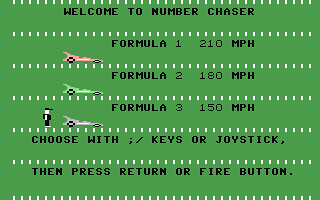
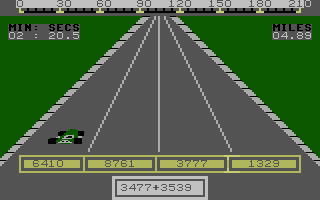
Also released under the much more fitting title of "Estimator Racer", Number Chaser is an educational game in which the player controls the lane in which a car is in, that relates to answering a mathematical question posed by the computer. Except you're not supposed to answer the question, you're supposed to choose the closest estimation to the answer. Which seems less educational than actually figuring out the answer since estimation skills are used in the first part of working out anyway.

Gameplay only involves changing lanes to lock in your estimation of the answer and game modes only change the speed and complexity of the problems. With the obvious option to add a fill in the blank mode, or something similar it seems rather simple just to leave it at this. Graphically the game is literally a simple pixel art version of a racetrack and the car seems almost flat. With hardly any sound effects, there's not much to comment on soundwise either.


Really this is hardly even a game, changing lanes to answer mathematical questions incorrectly isn't really my idea of fun when there's games like Speed King where you can (admittedly really crappily) actually race on a track. Realistically this is possibly the worst game I have ever played and its score should reflect that.

Rating: 1/100
Grade: F


Game: Xadium
Console: Commodore Plus/4
Developer: Mr. Chip Software
Release Date: 1987

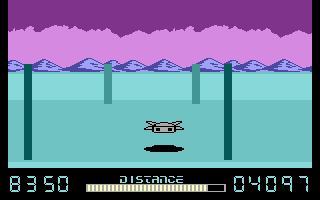
Xadium has two levels; I'm afraid to say that I've only played one of them and I'll get to why in a moment. The first level has the player making their way through gates on the planet Xadium, pushing forward on the joystick to increase their speed and using left and right to direct them through gates. Missing or hitting gates results in a time penalty, taking precious seconds off a countdown which you must beat the first level by the end of. Except that its almost impossible to do so.

Every single effort I have ever made to beat the first level of this game has failed. I've had runs without making any mistakes, and I've had runs where I've gone as fast as the ship will go but I assume that some sort of elite skill is needed to combine these two types of run to reach the second level. I can't even find a playthrough of the second level anywhere so I'll have to assume its as hard as the first, and no-one else has beaten it.


From the looks of the second level, it seems to be a rather standard sidescrolling stage where you have to fit between gaps in the landscape and avoid hitting the ceiling or floor. Graphically, the game is simple but there's a nice choice of colours and it doesn't look too bad stylistically. Soundwise there's a catchy menu tune and a background engine sound in the stages.

Overall, the time limit on the first stage is too harsh and doesn't allow players to even get to the second level, but there's some fun to be had at least, attempting to do so. It's still a bit of a failure as far as games go, but the gameplay that there is, is smooth and a little enjoyable.

Rating: 15/100
Grade: F


Game: Savage Island Part I
Console: Commodore Plus/4
Developer: Tynesoft
Release Date: 1986

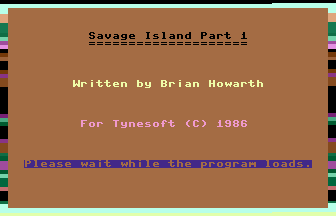
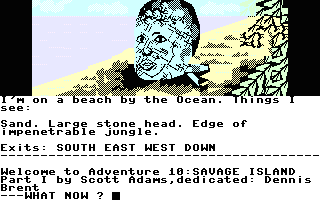
Savage Island is a two part text adventure for Commodore 16 in text only form and Commodore Plus/4 with pixel art of the locations. Both sides of the cartridge are playable although obviously the side with pixel art was intended to be the improved side, for Plus/4. The story follows a castaway on his quest to be rescued, facing such problems as aliens, bears and volcanoes as he uses the items at his disposal to make his escape.

The real problem with the game is that its very linear and only the exact correct action will allow you to progress. With the game being quite long, it's not always obvious what the next move is and its very hard to guess what needs to be done. the actions are also very specific as the game only recognises certain words so that "Dig Sand" is the only way to dig in the sand. Any other combination of words will not work.


Obviously I realise the challenges when programming a game such as this but somehow I feel it'd be frustrating to play even at the time of its release. The story only gets halfway before it requires you to insert Part 2 (sold seperately), and even judging the game by its storyline it seems contrived and fairly poorly written. The pixel art included on the Plus/4 version is fairly nice and helps the player to visualise the scene, however.

Rating: 8/100
Grade: F


Game: Number Builder
Console: Commodore Plus/4
Developer: A.S.K Software
Release Date: 1985

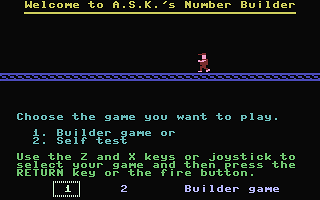
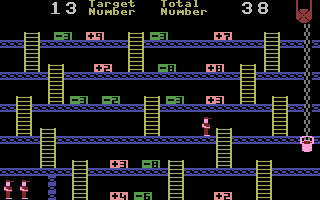
Number Builder is almost Number Chaser's more educational twin. It features platformer like levels with ladders and functions to change the current number into a target number. Once this is done correctly three times the player has beaten a level and moves onto bigger numbers and more complex functions. The player can move freely around, only having to avoid drops where there is a gap in the platform and no ladder.

With selectable speeds of walking and level complexity, it's easy for players to find settings which work well for them. Although it is supposed to be an educational game, there's a little fun to be had from just playing the game as if it were a regular platformer. It takes slightly more mental power than regular platform games, despite its simplicity.


Graphically the game is very simple with simple tones to indicate when the player has won the level. Overall the game certainly isn't the worst thing on the Commodore and the concept plays fairly well. Its hard to believe that it was made by the same people as Number Chaser, even.

Rating: 19/100
Grade: F

Wednesday, 10 July 2013

Commodore Plus/4 Games Review #2


Game: Paperboy
Console: Commodore 16 (Played on Plus/4)
Developer: Elite Systems
Release Date: 1986

Paperboy was originally an arcade game, developed by Atari, ported to no less than 19 home consoles and computers. With so many versions, there's a lot of graphical and gameplay differences between them but the aim of the game is to take the role of a paperboy, delivering to a number of houses on a street for 7 days, and attempting to avoid obstacles on his route and gain a bonus by breaking the windows of non-subscribers houses.

The Commodore 16 version plays a little shoddily, with no real indication of whether you're supposed to deliver to the houses highlighted in black, or the ones in white, from the map at the beginning of each level, and the sprites for the newspapers contained in a white square. The throwing mechanic for the newspapers sees them fly in an rather unexpected pattern from the paperboy's hand, and if I'm honest its hard to distinguish between having delivered a paper to a house, and not.


Graphically the game is basic, and looks comparably worse than the original Atari version. The backdrop and paperboy himself are incredibly blocky and it's sometimes hard to see approaching obstacles due to their colour (white on grey isn't the best combo). There's no music at all behind the game and the sound effects are a simple collision noise for the paper hitting doors/windows and the paperboy hitting obstacles. Although soundtracks aren't incredibly prevalent in Commodore games it'd be nice to see one in such a graphically simple title.

Rating: 9/100
Grade: F


Game: Spore
Console: Commodore 16/Plus/4
Developer: Mastertronic
Release Date: 1987

Spore is a maze type game released for both Commodore 64 and ZX spectrum, alongside the Commodore 16/Plus/4 version. The aim of the game is to collect a pesticide which will kill the attacking spores, which were a product of a failed experiment. The pesticide is stored in barrels around the levels and all of them must be collected to move onto the next level. The levels are infested, however with spores and generators making the players task more difficult.

The game plays very quickly, with the opening of new areas bringing a deluge of spores upon the player, and strategy being a large part of survival as encountering too many spores will accelerate the rate at which the players energy ticks down, leading to their loss. As such, it makes for a nice combination of maze and shooting gameplay.


Graphically the game is simple, with different squares to represent spores, generators and barrels, all of which are very colourful. Again, there's no musical backing to the game, just the sound effects from spores attacking and being hit with fire, in addition to the sounds for collecting barrels and powerups.

Overall this is actually a fairly rewarding game to play, working out strategy for it is pretty fun, and in gameplay terms its easy to pick up and has a fair amount of replay value when compared to other games. There's also a level editor included with the game, the only real downside being the repetitiveness of gameplay after a while.

Rating: 34/100
Grade: E


Game: Exorcist
Console: Commodore 16/Plus/4
Developer: Mr. Micro
Release Date: 1984

Exorcist is (as, on reflection the title may suggest) a Pac-man variant, where the players goal is to illuminate the walls underneath a ruined monastery, thus exorcising all the ghosts. The main characters name is Sparkie, who seems to be a representation of an electrical charge. Sparkie can collect lightning powerups which have to be used almost instantly to stun a ghost.

The gameplay area is fairly large, consisting of lots of maze sections. Once the player clears the section they are in, a gateway will open to the next section, and as they go further into the maze, the map in the corner of the screen will update with Sparkie's current progress. The game plays nicely with smooth movement and decent AI for the ghosts around the mazes.


The music used as a soundtrack is only a short clip and can quickly get tiresome, but I think it's better than having no music at all. There's not a whole lot of sound effects in the game, but those that are don't sound out of place at all. Graphically, it's very simple and although the ghosts do clip through eachother at times and there are some issues with flicker, it's generally pretty smooth.

With a little less repetition this game could have been a pretty solid title, the mazes end up seeming a little too infinitely big for being so similar. The gameplay mechanics work well, and its not such a close copy of Pac-man that you notice too much and the differences work in Exorcist's favour. This is one of my favourites for Commodore.

Rating: 47/100
Grade: D


Game: Harbour Attack
Console: Commodore 16/Plus/4
Developer: Mr. Micro
Release Date: 1984

Harbour Attack features 3 levels of sea based missions. The first sees the player navigating through the seas, trying to avoid moving buoys, by moving between safe spaces. Not only does the players submarine move incredibly slowly, but some of the buoys move pretty quickly, giving a very short time for the player to dodge between hiding spots. If the player is able to make it to the right hand edge of the screen, they move onto the second stage.

This stage involves a sort of combat, shooting at a boat in the water above, which has a fighter jet escort. Again the submarine controlled by the player moves at a snail's pace, which is not ideal when it's under siege from the enemy boat. If you are able to defeat the boat, you have to face about another 6 before moving to the third and final stage.


The final stage involves shooting upwards at a larger boat through a guard of smaller boats, with the hopes of sinking it. Once this has been done the game returns to the first level. All of the ideas for the levels are very simplistic and hardly any of them are executed well. the movement of the submarine is slow and this makes it very difficult to do anything.

Graphically the game is unbelievably basic, the submarine looks pretty poor, as do most of the enemies, adding to the frustration. Soundwise, the first level is the worst with constant explosion sound effects which serve no purpose. Overall, hardly any of this game is playable, let alone enjoyable.

Rating: 5/100
Grade: F

Friday, 14 June 2013

Commodore Plus/4 Games Review #1

For those of you who aren't aware, Plus/4 is a console released in 1984, by Commodore. The games are on cassette tapes which are read and then loaded by the Datasette addon, which is connected to the console. On average games take 5 minutes to load into the system's memory from the cassettes. For these it may seem as if the scores are very harsh, but as these are being ranked against all games I have previously reviewed, some of them may have been great for 1984 but in the present day, they just don't compare and so whilst its fun to play and see what games were like back then, they must be fairly and accurately assessed. Also as the NES was released in Japan in 1985, there's not much room to say that "games of the time were simpler" etc.


Game: Space Sweep + Invaders
Console: Commodore Plus/4
Developer: Mr. Micro Ltd.
Year: 1984

Space Sweep (I'll get to invaders later) is a space shooter of sorts, you control a ship and attempt to navigate the vast reaches of space without hitting meteorites, or literally anything else on the screen. Instant death is the penalty for those unable to avoid the obstacles, although there are five lives at the beginning of the game. The targets for the player to shoot are "satellites" (although its hard to tell what they are), and doing so earns points. Beyond this, there's a limited amount of fuel and if you're able to survive long enough to run out, you'll need to refuel at the mothership. Beyond this there's not much else to gameplay; you survive as long as you can in order to obtain the high score.


In terms of gameplay, the controls are pretty average by Commodore Plus/4 standards although gamers used to more modern controls might struggle at first. The game's difficulty in avoiding obstacles is quite high and this makes for fairly short attempts with each life. Graphically it's fairly poor, not a lot of the obstacles look like anything but boxes, and initially its difficult to tell what's what.


Space Invaders, is a version of the classic game that most people will be familiar with. Graphically its a little different from the Atari version, but it plays pretty similarly. Shooting and moving is surprisingly smooth and while the graphics seem a little odd if you're used to Atari's version, I'd contend that they're better than the original in some ways. There are 9 different difficulty levels, although approaching either end of the scale is a bad idea, 1 being far too easy and 9 being impossible. The invaders shooting patterns are odd also, with a rain of shots at some points and absolutely none at others. 


Soundwise, there's the classic decending tones and shot noises, nothing really too spectacular. Its pretty playable overall, and the better of the two games on the cassette. I can see Commodore's intention in putting two space themed games on a single cassette, but neither is incredibly impressive, even for the time. 


Rating: 29/100
Grade: F


Game: Speed King
Console: Commodore Plus/4
Developer: Mr Chip Software
Year: 1986

Speed King is an interesting, if utterly unplayable game. Released a year after Sega's Hang On, the game follows the same basic principles. You play as a motorcyclist, racing around a circuit (although here you play for position at the end of the race). Just like Hang On, hitting any other racer or obstacle will slow you down and cause you to reset on the track. There are a lot of ways this game is worse than Hang On, however. For a start the graphics are bad even for 1986 with the player looking more like a blob than a biker. Soundwise also there's only the droning of engines to accompany the game.


The gear system gives you a choice of 6 gears, although it doesn't reset upon collision, so you'll find yourself having to keep coming down through the gears to get started again. Crashes occur very often, as opponents come through from behind you to overtake, and as the sides are instant crash zones. Ultimately the racing isn't particularly fun, the graphics are bad even for the era, the difficulty is ridiculous and the choice of tracks seems to make almost no difference to what is onscreen.

Rating: 4/100
Grade: F


Game: Powerball
Console: Commodore Plus/4
Developer: Mastertronic
Year: 1986

Powerball is a simple game, where the player guides a ball along a series of platforms, in order to get it across the screen. The main reason you'd want to beat the game is that it says on the cassette packaging that there's no chance you will. The game difficulty is pretty hard, due to the controls being a little off, mixed with the bouncing mechanics of the ball. While it's not terrible, if the difficulty doesn't stop you from playing within about 5 minutes, the boredom will.


Graphically, the game is pretty simple too, and although some things are distinguishable as household objects etc., most things don't look great. Soundwise also, there's only a simple tune at the beginning and the ball's bouncing sound effect. While it's playable, its not something I'd come back to or even try to complete as even for Plus/4 it feels lazily made.

Rating: 12/100
Grade: F


Game: Prospector Pete
Console: Commodore Plus/4
Developer: British Software
Year: 1986

Prospector Pete is a puzzle game, where the player controls the titular character, who has to mine treasures underground, whilst avoiding "meanies" and floodwaters, controlled by the current level they have followed Pete's tracks to. With quick strategy, thinking and planning the player can set a course which helps Pete to collect all of the items before the flood waters get to him. While this can be fun, the same strategy works for basically every level, and the game does get repetitive after a short while.


While the graphics aren't anything that advanced gaming technology, its easy to see where you are and what you're doing. Soundwise, there's not a whole lot to the game, besides a digging sound and some effects for when the level is finished. Overall its a simple puzzle game that has a little play value, and controls fairly well.

Rating: 24/100
Grade: F