Showing posts with label Xbox. Show all posts
Wednesday, 16 March 2016
Series Review: Tony's Hawk's Part 2 (Underground Era)
Game: Tony Hawk's Underground
Console: Microsoft Xbox
Developer: Neversoft
Release Date: 14th November 2003
As the first release outside of the Pro Skater line of games, Tony Hawk's Underground had creative license to be different and show players an innovative and new skating experience. While the game adds a lot of new mechanics, such as off-board exploration and driving, much of this feels somewhat clunky and the skating action is still king as far as gameplay is concerned. Objectives as the Pro Skater titles had have been removed in favour of goals, handed to players by NPCs, of which all but one must be completed to move to the next level, with 30 levels in total.
Although there are 30 levels in total, each location has 5 or so levels which take place in it, and thus there are around the same number of locations as in the rest of the series. Having said this, the locations themselves tend to be less varied than in any of the previous games, as most are based on real life cities, and there's only so much that can be done with these. The goals featured in the game can be grouped into several types; fetch goals, trick goals, score goals and a few others. On the whole they're enjoyable, but the game itself feels a little too long and samey unless you're looking for a huge session of Tony Hawk's.
The skating gameplay featured is very similar to the rest of the series, though some tricks have been added. It's very easy to string a combo together, with reverts and manuals being the staple of hitting big scores. There's a custom trick editor that allows players to insert their own special move into the game, which is actually pretty cool. Driving or on-foot parts of the game are far less enjoyable and any goals involving these should really be skipped if possible.
The game's story is frustratingly slow moving, with much of the first half focused on making it to the Tampa-Am competition in order to compete. After getting a sponsor, a ride to the competition, arrested, freed, advertising the competition and impressing the pros enough to make it into the competition, players are finally allowed to actually compete and likely beat the pros by a mile. Perhaps the huge amount of levels is a plus for some players, but it honestly becomes a grind after a while.
Graphically the game isn't anything amazing but it's certainly a step forward from the Pro Skater titles. Musically I'm a big fan of Pro Skater and Pro Skater 2, but from there on the series seems to diversify into general musical anarchy. There are some good tracks, there are some bad tracks, it's just a case of catching a good song on a good run; at least there's some variety.
Overall Tony Hawk's Underground does best when it's tugging at the punk-sounding, mean-skating nostalgia we have for the previous games. The driving and on-foot segments and the fairly boring and slowly paced story have no real value to gamers, and it's a shame that the game seems to be so goal based. There's really no reward for freely skating around at any time where previously it could have been beneficial. With these ups and downs, it's a pretty average title overall.
Rating: 73/100
Grade: C
Game: Tony Hawk's Underground 2
Console: Sony Playstation 2
Developer: Neversoft
Release Date: 4th October 2004
Tony Hawk's Underground 2 is remarkably different for a sequel in such a homogeneous series of games. That's not to say it's changed much at all, but there's less "levels" and more sets of goals for each level, to be completed by different skaters. There's a set of goals for the player's original character, a set for a pro skater, a set for a guest skater and a special set which are completed on a special vehicle instead of a skateboard. This leads to some whacky guest appearances and goals mixed with the regular move and score goals we're used to.
The premise of the game is a skating tour, with two team captains; Tony Hawk and Bam Margera. The player attempts to earn points for their team by completing the objectives in each level. Once enough have been completed, it's possible move on. There's not a lot of stages in the game, compared to other instalments in the series, but the number of goals is certainly higher. As far as variety goes, there are some fun things to do in each level, with destructible environments in most and things to find.
The skating action itself feels similar to the other games in the series, though perhaps slightly clunkier in some ways. The levels featured in the main mode of the game tend to lack the flow of those featured in early titles also, making it far harder to string together combos and score runs, though time is no longer a factor in completing most goals. The special vehicles used instead of skateboards vary, but have some fun appeal even if they're not what we're used to.
In addition to the main mode, THUG2 features a Classic Mode allowing players to make their way through some of the game's levels, and remade classic levels in the original format; 2 minute runs, 10 goals per level and more levels unlocked once a certain amount of goals are cleared. This is all very well, and I personally appreciate the inclusion of the classic levels, but the first three levels (which are from THUG2) don't really fit this model well, and it's hard to string together a decent run.
Graphically the game isn't all that impressive; perhaps it's just the Playstation 2 version, but there were moments that I definitely preferred the first Underground game. There's nothing special about any of the skaters, their animations or the locations featured in the game, visually. The soundtrack is another mix of genres with a focus on Punk, Hip Hop and Alternative Rock. This works a little better than in Underground, though the inclusion of some wild card musical choices is questionable.
Overall Tony Hawk's Underground 2 is more of the same skating silliness we're used to with a few new tricks and features. The story mode flows better than in Underground and definitely doesn't drag on for quite as long. Classic Mode is a nice inclusion and can provide a nice nostalgia trip once players are past the first few levels. I prefer the Pro Skater series for the most part, with its fast paced, goal-clearing focus, but there's some acceptable fun to be had here too.
Rating: 73/100
Grade: C
Friday, 4 March 2016
Series Review: Ridge Racer
Ridge Racer is an arcade racing game which focuses on drifting around corners to win races. There are other elements introduced in other games in the series, but this is the main idea of the series. I don't own the original Ridge Racer for Playstation and there are a few other gaps in the chronology but I'll be exploring all the instalments that I own. While most of the early series was exclusive to Playstation there have been games for the Nintendo 64, Xbox 360, and 3DS.
Game: Ridge Racer Revolution
Console: Sony Playstation
Developer: Namco
Release Date: 3rd December 1995
While games in 1995 weren't as complex and replayable as they are today, Ridge Racer Revolution immediately presents an issue in terms of the amount there is to do. Players can choose from 3 tracks, in 3 modes, with a selection of 4 cars initially. While there are reversed versions of each track, and some more cars can be unlocked later, one race on each track in Race Mode is the entirety of the main gameplay. After winning a race, the Game Over screen appears and the game starts again, expecting players to clear each of the races and time trial mode, before it's literally 100% complete.
This is a shockingly small amount of content to offer players, and coming from later games like Ridge Racer Type 4 (which was still on the original Playstation), it's very disappointing. The racing action too is less enjoyable with horrible collision physics causing players to lose a lot of speed from hitting other cars or barriers even slightly. Drifting also seems to be less effective with very few points where it doesn't slow players down more than cornering normally.
Graphically the game could be a lot better though it's not bad for its time; cars and environments look very blocky and in faster sections there can be quite a lot of flicker. The sounds of the game are one of its worst points; while the music is reminiscent of the Prodigy's first album with a lot of dance style tunes, the voice over is far too present in giving feedback like "Ha ha, you're too slow" or "Come on, you've got to speed up!" when players are doing just fine in catching their opponents.
Even as a fan of the Ridge Racer series, Revolution is especially weak in terms of content, gameplay, sound and appearance. There's no area in which it excels and it can only really be excused in terms of being an early Playstation title. Other than this it offers literally minutes of fun for players, very little replayability and a yearning for the series to move on to a later format like that of Type 4.
Rating: 46/100
Grade: D
Game: Rage Racer
Console: Sony Playstation
Developer: Namco
Release Date: 30th April 1997
Rage Racer is perhaps the strangest instalment in the entire Ridge Racer series. For a start it's name is different to that of the rest of the series, and gave me the impression that it was some sort of parody/budget rip off for a while. Secondly the driving style is far more series and drifts are almost useless except for on the sharpest of turns, and lastly despite a complete change of handling, the game expected players to be as fast as ever on fairly difficult and technical tracks. While the cars in the game feel far more weighty and grip heavy than in Ridge Racer Revolution, the collision engine still hasn't been fixed, and hitboxes seem larger than ever, meaning that there are plenty of collisions with other cars, and the scenery which feel odd, and result in players losing a ton of speed. A consequence of this is that the races are near impossible to win, and even when passing a car from 2nd place, the counter doesn't hit 1st (it's possible it's just a lapped car, but it happened to me more than once).
The career mode finally features more than just an arcade run through a couple of races as players earn credits for finishing in the top 3 with which they can upgrade their cars and enter higher classes of race. While this is an exciting system, it does rather assume that the game isn't massively difficult to win at even in the easiest races. Between the heavier steering and the collision physics races are more than challenging and this can be frustrating enough to put players off entirely.
Graphically the game is the best in the series yet and features far more detail in its locations and cars than previous games. There's even night/day changes as players go around tracks which are more distracting than nice, but still a remarkable feature. Musically there's the same sort of music as in Ridge Racer Revolution, with dance and techno overtones but for some reason it's more bearable alongside the less abrasive female announcer.
Overall Rage Racer doesn't fix many of the glaring issues with the games but instead adds a heap of difficulty, and a more replayable Grand Prix mode. With better visuals and sound come more potential enjoyment, but anyone who's played the final instalment of the series on the Playstation knows that Ridge Racer Type 4 is even better.
Rating: 62/100
Grade: C
I've already reviewed Ridge Racer: Type 4, find my review here!
Game: Ridge Racer V
Console: Sony Playstation 2
Developer: Namco
Release Date: 24th November 2000
Ridge Racer V was a release game for the PS2 and from the outset seems like an updated and improved version of the Ridge Racer formula. There are 5 Grand Prix, featuring different variations of 7 tracks, and 21 vehicles to drive. the vehicles are separated into Drift and Grip categories which handle differently to eachother. Personally I find the Drift cars in this instalment far too easy to spin, so Grip is the obvious choice. In terms of the main mode (and that's all there really is to do, in game except for Time Trials and Free Runs, until players have unlocked everything), players compete in Grand Prix which consist of 4 races each. Players must place at least 4th in the 1st race, 3rd in the 2nd race and so on, until they have to win the final race to pass the Grand Prix. There are some interesting tracks and scenery, but nothing like the story featured in the main mode of Type 4.
The worst thing about the game seems to be the fact that the d-pad is the only method of controlling the car's direction. The analog sticks aren't supported, which forces players to drive a little differently than normal, making the game harder to beat. The collision physics also haven't been updated too much and still can ruin a good run with the slightest collision with a car or a wall. The AI are fairly competent and usually require a good run to beat, which means the racing action featured in the game is at least competitive and interesting.
Graphically the game is the best Ridge Racer so far; unsurprising given the leap in console technology for this game. There are far worse looking launch games for the Playstation 2, and there are impressive little details featured in the game like the shadows in the glass building in the picture above. The soundtrack is a strange mix of rock music and a departure from the music featured in the series so far. A DJ talks inbetween, and over tracks whilst players are racing, but this is less distracting that some of the voice overs featured in earlier games.
Overall Ridge Racer V is a fairly shallow game, with only 5 Grand Prix, though there are some fun special races which can be unlocked. The racing action is bearable, and though it's not perfect, players should be able to have at least some fun with the game. For the first "modern" Ridge Racer game, there's some good ideas, and if there'd been another main series instalment on the Playstation 2, I'm sure it'd have cemented these ideas into a much better experience.
Rating: 63/100
Grade: C
Game: R:Racing
Console: Sony Playstation 2
Developer: Namco
Release Date: 9th December 2003
Instead of releasing another main series instalment in the Ridge Racer series, Namco decided that a spin-off game, featuring Rena Hayami, a new character, in a story based career mode was the best way forwards. In 14 chapters of racing action, players guide Rena through many different types of racing; apparently her skills as an ambulance driver impressed a race team owner enough to give her a spot in a professional race series. The game features licensed tracks and vehicles (which is new for the series), and spans rally racing, drag racing and the Japan Grand Touring Car Championship.
The game's handling can be described as simcade; a mix between the styles featured in arcade and simulation gaming. Unlike previous Ridge Racer games, braking is necessary before corners and drifting is ineffectual, but it's still very easy to lose control with late braking, especially in some cars. There's a huge difference between the handling of cars in the game, and besides a Fiat 500, Bentley Speed 8 and Audi LMP car, most of them are fairly frustrating to drive around tracks to some degree.
Graphically the game is reminiscent of Gran Turismo, albeit at a slightly lower quality level. There are a few circuits which feature in both games, so it's an easy comparison between the two. The cars themselves look a little too featureless and shiny for what they're supposed to be, There's an interesting selection of electronic music on the soundtrack and it's more fitting for the series than the music featured in Ridge Racer V.
Overall R:Racing doesn't really know what it wants to be; spanning the line between Toca and Gran Turismo in its concept, and yet providing very fiddly and frustrating handling. For fans of the Ridge Racer series, this game features too many elements of simulation games, and much less drift-based handling, yet fans of simulation games already had Gran Turismo 3 to keep them satisfied, so I'm not quite sure what Namco were going for.
Rating: 58/100
Grade: D
Game: Ridge Racer
Console: Sony Playstation Portable
Developer: Namco
Release Date: 1st September 2005
Ridge Racer for the PSP is an example of a handheld game done right; the game features 12 tracks, with forward and reverse variants, 2 of which are from each of the original Playstation Ridge Racer titles, with a further 2 from Rave Racer, an arcade title, and the final 2 loosely based on Rave Raver tracks. This means that fans of the series should at least be familiar with some of the tracks featured in game.
The World Tour mode has 40 tours, made up of different combinations of tracks with between 2 and 6 courses per tour. with a different car classes and requirements in each tour. There's a good selection of original cars to be found and unlocked, but the real draw of the game is that the handling and drifting finally works perfectly, just like in Ridge Racer Type 4, if not even better. Drifting around corners fills the 3 nitrous bars onscreen which can be used to great effect during races to gain first place.
Graphically the game looks good on the small screen on the PSP but perhaps a little worse when it's shown in a larger resolution. While the cars are a little blocky, the tracks and other details are generally good. The collision physics of the other games remain, if a little toned down, but the improved handling makes up for it. There's a large amount of music from previous Ridge Racer games as well as some new tracks, most of which are great for racing to.
Overall Ridge Racer for PSP was undoubtedly the best game in the series at its time of release. While it lacked the story mode interest of Ridge Racer Type 4, the improvements and upgrades as well as the retrospective mood put the game in a league of it's own. If anything there's a bit too much to do, with 40 tours to clear, but dedicated players will get their money's worth.
Rating: 81/100
Grade: B
Game: Ridge Racer 2
Console: Sony Playstation Portable
Developer: Namco
Release Date: 13th October 2006
Perhaps one of the laziest sequels ever released, Ridge Racer 2 on the PSP is almost identical to the game released the previous year. Sure, there are a few more cars, and a few more tracks, perhaps even a couple more modes to play, but the career mode progression, game engine and graphics engine are exactly the same as Ridge Racer. There's literally no point owning the first game if you don't already, just skip to this one.
The handling is predictably good, just like that of the first game; drifting is easily achieved and the nitrous bars are easy to fill. The AI gets fairly tough in later Grand Prix, and the more powerful cars are more difficult to handle and drive. There's very little in terms of differences from how career mode played out in the first game, if the cars and tracks could have been released as DLC, that'd have been a far better decision.
Graphically there's no difference from the first handheld instalment on the PSP, in fact many of the cars and tracks are the same, so it's easy to tell that little to no effort has been put into improving the look of the game. The soundtrack features a mix of songs from other instalments and new songs, and is probably the most changed aspect of the entire sequel.
Overall although Ridge Racer 2 as a standalone is a perfectly good game, and probably the better of the two PSP games, it's almost offensive to gamers how little was changed between releases. For those who bought both games on release, there must have been a moment of sheer disappointment upon realising they essentially already owned the content of Ridge Racer 2. For gamers who have yet to buy either game, this is the one to go for, though.
Rating: 81/100
Grade: B
Game: Ridge Racer 3D
Console: Nintendo 3DS
Developer: Namco
Release Date: 22nd March 2011
Ridge Racer 3D was a launch title for the 3DS, mirroring the fact that Ridge Racer games had been launch titles for Playstation, Playstation 2, and 3. The only previous instalment of the series on a Nintendo console had been Ridge Racer 64. In terms of gameplay advancements, there's really not a lot of new features in the game, but the added 3D effect which the console makes use of is an interesting addition.
The handling of the game is much the same as the previous 3 instalments of the series, with good drifting and general handling featured. Grand Prix mode features a tree of possible race options, meaning that players don't have to complete every Grand Prix to get through a level. With 4 races per Grand Prix and a ton of choice though, things can get a little too repetitive with long play sessions. A new feature of this game is avatars for each racer, above their head, based on classic Namco characters.
Graphically the game isn't as sharp as the PS3 instalment, but does well with it's 3D mode as well as with the 3D turned off. The overall sense of speed is good, and the heads up display is somewhat clearer than in other games, though the avatars of other players can get in the way sometimes. Musically there's a huge selection of new and previous in-game music, which is good, though it's often overshadowed by the 'encouragement' of the in-game announcer who pipes up far too often.
Overall Ridge Racer 3D is a nice addition to the 3DS launch line up and not a bad game per se, though there's no real innovation in terms of the series gameplay. While different nitrous modes can be used, and there are advantages which can be bought before races to help players get a headstart, I'd have much preferred a different race type, tournaments or a storyline of some kind.
Rating: 76/100
Grade: B
Game: Ridge Racer 7
Console: Sony Playstation 3
Developer: Namco
Release Date: 23rd March 2007
As the seventh main series instalment in the series, Ridge Racer 7 almost had to change up its career mode a little from the frankly lacklustre Ridge Racer V on PS2. Since I don't own Ridge Racer 6 on the Xbox 360, it's hard to tell when the switch occurred, but career mode on Ridge Racer 7 is much different to anything reviewed thus far. As a launch title for the PS3, the graphics are a good showcase of what could be done with the system at launch, and the racing engine feels easy to control.
In career mode players have the choice of 3 event types; Grand Prix series which have been the mainstay of the Ridge Racer series for a long time, Manufacturer Races in order to earn cars and parts for use in races and UFRA races which have special conditions and types and earn players money and fame. Whilst the AI difficulty cranks up to almost cheating levels pretty quickly, the racing action is fun and there's a great deal more choice in terms of race types and things to do than many other games from the series.
Graphically the game looks very nice with impressive lighting and location effects combining with the HD graphics to provide a truly visually pleasing experience. Unfortunately the sense of speed given by the game lets it down a little, as 200mph can feel the equivalent of 50mph on some stretches of road. The nitrous boosts give a much faster feel, but don't last particularly long as they use the same system as the PSP games. Ridge Racer 7's soundtrack is a little disappointing; though there are some good tracks, they're outweighed by the mediocre and a couple of truly unbearable tracks.
Overall the game feels like a fresh HD kickstart for the series, building on previous instalments to provide a deeper career mode and visually exciting tracks and cars. The racing action is very much enjoyable though the AI rubberbanding can ruin races at times. It's definitely worth giving a go, even if you're not a racing fan, since the easy handling and fun of drifting are pretty much universally enjoyable, even if the formula still wears thin after lengthy playsessions.
Rating: 83/100
Grade: B
Game: Ridge Racer Unbounded
Console: Microsoft Xbox 360
Developer: Bugbear Entertainment
Release Date: 30th March 2012
The latest game in the Ridge Racer series, Unbounded's main theme seems to be that of indecisiveness. Firstly it can't decide whether it wants to be Need for Speed or Burnout more, featuring street racing with "fragging" which is basically a codeword for takedowns, secondly it can't decide whether to fully part ways with the old Ridge Racer formula, still leaving drifting in the game, but making it feel awful in terms of the handling model and not letting players corner without it. Lastly many of the Burnout-esque options such as the takedown cam can be switched off in the menu, as if they weren't sure whether players would like the new tone of the game.
With destructible environments, city based street racing and a star rating system for dominating events, you'd be forgiven for wondering what series this game came from if you didn't already know. Existing fans of the Ridge Racer series are presented with a game more foreign to them than an imported RPG. For the first main series game not developed by Namco themselves, this is a pretty huge departure from the happy and relaxed mood of the rest of the games.
Being the open minded gamer that I am however, I was willing to give the game a chance; the career mode is based around many city districts which unlock as events are dominated by finishing first. There are many different types of events in the game such as Dominator Races, Drift Races, Shindo races (more on these later), Time Trials and Frag Challenges. All events are based on a 3 star rating system where usually finishing 1st gains 3 stars and so on, until finishing 4th counts as failing the event.
The driving and racing itself feels pretty horrible, the car's handling is almost straight line based, and any preconceived ideas of cornering players may have had before playing the game are shattered as the cars will literally refuse to corner without a drift being initiated. This is Ridge Racer though, so players should be used to this. Except the drift system has changed massively and is far less arcade based now.
Winning events seems to be basically random; in any events which aren't Shindo or Drift racing, there are destructible parts of the environment like car dealerships, city halls and railway stations which can be used as shortcuts if the player's power meter is full. Additionally destroying girders and other parts of the track also add power to the player's meter. Not everything is destructible though, and this is a problem because crashing once can be the difference between winning a losing a race, like in Burnout. So it's up to the player to guess which parts of the track are meant to be destroyed and which are solid.
Shindo events completely ignore the destruction part of the game, and don't allow you to frag your opponents. This is partly useful as it stops the player from being fragged too, but shows yet more indecision from the developers; either make it a part of the game or don't, it's pretty weak to force players to race both ways and pretend it's a choice. These races usually feature many AI cars getting in your way as there's no fragging, the drifting is a much bigger feature of the shindo racing but still feels pretty awful.
I had a hard time caring about unlocking any of the cars, locations or star ratings in the game because it seemed like a real mash of playstyles and ideas from other games. There was hardly any Ridge Racer left in the game, and what was left was an indecisive grey mess. There's no real story as such, and so no compelling reason to continue with the races presented to the player, and there's not even a need to finish 1st, players could easily finish 3rd in all race events and still get pretty far into the game, which is a little ridiculous in a racing title.
Graphically the game looks pretty great; the destructible environment parts all crumble rather too easily into predictably sized pieces, but the rest of the game looks very sharp, and I particularly enjoyed the information displays along the sides of the track. The music featured behind gameplay is all licensed and as such not quite as interesting as an original soundtrack. There's a decent mix of electronic stuff, but the soul of the Ridge Racer series is definitely gone from the game.
Overall Ridge Racer Unbounded might as well be any other large budget racing title from the past few years; there's city street racing, there's licensed tunes, takedowns, and a star rating system for how well you've done in each race. Without anything to invest players in it's brand of racing, there's very little to keep them hooked, and I'd personally rather play literally any other instalment of the series thanks to the poor handling and soulless presentation.
Rating: 61/100
Grade: D
Game: Ridge Racer Revolution
Console: Sony Playstation
Developer: Namco
Release Date: 3rd December 1995
While games in 1995 weren't as complex and replayable as they are today, Ridge Racer Revolution immediately presents an issue in terms of the amount there is to do. Players can choose from 3 tracks, in 3 modes, with a selection of 4 cars initially. While there are reversed versions of each track, and some more cars can be unlocked later, one race on each track in Race Mode is the entirety of the main gameplay. After winning a race, the Game Over screen appears and the game starts again, expecting players to clear each of the races and time trial mode, before it's literally 100% complete.
This is a shockingly small amount of content to offer players, and coming from later games like Ridge Racer Type 4 (which was still on the original Playstation), it's very disappointing. The racing action too is less enjoyable with horrible collision physics causing players to lose a lot of speed from hitting other cars or barriers even slightly. Drifting also seems to be less effective with very few points where it doesn't slow players down more than cornering normally.
Graphically the game could be a lot better though it's not bad for its time; cars and environments look very blocky and in faster sections there can be quite a lot of flicker. The sounds of the game are one of its worst points; while the music is reminiscent of the Prodigy's first album with a lot of dance style tunes, the voice over is far too present in giving feedback like "Ha ha, you're too slow" or "Come on, you've got to speed up!" when players are doing just fine in catching their opponents.
Even as a fan of the Ridge Racer series, Revolution is especially weak in terms of content, gameplay, sound and appearance. There's no area in which it excels and it can only really be excused in terms of being an early Playstation title. Other than this it offers literally minutes of fun for players, very little replayability and a yearning for the series to move on to a later format like that of Type 4.
Rating: 46/100
Grade: D
Game: Rage Racer
Console: Sony Playstation
Developer: Namco
Release Date: 30th April 1997
Rage Racer is perhaps the strangest instalment in the entire Ridge Racer series. For a start it's name is different to that of the rest of the series, and gave me the impression that it was some sort of parody/budget rip off for a while. Secondly the driving style is far more series and drifts are almost useless except for on the sharpest of turns, and lastly despite a complete change of handling, the game expected players to be as fast as ever on fairly difficult and technical tracks. While the cars in the game feel far more weighty and grip heavy than in Ridge Racer Revolution, the collision engine still hasn't been fixed, and hitboxes seem larger than ever, meaning that there are plenty of collisions with other cars, and the scenery which feel odd, and result in players losing a ton of speed. A consequence of this is that the races are near impossible to win, and even when passing a car from 2nd place, the counter doesn't hit 1st (it's possible it's just a lapped car, but it happened to me more than once).
The career mode finally features more than just an arcade run through a couple of races as players earn credits for finishing in the top 3 with which they can upgrade their cars and enter higher classes of race. While this is an exciting system, it does rather assume that the game isn't massively difficult to win at even in the easiest races. Between the heavier steering and the collision physics races are more than challenging and this can be frustrating enough to put players off entirely.
Graphically the game is the best in the series yet and features far more detail in its locations and cars than previous games. There's even night/day changes as players go around tracks which are more distracting than nice, but still a remarkable feature. Musically there's the same sort of music as in Ridge Racer Revolution, with dance and techno overtones but for some reason it's more bearable alongside the less abrasive female announcer.
Overall Rage Racer doesn't fix many of the glaring issues with the games but instead adds a heap of difficulty, and a more replayable Grand Prix mode. With better visuals and sound come more potential enjoyment, but anyone who's played the final instalment of the series on the Playstation knows that Ridge Racer Type 4 is even better.
Rating: 62/100
Grade: C
I've already reviewed Ridge Racer: Type 4, find my review here!
Game: Ridge Racer V
Console: Sony Playstation 2
Developer: Namco
Release Date: 24th November 2000
Ridge Racer V was a release game for the PS2 and from the outset seems like an updated and improved version of the Ridge Racer formula. There are 5 Grand Prix, featuring different variations of 7 tracks, and 21 vehicles to drive. the vehicles are separated into Drift and Grip categories which handle differently to eachother. Personally I find the Drift cars in this instalment far too easy to spin, so Grip is the obvious choice. In terms of the main mode (and that's all there really is to do, in game except for Time Trials and Free Runs, until players have unlocked everything), players compete in Grand Prix which consist of 4 races each. Players must place at least 4th in the 1st race, 3rd in the 2nd race and so on, until they have to win the final race to pass the Grand Prix. There are some interesting tracks and scenery, but nothing like the story featured in the main mode of Type 4.
The worst thing about the game seems to be the fact that the d-pad is the only method of controlling the car's direction. The analog sticks aren't supported, which forces players to drive a little differently than normal, making the game harder to beat. The collision physics also haven't been updated too much and still can ruin a good run with the slightest collision with a car or a wall. The AI are fairly competent and usually require a good run to beat, which means the racing action featured in the game is at least competitive and interesting.
Graphically the game is the best Ridge Racer so far; unsurprising given the leap in console technology for this game. There are far worse looking launch games for the Playstation 2, and there are impressive little details featured in the game like the shadows in the glass building in the picture above. The soundtrack is a strange mix of rock music and a departure from the music featured in the series so far. A DJ talks inbetween, and over tracks whilst players are racing, but this is less distracting that some of the voice overs featured in earlier games.
Overall Ridge Racer V is a fairly shallow game, with only 5 Grand Prix, though there are some fun special races which can be unlocked. The racing action is bearable, and though it's not perfect, players should be able to have at least some fun with the game. For the first "modern" Ridge Racer game, there's some good ideas, and if there'd been another main series instalment on the Playstation 2, I'm sure it'd have cemented these ideas into a much better experience.
Rating: 63/100
Grade: C
Game: R:Racing
Console: Sony Playstation 2
Developer: Namco
Release Date: 9th December 2003
Instead of releasing another main series instalment in the Ridge Racer series, Namco decided that a spin-off game, featuring Rena Hayami, a new character, in a story based career mode was the best way forwards. In 14 chapters of racing action, players guide Rena through many different types of racing; apparently her skills as an ambulance driver impressed a race team owner enough to give her a spot in a professional race series. The game features licensed tracks and vehicles (which is new for the series), and spans rally racing, drag racing and the Japan Grand Touring Car Championship.
The game's handling can be described as simcade; a mix between the styles featured in arcade and simulation gaming. Unlike previous Ridge Racer games, braking is necessary before corners and drifting is ineffectual, but it's still very easy to lose control with late braking, especially in some cars. There's a huge difference between the handling of cars in the game, and besides a Fiat 500, Bentley Speed 8 and Audi LMP car, most of them are fairly frustrating to drive around tracks to some degree.
Graphically the game is reminiscent of Gran Turismo, albeit at a slightly lower quality level. There are a few circuits which feature in both games, so it's an easy comparison between the two. The cars themselves look a little too featureless and shiny for what they're supposed to be, There's an interesting selection of electronic music on the soundtrack and it's more fitting for the series than the music featured in Ridge Racer V.
Overall R:Racing doesn't really know what it wants to be; spanning the line between Toca and Gran Turismo in its concept, and yet providing very fiddly and frustrating handling. For fans of the Ridge Racer series, this game features too many elements of simulation games, and much less drift-based handling, yet fans of simulation games already had Gran Turismo 3 to keep them satisfied, so I'm not quite sure what Namco were going for.
Rating: 58/100
Grade: D
Game: Ridge Racer
Console: Sony Playstation Portable
Developer: Namco
Release Date: 1st September 2005
Ridge Racer for the PSP is an example of a handheld game done right; the game features 12 tracks, with forward and reverse variants, 2 of which are from each of the original Playstation Ridge Racer titles, with a further 2 from Rave Racer, an arcade title, and the final 2 loosely based on Rave Raver tracks. This means that fans of the series should at least be familiar with some of the tracks featured in game.
The World Tour mode has 40 tours, made up of different combinations of tracks with between 2 and 6 courses per tour. with a different car classes and requirements in each tour. There's a good selection of original cars to be found and unlocked, but the real draw of the game is that the handling and drifting finally works perfectly, just like in Ridge Racer Type 4, if not even better. Drifting around corners fills the 3 nitrous bars onscreen which can be used to great effect during races to gain first place.
Graphically the game looks good on the small screen on the PSP but perhaps a little worse when it's shown in a larger resolution. While the cars are a little blocky, the tracks and other details are generally good. The collision physics of the other games remain, if a little toned down, but the improved handling makes up for it. There's a large amount of music from previous Ridge Racer games as well as some new tracks, most of which are great for racing to.
Overall Ridge Racer for PSP was undoubtedly the best game in the series at its time of release. While it lacked the story mode interest of Ridge Racer Type 4, the improvements and upgrades as well as the retrospective mood put the game in a league of it's own. If anything there's a bit too much to do, with 40 tours to clear, but dedicated players will get their money's worth.
Rating: 81/100
Grade: B
Game: Ridge Racer 2
Console: Sony Playstation Portable
Developer: Namco
Release Date: 13th October 2006
Perhaps one of the laziest sequels ever released, Ridge Racer 2 on the PSP is almost identical to the game released the previous year. Sure, there are a few more cars, and a few more tracks, perhaps even a couple more modes to play, but the career mode progression, game engine and graphics engine are exactly the same as Ridge Racer. There's literally no point owning the first game if you don't already, just skip to this one.
The handling is predictably good, just like that of the first game; drifting is easily achieved and the nitrous bars are easy to fill. The AI gets fairly tough in later Grand Prix, and the more powerful cars are more difficult to handle and drive. There's very little in terms of differences from how career mode played out in the first game, if the cars and tracks could have been released as DLC, that'd have been a far better decision.
Graphically there's no difference from the first handheld instalment on the PSP, in fact many of the cars and tracks are the same, so it's easy to tell that little to no effort has been put into improving the look of the game. The soundtrack features a mix of songs from other instalments and new songs, and is probably the most changed aspect of the entire sequel.
Overall although Ridge Racer 2 as a standalone is a perfectly good game, and probably the better of the two PSP games, it's almost offensive to gamers how little was changed between releases. For those who bought both games on release, there must have been a moment of sheer disappointment upon realising they essentially already owned the content of Ridge Racer 2. For gamers who have yet to buy either game, this is the one to go for, though.
Rating: 81/100
Grade: B
Game: Ridge Racer 3D
Console: Nintendo 3DS
Developer: Namco
Release Date: 22nd March 2011
Ridge Racer 3D was a launch title for the 3DS, mirroring the fact that Ridge Racer games had been launch titles for Playstation, Playstation 2, and 3. The only previous instalment of the series on a Nintendo console had been Ridge Racer 64. In terms of gameplay advancements, there's really not a lot of new features in the game, but the added 3D effect which the console makes use of is an interesting addition.
The handling of the game is much the same as the previous 3 instalments of the series, with good drifting and general handling featured. Grand Prix mode features a tree of possible race options, meaning that players don't have to complete every Grand Prix to get through a level. With 4 races per Grand Prix and a ton of choice though, things can get a little too repetitive with long play sessions. A new feature of this game is avatars for each racer, above their head, based on classic Namco characters.
Graphically the game isn't as sharp as the PS3 instalment, but does well with it's 3D mode as well as with the 3D turned off. The overall sense of speed is good, and the heads up display is somewhat clearer than in other games, though the avatars of other players can get in the way sometimes. Musically there's a huge selection of new and previous in-game music, which is good, though it's often overshadowed by the 'encouragement' of the in-game announcer who pipes up far too often.
Overall Ridge Racer 3D is a nice addition to the 3DS launch line up and not a bad game per se, though there's no real innovation in terms of the series gameplay. While different nitrous modes can be used, and there are advantages which can be bought before races to help players get a headstart, I'd have much preferred a different race type, tournaments or a storyline of some kind.
Rating: 76/100
Grade: B
Game: Ridge Racer 7
Console: Sony Playstation 3
Developer: Namco
Release Date: 23rd March 2007
As the seventh main series instalment in the series, Ridge Racer 7 almost had to change up its career mode a little from the frankly lacklustre Ridge Racer V on PS2. Since I don't own Ridge Racer 6 on the Xbox 360, it's hard to tell when the switch occurred, but career mode on Ridge Racer 7 is much different to anything reviewed thus far. As a launch title for the PS3, the graphics are a good showcase of what could be done with the system at launch, and the racing engine feels easy to control.
In career mode players have the choice of 3 event types; Grand Prix series which have been the mainstay of the Ridge Racer series for a long time, Manufacturer Races in order to earn cars and parts for use in races and UFRA races which have special conditions and types and earn players money and fame. Whilst the AI difficulty cranks up to almost cheating levels pretty quickly, the racing action is fun and there's a great deal more choice in terms of race types and things to do than many other games from the series.
Graphically the game looks very nice with impressive lighting and location effects combining with the HD graphics to provide a truly visually pleasing experience. Unfortunately the sense of speed given by the game lets it down a little, as 200mph can feel the equivalent of 50mph on some stretches of road. The nitrous boosts give a much faster feel, but don't last particularly long as they use the same system as the PSP games. Ridge Racer 7's soundtrack is a little disappointing; though there are some good tracks, they're outweighed by the mediocre and a couple of truly unbearable tracks.
Overall the game feels like a fresh HD kickstart for the series, building on previous instalments to provide a deeper career mode and visually exciting tracks and cars. The racing action is very much enjoyable though the AI rubberbanding can ruin races at times. It's definitely worth giving a go, even if you're not a racing fan, since the easy handling and fun of drifting are pretty much universally enjoyable, even if the formula still wears thin after lengthy playsessions.
Rating: 83/100
Grade: B
Game: Ridge Racer Unbounded
Console: Microsoft Xbox 360
Developer: Bugbear Entertainment
Release Date: 30th March 2012
The latest game in the Ridge Racer series, Unbounded's main theme seems to be that of indecisiveness. Firstly it can't decide whether it wants to be Need for Speed or Burnout more, featuring street racing with "fragging" which is basically a codeword for takedowns, secondly it can't decide whether to fully part ways with the old Ridge Racer formula, still leaving drifting in the game, but making it feel awful in terms of the handling model and not letting players corner without it. Lastly many of the Burnout-esque options such as the takedown cam can be switched off in the menu, as if they weren't sure whether players would like the new tone of the game.
With destructible environments, city based street racing and a star rating system for dominating events, you'd be forgiven for wondering what series this game came from if you didn't already know. Existing fans of the Ridge Racer series are presented with a game more foreign to them than an imported RPG. For the first main series game not developed by Namco themselves, this is a pretty huge departure from the happy and relaxed mood of the rest of the games.
Being the open minded gamer that I am however, I was willing to give the game a chance; the career mode is based around many city districts which unlock as events are dominated by finishing first. There are many different types of events in the game such as Dominator Races, Drift Races, Shindo races (more on these later), Time Trials and Frag Challenges. All events are based on a 3 star rating system where usually finishing 1st gains 3 stars and so on, until finishing 4th counts as failing the event.
The driving and racing itself feels pretty horrible, the car's handling is almost straight line based, and any preconceived ideas of cornering players may have had before playing the game are shattered as the cars will literally refuse to corner without a drift being initiated. This is Ridge Racer though, so players should be used to this. Except the drift system has changed massively and is far less arcade based now.
Winning events seems to be basically random; in any events which aren't Shindo or Drift racing, there are destructible parts of the environment like car dealerships, city halls and railway stations which can be used as shortcuts if the player's power meter is full. Additionally destroying girders and other parts of the track also add power to the player's meter. Not everything is destructible though, and this is a problem because crashing once can be the difference between winning a losing a race, like in Burnout. So it's up to the player to guess which parts of the track are meant to be destroyed and which are solid.
Shindo events completely ignore the destruction part of the game, and don't allow you to frag your opponents. This is partly useful as it stops the player from being fragged too, but shows yet more indecision from the developers; either make it a part of the game or don't, it's pretty weak to force players to race both ways and pretend it's a choice. These races usually feature many AI cars getting in your way as there's no fragging, the drifting is a much bigger feature of the shindo racing but still feels pretty awful.
I had a hard time caring about unlocking any of the cars, locations or star ratings in the game because it seemed like a real mash of playstyles and ideas from other games. There was hardly any Ridge Racer left in the game, and what was left was an indecisive grey mess. There's no real story as such, and so no compelling reason to continue with the races presented to the player, and there's not even a need to finish 1st, players could easily finish 3rd in all race events and still get pretty far into the game, which is a little ridiculous in a racing title.
Graphically the game looks pretty great; the destructible environment parts all crumble rather too easily into predictably sized pieces, but the rest of the game looks very sharp, and I particularly enjoyed the information displays along the sides of the track. The music featured behind gameplay is all licensed and as such not quite as interesting as an original soundtrack. There's a decent mix of electronic stuff, but the soul of the Ridge Racer series is definitely gone from the game.
Overall Ridge Racer Unbounded might as well be any other large budget racing title from the past few years; there's city street racing, there's licensed tunes, takedowns, and a star rating system for how well you've done in each race. Without anything to invest players in it's brand of racing, there's very little to keep them hooked, and I'd personally rather play literally any other instalment of the series thanks to the poor handling and soulless presentation.
Rating: 61/100
Grade: D
Wednesday, 8 July 2015
Game Review: Midtown Madness 3
Game: Midtown Madness 3
Console: Microsoft Xbox
Developer: Digital Illusions CE
Release Date: 17th June 2003
With the first two instalments on PC, Midtown Madness was a series that largely flew under my radar at the time of its release. The third and final release in the series, Midtown Madness 3 challenges players to go undercover in 2 cities; Paris and Washington D.C. in order to solve 2 cases through working in a variety of jobs such as Delivery Worker, Limo Driver, Ambulance Driver and finally breaking their cover to solve each case.
Each job has 4 missions, 3 of which are available once the job has been unlocked and a fourth which unlocks after every other mission has been completed. Beating the final mission on a job will unlock the next job and allow players to continue progressing through the game. Most missions are under 5 minutes in length though their difficulty increases as the game progresses, and some of the harder ones take a few tries to beat.
While the handling is arcade like for the most part, it's pretty easy to get used to and despite crashes being difficult to avoid sometimes, driving is still a fun experience. The overall sense of speed isn't anything special, and often 120mph on the speedometer will feel more like 60-70mph. The range of cars featured in the game is good, although there's a large amount of service vehicles such as taxis, ambulances, and delivery cars rather than licensed vehicles. Alternative paint jobs for each car are hidden around the two cities, though they're not really worth collecting unless you're a completionist.
The two cities featured in the game are fairly large in size, especially for the era though they're certainly not as large as their real life counterparts. Paris feels as if it has more character and point of interest than Washington D.C. but this may be true in real life as well as in game. Aside from the main undercover mode, there's some race modes and a free roam available, but these are only supplementary and don't entertain for long.
Undercover mode has some interesting moments and is well worth playing, but can be inconsistent in terms of overall difficulty. Both campaigns are fairly similar, with the same mission types and even some of the same professions appearing across both cities. Gameplay is reminiscent of such games as Super Runabout and even Crazy Taxi at times, with a floating arrow that sometimes sends players the wrong way.
While the overall story might not be all that enjoyable, the mission based concept and humourous presentation give the game an element of fun and light heartedness that is perhaps missing from many games of the present day. Sometimes it's fun just to see how much mayhem can be caused, though without much of a damage engine, it's difficult to measure quite how much chaos has occurred.
Graphically the game features some impressive visuals for having been released in 2003. The cars, buildings, and scenery are all fairly detailed, especially for the map size, and the only real letdowns are the slightly wonky physics engine and lack of damage to cars. Musically the game has a fairly bland electronic accompaniment which is drowned out by engine noise, and most other sound effects.
Overall Midtown Madness 3 is a decent driving game which allows players to work undercover in a variety of jobs, following a humourous storyline with a few standout missions. There's nothing to keep players coming back though, and one playthrough of the undercover mode should be more than sufficient to experience all the game has to offer.
Rating: 64/100
Grade: C
Saturday, 6 June 2015
Game Review: Stubbs the Zombie in Rebel Without A Pulse
Game: Stubbs the Zombie in Rebel Without A Pulse
Console: Microsoft Xbox
Developer: Wideload Games Inc.
Release Date: 18th October 2005
Recently we've had an overload of zombie games; Dead Island, Dead Rising, The Walking Dead and other titles based on survival and reanimated corpses have flooded the marketplace and made slashing hordes of green undead somewhat less exciting than it used to be. In 2005 though, there was a game that turned the zombie fighting model on its head, and challenged players to cause mayhem as the leader of a zombie invasion in the retro-futuristic town of Punchbowl.
The game's main character, Edward "Stubbs" Stubblefield was a poor travelling salesman from the Great Depression era, who met an unfortunate end when his young lover's father shoots him dead in the wilderness. Rising from his grave, years later in 1959, the city of Punchbowl has been built on top of Stubbs' final resting place, as he becomes a zombie and begins to eat the brains of local residents leading to a full scale zombie army by the end of the game.
Players control Stubbs as he roams the various locations of the game, and are able to eat brains with the press of a button, and attack with melee strikes as Stubbs is unable to wield a conventional weapon. Instead once a certain amount of brains have been eaten, Stubbs refills the ability to use his special moves. The first is a fart bomb which stuns nearby citizens, allowing their brains to be easily munched, the next is a guts bomb, which explodes, kills and transforms nearby citizens into zombies within the blast radius. Stubbs is also able to detach an arm which moves freely and can possess citizens (which really helps in levels with gun wielding enemies), and lastly there's the head bomb where Stubbs detaches his head before rolling it towards a group of enemies; players can steer the head to guide it and cause as much damage as possible.
The levels in the game are based all around Punchbowl and allow players to visit the Police Station, Mall, Dam and a farm which is home to Stubbs' original killer. Most levels involve making your way through to a certain point, with a few objectives to complete in some levels. Converting citizens to zombies is optional in many places, but helps as they will also attack any citizens that may be trying to take Stubbs down. Occasionally there's a level which has a different style of gameplay; notable examples include a dance showdown with the chief of police, driving levels and Stubbs relieving himself into the town's water supply whilst fighting off police and scientists.
While the game's plot may well be fairly transparent, and there's little variety within the game's main levels, causing mayhem as a zombie is a lot of fun, and its certainly a nice change from slaughtering hordes of undead. In particular, detaching Stubbs' arm to possess other citizens and strategically take down armed officers is a major selling point. Trial and error is a big part of the later gameplay as progress is saved fairly often, leaving players to experiment with all out an all out offensive strategy compared to gathering a horde of undead and using them as protection.
The overall difficulty level is manageable, as with enough time any level can be beaten. While the levels which change up the formula tend to be a little easier than more strategic levels, the most difficulty I had whilst playing was in finding where Stubbs needed to go to continue levels. Past the initial tutorial, players aren't given much guidance as to where to go, so some experimentation is necessary.
Graphically the game looks great on the Xbox; there's tons of uncensored gore and gross-out moments, even if the humour can be a little "fart-based". The retro-futuristic town of Punchbowl is interesting to explore and discover, as fantasy mixes with historic ideas. The musical soundtrack of the game is also impressive, as it features many songs in the style of the era and really contributes to the feel of the time.
Overall Stubbs the Zombie isn't your traditional zombie game; I'm sure there's other games like it where players control the zombies instead of someone looking to survive, but it's nice to have a light hearted and comedic portrayal of a zombie invasion after so many gritty and serious survival stories. For a game that's almost 10 years old, it's aged pretty well, and I'd recommend trying it out if you can find a copy!
Rating: 79/100
Grade: B
Saturday, 24 January 2015
Fighters Month: Series Review: Dead Or Alive
Game: Dead Or Alive
Console: Sony Playstation
Developer: Team Ninja
Release Date: 31st March 1998
Released fairly late in the original Playstation's lifespan, Dead or Alive is somewhat to Tekken in terms of gameplay and visual style, though there are distinct differences between the two also. Players can choose from 11 fighters, none of whom have any of their motives for fighting explained as instead of ending sequences for each character, new costumes and/or options are unlocked once Tournament Mode is completed. While this is nice, many games feature both storylines in addition to unlockables, putting DoA at a disadvantage.
Controlwise the game is simple with only three attack types; punches, kicks and grabs. There's no real block move, instead a sort of counter system is featured but it's fiddly and difficult to make work. Consequently, most battles are spent attempting to hit opponents before they can hit you, with whatever combination of moves seems to work best, rather than waiting for an opportune moment to counter/developing an actual strategy for beating opponents.
The speed of fights is satisfactory and compares favourably to many other titles of the era. Where other Playstation games would feature slower movements an animations, Dead or Alive certainly attempts to keep the game flowing quickly. One of the game's main focal points was the large number of revealing outfits available for female fighters, with later spin-off games based almost solely on this concept. While it's nice to unlock many different outfits for fighters, 14 outfits for a single character seems a little excessive.
Other modes included in the game are pretty standard fighter fare, and though there's a good range of things to do (much like in Tekken), Tournament mode has the most appeal in terms of depth and unlockables, with 10 fights of two rounds each while most other modes are simply variants of an exhibition style gameplay and have little more to offer.
Graphically Dead or Alive looks pretty good for its time, with much less blockiness than Tekken and other early fighting games on the Playstation. Backgrounds are nicely detailed, and animations are smooth and realistic also. The music that plays behind the game is fairly standard for fighter-style titles, but suits the action well nonetheless. Some of the fighters vocal noises can become annoying if the same attacks are used over and over, but other than this the in game sound effects are generally good.
Overall Dead Or Alive doesn't play as well as some fighting games of its time, but show promise in fast gameplay and animation as well as a range of unlockable outfits and options. The lack of real depth in modes and storyline lets the game down somewhat, but it's still fairly enjoyable overall, especially in multiplayer modes.
Rating: 71/100
Grade: C
Game: Dead Or Alive 2
Console: Sony Playstation 2
Developer: Team Ninja
Release Date: 30th March 2000
Unlike many video game sequels, Dead or Alive 2 had the benefit of being on a new console with more power than the last to enhance the experience and feeling of the series moving forward. In addition to this, some changes were made to the overall gameplay experience. Tournament mode now features 7 fights of a single round each, meaning that less time is required to complete the mode. The controls have also been changed slightly, with the throw button remapped to X instead of Square, and Square taking on a new role as the "free" button, with different uses depending on the situation.
An attempt has been made to add an element of story to tournament mode, with various cutscenes playing before fights, and once the mode has been cleared, but there's hardly any dialogue and no consistent plot outlined in the scenes. Thanks to this, players can only guess at what's going on, rendering the story fairly useless as a narrative device. It doesn't provide an incentive to continue with tournament mode any more than wanting to get to the end.
Fighting seems to have generally improved since the last instalment of the series; it's smoother, more responsive and easier to pull off combos and counters. Additionally when counters are made, the animations are much clearer as to exactly how the attack was countered. Strangely the fights have been reduced to a single round, which makes Tournament Mode a lot shorter, but that could be seen as improvement as players will need to play through many times to unlock all outfits and characters.
As for the game's other modes, there's more than in the original Dead Or Alive, since Tag Battle mode acts like another Tournament mode, and Survival and Time Attack modes are also fairly enjoyable. As for the option to simply spectate on a CPU fight, I'm not completely sure when this'd be helpful, but there's no harm in having it there, I suppose. The game's overall difficulty is strange; sometimes it's pretty easy, as in Tournament Mode on the Normal difficulty setting (I beat the final boss first time, without any practice), and at other times it's out to destroy players without any mercy (as in Time Attack mode on Normal difficulty).
Graphically the game is pretty impressive, especially for a game which came along so early in the Playstation 2's lifespan. There's a wide range of outfits available for each character, and an interesting set of arenas in which to fight. The game runs just as fast as the original Dead Or Alive, if not faster and there's no noticeable slowdown anywhere. Musically some of the game's impact and general mood comes from its soundtrack, which is pretty enjoyable.
Overall Dead Or Alive 2 has many features that make it a good sequel; improved graphics, gameplay and controls mean that it is a distinct step up from the original, but without more story in its Tournament Mode, a wider selection of meaningful game modes and other options it still feels somewhat limited. Dead or Alive 2: Hardcore was released shortly after the original version, possibly fixing all or some of these issues though.
Rating: 73/100
Grade: C
Game: Dead Or Alive 3
Console: Microsoft Xbox
Developer: Team Ninja
Release Date: 14th November 2001
As a launch game in all regions for the original Xbox, Dead or Alive 3 came out pretty soon after Dead or Alive 2 and its Hardcore edition. Thanks to this, the game is very similar to the last instalment as the controls and most movesets have hardly changed. The AI difficulty has been lessened slightly between the two games, and 4 new fighters have been added.
Story mode still features very few details of any coherant plot, opting instead for short cutscenes without much dialogue. Even the final boss goes unexplained for players who haven't read the Prologue to the game in the manual. Once again Story mode fights last only one round, with 7 fights needed to reach the final boss.
On the whole, Dead or Alive 3 plays like a slightly improved Dead or Alive 2. The gameplay is a little faster and smoother, with less issues surrounding counters. The arenas too seem to have become more detailed, with greater variety of terrain and location. Sometimes the use of ice and water on levels feels like the developers were attempting to show off the power of the Xbox graphically, but they're interesting effects nonetheless.
Another fun feature of the series is the ability to knock opponents down one or more levels of the arena. Many of the arenas feature breakable barriers which lead to sheer drops, which will damage fighters who fall, but not those who jump. There add an interesting tactical side to some battles, as 3D-axis rotation is unlimited in DOA3.
Graphically the game is the best yet in the series, which is unsurprising considering the game's exclusivity to the Xbox. Characters and locations are well defined and detailed, with impressive lighting effects and movements. The visual impact of the games has always been a big part of the Dead or Alive series and this game is no exception. Musically too the game works well, with exciting and engaging accompaniment to gameplay.
Overall even though Dead or Alive 3 is essentially an improved version of Dead or Alive 2 without any extra modes or real improvements to gameplay, it makes for a fun and engaging fighting game that features a host of familiar characters (if you've played the previous instalments, at least). With the difficulty issues fixed too, it continues the series' upwards trend in quality.
Rating: 75/100
Grade: B
Wednesday, 11 December 2013
Game Review: Jet Set Radio Future
Game: Jet Set Radio Future
Console: Microsoft Xbox
Developer: Sega
Release Date: 25th February 2002
If you've read my Jet Set Radio review from a few months ago, you'll be aware of the general premise of the series. If not, then all you really need to know is that it's about youths on jet powered rollerskates called "Rudies" who form graffiti gangs and save/terrorise the streets of Tokyo-to. While Jet Set Radio Future isn't a direct sequel in terms of storyline (in fact, aside from featuring several characters from the original game, there's no mention of old locations or events at all) it follows a similar storyline to Jet Set Radio with a few slight changes to gameplay.
This time you begin by investigating why a statue was stolen by a rival gang. To get their attention, you spray their home turf with graffiti and then start to reclaim other areas of the city. One of your gang members is kidnapped and robots impersonate another of your friends before a plot to erect a giant evil statue in the middle of the city is uncovered, and it's up to you to stop it.
The player's central hub is at the GG's garage which is pretty much in the centre of the city, leading to 4 different districts, which in turn lead to 2 or 3 more locations. This is far more than was featured in the original Jet Set Radio. Missions usually involve spraying graffiti throughout an area of the city, and defeating rival gangs, or the police to advance the storyline. Players are allowed to come and go between unlocked areas as they please, even during missions as there is no time limit, unlike JSR. In a way this makes the game easier, but there are more demanding challenges featured.
The locations of the game vary greatly including levels based on a skyscraper district in the sky, an Egyptian theme, a rollercoaster, the lower levels of a sewer system and several other engaging and interesting places to skate around. Overall the level design is very good; there's always another part to explore and places where Graffiti Souls are hidden for extra rewards.
Controlwise some new tricks have been added from the first game; the ability to earn larger combos, handplant and boost dash have all made their way into the game. There's no way to make your character sprint but they skate a little faster than they did in JSR. The selection of playable characters has improved greatly, with many of the original game's cast included as well as new characters and unlockables also. There's still some issues camerawise, with the view being obstructed at points and walls popping in and out of existence, but they're not too major and don't happen too often.
Overall the gameplay is enjoyable and many different styles of combat have been added. Racing and tagging the backs of police and rival gangs remains in the game from the first installment, but Death Ball, and Flag Battles are new and exciting ways of facing off against opponents. The QTE like graffiti mechanism used for larger pieces of art in the first game has been removed and replaced with a simple trigger pull for convenience.
Graphically the game continues the cel-shaded look of the first installment with some minor improvements to objects and smaller details within the locations. It's a very stylistic game and on the whole it works well in establishing a consistent feel throughout the game. The selection of music provided is once again excellent and includes mostly electronic mash-up style songs by the main composer Hideki Naganuma, but also stretches to J-Rock and Hip-Hop.
Overall it's difficult to score this game against its predecessor as there's a few improvements as well as some weaker areas when comparing the two. As the plots are very similar, the only real difference in this respect is that Jet Set Radio Future is a fair amount longer than JSR. While this does provide more gameplay, some of it does feel slightly repetitive. That's not to say that this isn't a highly enjoyable game though, it's a great sequel to a great game.
Rating: 89/100
Grade: A
Sunday, 8 September 2013
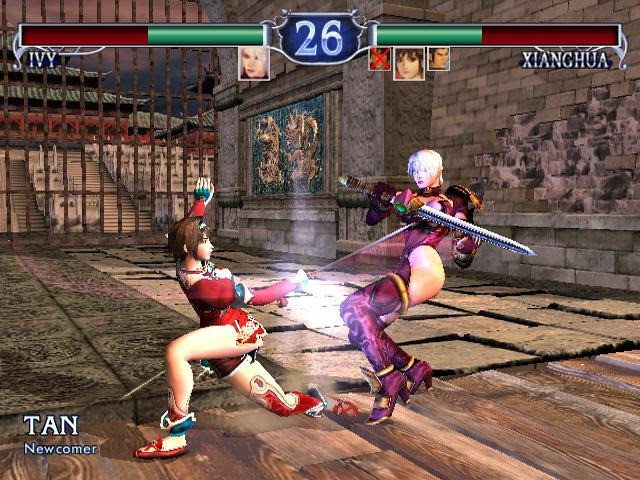
Game Review: Soul Calibur II
Game: Soul Calibur II
Console: Xbox
Developer: Namco
Release Date: 27th August 2003
Appearing on 3 of the 4 sixth generation games consoles, Soul Calibur II had an exclusive character for each version. Spawn (a comic book character) appeared in the Xbox version, Link (Legend of Zelda) appeared in the Gamecube version, and Heihachi Mishima (from Tekken) appeared in the PS2 version. Featuring a total of 23 characters, there's a good amount of choice and variation between characters. As a fighting game, Soul Calibur II is a little different from other titles, with more focus on weapon combat and blocks than physical attacks.
There are two main modes, as well as a large amount of supplementary modes which are unlockable through Weapon Master Mode. In this mode, you take control of a character of your choice and journey through different lands in order to get the Soul Edge, a legendary sword. With 10 chapters, 4 subchapters, and 2 extra chapters, this mode is pretty long (each chapter contains 4-6 stages where you must fight). Arcade Mode is as you might expect, the regular mode in a tournament fighting game, working your way through 8 opponents toward an ending.
The gameplay is smooth and balanced, with 8 way movement in three dimensions, a nice block and counter system. The main attack options are vertical strikes, horizontal strikes and kicks all of which have different ranges and are useful in different situations and you're also able to throw with a combination of two buttons. The player is able to block using the a button, but to get into a favourable position after an enemy attack it's best to use guard impact, which is pressing A and the d-pad towards the enemy at the correct time to counter the enemy and throw them off balance.
This simple, but effective set of controls serves to give the game movesets which can be used by both beginners and seasoned players to be competitive. Alongside the basic controls, there are combos and special moves which can be learned as a player advances with a certain character but the most effective weapon in the game tends to be timing.
I mentioned Weapon Master Mode in a little detail earlier in the review, but I think it's only fair to explain it a little more. You begin chapter one in Regulus at a training centre and after learning the basic moves, progress to the first couple of fights which are easy to clear. As the chapters wear on, there are different objectives for some fights, such as invisible enemies, timed fights and having to use guard impact to damage opponents. This mode is very helpful for players who wish to become better at the game, since there's a lot of different tactics which need to be used in order to progress.
Although it can get a little too long after a while, it's an interesting main mode for a fighting game as there's a lot of variation and even more story than games like Tekken or Rival Schools. The only real downside is that I felt less inclined to complete arcade mode with each character after playing Weapon Master Mode. Most, if not all of the unlockable characters, weapons and stages are accessed via this mode also.
The other modes are reminiscent of Tekken, with Team Battle, Time Attack and Survival modes available, both with the characters default weapons, and ones earned in Weapon Master Mode. Additionally there's Gallery and Theatre modes where players can look through artwork for the game and watch cutscenes that have been unlocked.
The character designs overall are fairly varied, although at times it can be difficult to differentiate between moody sword wielding fighters. The stages in the game can also get a little samey, with dungeon stages in Weapon Master Mode being basically the same all the way though. There's also a lot of stages that fighters can fall from, resulting in a win for the other player. This makes for a nice balance in a way, but can also get easily abused in game.
Graphically, the game looks great on Xbox with a large amount of detail put into both the characters and their clothes, as well as the environments and areas where the fighting takes place. With the ability to play in HD (720p), its the best looking version from the 6th generation. Musically the game can be a little bland and disappointing in places, with a lot of the soundtrack hardly even registering whilst the game is being played.
Overall Soul Calibur has all the elements of a good fighting game; Simple controls which can be used to a skilled players advantage, an impressive guarding system, challenging gameplay with lots of modes, characters and stages to choose from. Weapon Master mode makes a nice addition also with extra playability and features to unlock for the player that make the game more appealing than some of its counterparts. While it does suffer from some repetitivity in stages and concept later on in Weapons Master mode, the gameplay and general concept of weapon based fighting is impressively pulled off.
I'd reccomend this as a place to start, even if you don't enjoy fighting games because its easy to pick up and play, has a lot of replay value and there's a lot more to it than "just tournament fighting". I'm hoping that soon I'll pick up both of the other versions of this game for Gamecube and PS2, as well as the original for Dreamcast.
Rating: 87/100
Grade: B
Subscribe to:
Posts (Atom)