Showing posts with label N64. Show all posts

Thursday, 23 February 2017

Game Review: Mario Tennis


Game: Mario Tennis
Console: Nintendo 64
Developer: Nintendo
Release Date: 28th August 2000

Released in the middle of the N64's lifespan, Mario Tennis was the first proper tennis game to feature Mario and friends, since I'm not counting Mario's Tennis on the Virtual Boy or the original Tennis for NES, which featured Mario as referee. Also of note is the fact that Waluigi debuted in this game, as a partner for Wario in doubles games. Alongside Mario Golf which was released a year previous, it paved the way for further Mario sports games on the Gamecube and later consoles.

The gameplay is solid for a tennis game; mostly intuitive and easy to grasp. The characters seem a little big on the court compared to most tennis games featuring real players. Running around the court can feel a little slidey in a similar way to Mario's momentum in Super Mario 64, and learning the distance at which players lock on to hit the ball can take a while also. As with most Mario sports games, each character has slightly different stats and this affects gameplay also.


Players can choose to compete in tournaments of rising difficulty, ring challenges where the goal is to pass the ball through rings, a special match with Bowser, with items and a tilting court, or a Piranha Challenge where balls are spewed towards the baseline, and players hit back as many as they can, out of 50. This is a great variety of tennis based matches and challenges, and with doubles also featuring in the game there's a ton of stuff to complete and work through. 

While there's a good selection of characters unlocked at the start of the game, there's a couple that can be unlocked through completing cups and connecting a Gameboy version of the game to the N64 with a transfer pak. There are also unlockable courts and cups to provide the game with even more content than it initially seemed to have. As with many Nintendo titles, the replayability is very high.


Graphically the game isn't perfect by any means, but there are some nice touches which improve the game. The ball boys are either Bob-ombs or Koopas and will react in certain ways if the ball comes their way. Mario is usually the umpire unless he's playing in the match, and Lakitu sometimes does humourous things as camera operator. Musically the game is acceptable but there's nothing particularly special like you'd see in main series Mario titles.

Overall Mario Tennis is a solid tennis game with tons of modes and things to do. There's lots of characters and it's generally very good fun despite not having ultra tight controls as we'd see in today's realistic tennis games, or whacky super powered shots as with Mario Strikers.

Rating: 72/100
Grade: C

Thursday, 16 February 2017

Game Review: Top Gear Rally


Game: Top Gear Rally
Console: Nintendo 64
Developer: Boss Game Studios
Release Date: 1997

Top Gear Rally is a simple but enjoyable rally game for the Nintendo 64. There are two main game modes, Arcade and Championship as well as Time Trial and Practice modes. In Arcade mode players compete against a single AI opponent through checkpoints for three laps on any unlocked circuit. In Championship mode players race through seasons and attempt to gain a set amount of points overall to progress and unlock new cars and circuits.

There are three types of handling in game; A, B and C. A is the loosest handling, with which the player's car will turn and slide very easily. Handling type C is the tightest handling, requiring more input to turn and hardly ever breaking into a slide. Personally type B seems to be the best since its inbetween these two extremes and as such allows players to slide when needed, but avoid doing so unnecessarily and potentially spinning the car around or into barriers. There seems to be no way of reversing, meaning that one mistake can spell the end of a race.


The selection of cars is limited by a lack of licensing; all cars are given a two letter moniker. Their stats vary but there's little else to go on in terms of choosing a car, and there are real differences in handling. Edited car decals can be made and saved, but the default ones are bearable too. There could definitely be more variety in the types of cars featured; nearly all of them look like the same type of box-shaped racer.

The circuits are interesting and fairly varied; a coast and jungle circuit are unlocked initially and both of these offer different racing experiences. The jungle circuit reminded me a little of Sega Rally Championship 2 with its wide turns and open plains. The only downside here is that the courses aren't in a point-to-point format, as with many later rally titles. Arcade mode also features another racing pet peeve of mine which is competitive checkpoint racing; it's not enough that you're beating the AI; you have to race against time as well. Checkpoints could have been perfect for the time trail mode instead.


Graphically the game holds up pretty well for the era, but is obviously dated with a view to modern graphics. There's a lot of fog covering up a lack of horizon detail and draw distance, but the tracks themselves disguise these issues well. The soundtrack to the game features looped music which is a little short at times, but it's to be expected from cartridge based games, when compared to disc based PS1 titles of the time.

Overall Top Gear Rally scores big in the important sector of actual gameplay; Championship Mode is fun and competitive, and features a variety of circuits to race. Arcade mode can be difficult with its added time limits, but once a few faster cars have been unlocked it doesn't pose as much of a problem. It'd be nice to have seen a little more progression in the game, with only car and circuit unlocks driving players to complete Championship Mode, but it's worth a few hours to enjoy.

Rating: 66/100
Grade: C

Wednesday, 28 October 2015

N64 Racing Double Header: Re-Volt vs Wave Race 64


Game: Re-Volt
Console: Nintendo 64
Developer: Acclaim Studios London
Release Date: 31st July 1999

While Micro Machines pioneered the genre of tiny cars racing around huge everyday household environments, there were more than a few challengers and imitators in that field also. Re-Volt seems to me to be somewhere inbetween the two labels, with enough differences to have merely been influenced by earlier games and with enough similarities to land it in the same pile as other R/C racers and toy car games.

In the Bronze Grand Prix players race around the streets of a neighbourhood, a supermarket, a museum and a botanical centre. While there's not much detail in any of the environments it's pretty obvious as to where the races are meant to be taking place, and really the slightly confusing directional nature of some of the tracks is far more of a concern. This is compounded by the fact that there are 2 or 3 different variants of each track featured in the game, and each of them feature many crossroads at which players must remember which is the right direction (though there are arrows to direct players, there's enough going on elsewhere on screen to make them easy to miss).


There's a fairly big selection of cars to choose from which increases as players beat each grand prix, but the variety between cars is limited as most simply look like remote control vehicles, with slightly different handling and acceleration stats. This being said, the handling of all vehicles feels pretty much the same; they stick to the floor and turn in the way you'd expect a remote control car to. The racing action can be hard fought at times, but as players get better at the game, there is a tendency to leave the AI cars behind.

Also included in the game alongside the Grand Prix mode is a track editor, as well as some other racing modes that are fairly similar to Grand Prix. There's a good amount of variety and things that can be done with the track editor, and it's fairly easy to use. The only downside is that a memory pak is required to save any tracks that are created, and any progress in the game as a whole.


Graphically the game isn't the best; this is evident both before and after comparison with the Dreamcast version of the game. As a late N64 game, I'd have expected better from it, but many issues including fuzzy textures and a poor draw distance tend to hinder the enjoyability somewhat. Soundwise, there's electronic music playing behind the racing, but nothing that really stands out or contributes to the overall experience of the game.

As a game, Re-Volt on the Nintendo 64 has the bare bones of a fun title; the racing can be competitive at times, and the tracks have interesting real world inspirations, but there's always a sense that it could be better. I'd like to check out the Dreamcast version at some point, because it seems as if it holds more promise, but for now I'd steer clear of this average title.

Rating: 61/100
Grade: D


Game: Wave Race 64
Console: Nintendo 64
Developer: Nintendo
Release Date: 1st November 1996

Unlike most conventional racing games, Wave Race 64 takes place on water and sees players riding jetskis around preset courses, on the correct side of buoys against 3 other AI competitors to score points and eventually win the championship. There are 4 difficulty modes, Normal, Difficult, Expert and Reverse, Normal mode has 6 races, with one added for each difficulty up to Expert which has 8, as does reverse, though all courses are backwards.

One of the most annoying aspects of the game is that whilst there's a choice of 4 jetski riders to choose from, one of them is undoubtedly better than any of the others, and must be tuned to his optimum setting via fiddling with the tightness of his grip. There's honestly no reason to use any of the other riders, unless you're playing in stunt mode where there's another clear favourite from the four.


Racing action is fun, and arcade like; players are allowed 5 mistakes before they're disqualified for going the wrong side of buoys. The power meter builds up for each buoy players go the correct side of, and other than this it's all out racing action. There's a danger of falling off the jet ski, with too harsh of a collision with anything but for the most part, hitting objects and scenery is avoidable.

There's a good variety of tracks, and with each increase in difficulty level, slight changes are made to each track layout, to keep things fresh and interesting. The stunt mode offered by the game isn't as good; players ride their jetski through hoops in order to earn points, and can do various stunts with combinations of buttons. Unfortunately there's not very many stunts available to do, and overall the whole experience feels like an add on, rather than a fun and alternative mode to try.


Graphically the game looks great for the time of its release, and there's some nicely rendered scenery and water effects. With the fast pace of the game, and the high intensity of the racing action, the visuals hold up well. Musically the game's funky 90s soundtrack adds to the experience and fun loving extreme sports vibe, fitting the action well.

Overall Wave Race 64 is a fun and refreshingly different racing game that despite its flaws manages to embody the era of gaming that it came from, both in visuals and audio. Multiplayer is obviously another advantage, with the ability to fight it out with up to 3 other friends for the title of jet skiing champion.

Rating: 75/100
Grade: B

Monday, 23 March 2015

Game Review: Ocarina Of Time


Game: The Legend Of Zelda: Ocarina Of Time
Console: Nintendo 64
Developer: Nintendo
Release Date: 23rd November 1998

As one of the most highly rated videogames of all time, The Legend of Zelda: Ocarina of Time was high on my list of games to review, and after almost 2 years of procrastinating I'm finally ready to do so. I'll start with a disclaimer; I played the game on the 3DS and have previously completed it on the Gamecube. Personally I don't think that the changes between any of these versions affect the gameplay significantly and so all versions will receive the same score, though I will discuss the differences between the original game and 3DS version briefly.

For those that haven't played Ocarina of Time, the game follows Link, the Hero of Time as he attempts to save Hyrule from the clutches of Ganondorf. As a child, Link journeys through The Great Deku Tree, Dodongo's Cavern, and the Inside of Jabu-Jabu's Belly to obtain three spiritual stones which will open the Sacred Realm, allowing him access to the Master Sword. After being sealed for 7 years in the Sacred Realm, Link emerges as an adult to find the world overtaken by Ganondorf. To put things right, he must obtain 5 medallions from various temple sages before facing Ganondorf, and finally Ganon himself, in order to seal the evil in the Sacred Realm and save Hyrule.


The story of the game as a whole seems to be its weakest point as despite some strong supporting characters and locations, Link has no lines of dialogue and very little characterisation leaving him as somewhat of a blank slate. Personally I found that my main motivation for progressing was in order to beat the game, rather than wanting to save Princess Zelda or put Hyrule back to rights, as I simply wasn't invested enough from Link's point of view.

This being said, the gameplay is fantastic in most if not all elements with incredibly inventive and varied puzzles and challenges through the 9 dungeons and 3 mini-dungeons. Weapons and items are acquired in such a way that players can familiarise themselves with their use, and most equippable items are needed specifically at one point or another in game. A few of the puzzles featured can be a little obtuse, but there were fairly few occasions where I had to consult a walkthrough in order to progress. Enemies featured throughout the game are varied in appearance and the strategies required to beat them, but there's not so many that players won't become familiar with most, if not all types.


Each of the dungeons featured in the game has its own ambiance and atmosphere, with music, visuals and puzzles combining to support the overall mood. While some dungeons seem to be a little longer than others, none felt too long or too short overall, and the level of difficulty rises slowly but surely throughout the game. Despite the variation in puzzles, items and concepts throughout dungeons, there's a nice predictability to finding the map, compass and boss key for each.

Talking of the bosses, this is another area with excellent variation as each is usually defeated using a weapon or item found inside of their temple, and requires a different strategy to defeat. Thanks to the overall mix of dungeons and bosses, no single dungeon or boss fight was a favourite of mine; rather they all came together to form a part of Link's experience and journey towards saving Hyrule.


Graphically the game can seem a little dated every now and then on the N64, but on the whole it holds up pretty well with interesting and engaging character models, locations, and items. In the case of the 3DS version, it's nice to have the improved graphics and option of 3D, and this definitely helps the game to feel less dated however it's not crucial to the experience and doesn't improve the game by a whole lot, unless you're super graphics concious.

Musically the game excels, sporting many memorable themes and songs thanks in part to having to learn many of them on the ocarina and their various uses in game. I can't think of a single theme I didn't enjoy in the entire game, and many of the locations and experienced were vastly enhanced by the musical score.


As mentioned before there's not a huge amount of differences between the original game and the 3DS re-release save for visuals, and they are essentially the same game and experience. A few things stood out to me however; Annoyingly Navi has been programmed to remind players to take a break every now and then, Sheikah Stones lend a little less difficulty to the game by providing hints and fairies to players, and Link seems to be a little more animated than in the original, looking around and observing enemies/locations.

Overall Ocarina of Time is a brilliant game, and certainly a benchmark for fantasy adventure games as a whole. Featuring brilliantly varied dungeons with well programmed enemies and bosses, a challenging but fair difficulty curve, and a concise but well paced progression, there's not much which could be improved without changing key features of the game. While the story could be slightly more engaging, additional cutscenes and history may well take away from the pacing and tone of the adventure.

Many gamers regard Ocarina of Time as the greatest game ever made; if it isn't, then it's gotta be pretty close.

Rating: 98/100
Grade: A

Friday, 16 January 2015

Fighters Month: Fighters Destiny


Game: Fighters Destiny
Console: Nintendo 64
Developer: Opus
Release Date: 31st January 1998

Fighters Destiny was released almost 17 years ago to the day and although we've advanced in terms of technology, there's still some fun and innovative elements to the game. In the main mode, players fight through 10 stages, earning enough stars in each battle to progress to the next. Stars are earned by knocking the opponent out of the ring (1), throwing the opponent (2), knocking them down completely (3), performing a special move (4) and winning a judges decision after a fixed amount of time (1).

The default values of stars given for each of these are given in brackets, but can also be changed in the options menu, as well as the number of stars needed to win a bout (which is set at 7 initially). This system of awarding stars means that battles aren't limited to 2 rounds as in normal fighting games, but can swing back and forth between opponents as points are gained. Both fighters health bars are reset after each point scored.


One disadvantage of the points system however, is that most of the time winning matches becomes a formula which can be used for all 10 rounds, stopping players from experimenting and trying new strategies. Personally I attempted to get 2 knockdowns and a throw or ringout in each battle, to earn 7 stars. The computer seems to mostly attempt knockdowns to earn its stars, with very few instances of throws or special moves in Easy or Normal difficulty modes. The overall difficulty of the game seems to be pretty low, until the final round of the main mode which is set at a challenging, but not impossible level.

Other modes offered by the game include Survival mode, featuring 1 star battles against 100 opponents, Fastest mode, where opponents must be defeated in under a minute, Rodeo mode where players fight an opponent in a cow suit in an attempt to knock him out of the room, and Master mode where players acquire new skills and attempt to keep hold of them in battles against 'Joker', a particularly difficult opponent.


Graphically the game is blocky with fairly undetailed backgrounds and textures, but somehow it manages to average out to a bearable visual experience. The character animations and fighting aren't bad for the era, and there's a choice of outfits for each fighter to choose from. The voice of the narrator can become somewhat annoying as he announces each point scored and various other things, but the audio in general isn't too bad.

Overall Fighters Destiny attempted a different spin on fighting games, with 2D style fighting on 3D platforms in the middle of nowhere, a points scoring system with plenty of options on how to score, and plenty of supplementary modes. The N64 controller lets it down a little, with just 2 attack buttons, and none of the game modes are particularly deep in terms of progression or story. For me its a nice little oddity that plays fairly well, but has no real lasting value in terms of interest.

Rating: 65/100
Grade: C

Sunday, 23 February 2014

Series Review: Mario Kart

To take me past 250 games reviewed in total, I thought I'd play an incredibly popular series that has both classic and modern instalments and is still going to this day. With a game from the series on nearly every Nintendo console since 1993 and almost 100 million sales in total, the Super Mario Kart series stands 16th on a list of all time best selling franchises.


Game: Super Mario Kart
Console: Super Nintendo Entertainment System
Developer: Nintendo
Release Date: 21st January 1993

The earliest independently successful spin-off from the Mario platforming series and pioneer of the Kart Racing game genre, Super Mario Kart took Mario, his friends, and some enemies and allowed them to vent their frustrations through vehicular mayhem. The game features 8 different characters, racing on 20 unique tracks which are based off Super Mario World locations, with 9 items used to gain some sort of advantage over other players.

The player can choose to race in GP mode which consists of five laps, on five different circuits with points awarded for finishing in the top 4 positions. If players finish below this, they must retry the race until they attain at least 4th place and have a limited number of lives to do so. With 3 difficulty levels (50, 100 and 150cc), and 4 cups per difficulty level, there's a good amount of replayability for such a seemingly basic racing game.


When racing in one player mode, the screen is split into two halves; the top showing the racer's viewpoint of the circuit and the bottom showing more of an overview. In two player modes, the bottom screen is replaced by the view of the second player. The coins that a player has collected are shown in the bottom right and these make the kart go faster, up to a total of 10. The player's remaining lives and current position are shown alongside the number of coins.

The driving itself feels looser than in later Mario games; it's definitely a good idea to take your foot off the gas pedal if you're cornering (unless you plan to drift around corners). Overall it fits well with the age of the game and feels a lot easier to control than F-Zero on SNES, perhaps due to reduced speed. Players are able to jump over obstacles with the L and R buttons, as well as using them to initiate a drift.


There's a choice of two player modes; players can choose to race each other in both time trial and cup modes as well as battling to pop balloons in specially designed levels. The tracks featured in the game are imaginative and do a good job of evoking the feel of Super Mario World. Toward the end of the game there are some devilishly difficult tracks, including the first incarnation of the infamous Rainbow Road.

The items are what give competitive racing the edge over most racing games of the time; using green and red shells to slow your opponents down is incredibly satisfying and although the item selection is only small in this game, the core ideas are present. A lot of the features we see in Mario Kart games of the present day originated in this game.


Graphically the game is fairly impressive for the time, using Mode 7 graphics to emulate a 3D feel with only 2D components. The problem with this, however is that in some levels (particularly ice and lava levels) it's difficult to recognise items on the floor, as they appear flat. There's nothing more infuriating that being in the lead and crashing into a surface that doesn't appear to be in your way. The music of the game is generally enjoyable although not particularly notable.

Overall Super Mario Kart was a great start to the spin-off series, featuring enjoyable gameplay and ideas combining with good use of the technology of the time to produce a fast, fun and competitive experience. 100cc and 150cc difficulties can be fairly hard to win races on, and laps on most tracks are incredibly short, but other than these minor points, there's some good racing to be had.

Rating: 75/100
Grade: B


Game: Mario Kart 64
Console: Nintendo 64
Developer: Nintendo
Release Date: 24th June 1997

Four years after the first game in the series, Mario Kart 64 provided an updated look and feel for the games which is much closer to what we're used to from modern instalments. With fully 3D tracks came the ability to have changes in elevation, proper jumps and more complex obstacles such as walls and pits, even though the pre-rendered character sprites and items were still only in 2D. The game still featured 8 racers, replacing Koopa Troopa and Donkey Kong Jr. with Wario and Donkey Kong.

Making a change from Grand Prix races being 5 laps of a very short track, players now complete 3 laps of slightly longer tracks (although in some cases, the tracks are incredibly long). There are also 4 tracks per Grand Prix instead of 5. The 50, 100 and 150cc difficulty levels are retained, with an added Extra difficulty mode which allows players to race on mirrored tracks. Up to 4 players can compete in multiplayer modes, up from Super Mario Kart's 2 and Battle mode re-appears with many of the same ideas.


Driving definitely feels a little different from Super Mario Kart with more of a sliding dynamic to cornering and less places where it's necessary to take your finger off the A button. While this style of control is less precise, it works well with the analog stick of the Nintendo 64 and the 3D graphics of this instalment. The players view whilst playing the game in one player modes is slightly changed, as the map no longer takes up a whole half of the screen.

Grand Prix Mode is fairly easy on 50cc difficulty, 100cc can be challenging on the harder tracks and 150cc cranks the rubberband AI up to a level which is very hard to beat. On all levels of difficulty, the AI's programming means that they'll catch up with your kart quickly, even from shell and banana attacks. Another factor that increases the difficulty is the way that the character who is first (or second if you're first) in the ranking table after Race 1 of each Grand Prix will be your toughest competitor in the next rounds, securing victory in the Grand Prix overall for the AI unless you win at least 3 races and place well in the other race.


Most of the items from Super Mario Kart make a return in 64, with only the coins and feather taken away, and the Boo item re-purposed to steal an item from another player rather than turning the player invisible. New items that appear in Mario Kart 64 include the blue shell, which travels along the floor to halt the progress of the player in pole position (although not as devastatingly as in later installments), fake item boxes and multiples of pre-existing items such as bananas, green shells, red shells and mushrooms.

Battle mode is fun and arguably better than in the original, with the use of the new items and 4 player capabilities. There's 4 courses to battle on, as well as the ability to race without any AI players against other human players on any track from the main game. This is the first point in the series where the games feel geared towards the multiplayer experience as one player mode is plagued by the rubberbanding AI and hugely varied difficulty levels.


Graphically the game's tracks are impressive for the most part, and even the 2D character and item sprites are bearable. It's an improvement on the Super Mario Kart's ground based obstacles which were hard to see and thus avoid. The game also is better musically with some memorable themes which are remixed for stages in later games; particularly the theme for Rainbow Road.

Overall Mario Kart 64 is an enjoyable racer, just like its predecessor; there's good competitive action most of the time, and excellent multiplayer modes. Although there's less laps in this installment, some races last far too long, especially on Wario's Stadium and Rainbow Road, with the latter's 3 laps lasting around 8 and a half minutes. The difficulty is also a bit off with 50cc mode being far too easy, and 100cc mode a bit too challenging when the rubberband AI is factored in. It's a small improvement on the SNES version in my opinion.

Rating: 76/100
Grade: B


Game: Mario Kart Super Circuit
Console: Nintendo Game Boy Advance
Developer: Nintendo
Release Date: 14th September 2001

The first handheld instalment of the Mario Kart series, Super Circuit plays like an updated version of Super Mario Kart featuring the same sort of 2D graphics for the tracks, with features of the game more akin to Mario Kart 64. With 20 new tracks as well as all 20 original tracks from Super Mario Kart as unlockables, it has the most playable tracks of any Mario Kart game. The same 8 racers return from the previous instalment and no new characters have been added.

The tracks, sprites and items are all in 2D, although there are some nice scenery and background effects which give the game an edge over the original. The items featured in the game are the same as those in Mario Kart 64, with the Golden Mushroom removed. Single player mode features Mario GP, Time Trial and Quick Play modes, and 2 Player is achieved through a Link cable. Surprisingly, Super Circuit can be played with others who don't own the game, and is one of only a few Game Boy Advance games to make use of this, although it's a stripped down version due to memory limitations.


Driving in this game feels like a mixture of both preceding games; the controls are fairly tight and it's less drifty than Mario Kart 64, but the circuits have a little more influence from the later game. It handles well on the whole and the difficulty issue with previous games has been fixed. 50, 100 and 150cc races are all potentially winnable, but with each rise in difficulty there's a steady rise in challenge also.

The tracks themselves could be a little more original; some of the new ones are based on courses from Mario Kart 64, and the game features all of the courses from Super Mario Kart. That said, it's still a lot of fun and  later games have indulged in classic cup features also. The game retains the 4th or better to continue dynamic in GP races, for the last time in the series, as well as the 9, 6, 3, 1 point scoring structure.


Graphically the game doesn't look great when inspected up close, but on the Game Boy Advance's small screen, there's not a whole lot wrong with it; in fact it can look pretty nice at times. There's a marked musical improvement also with funky basslines and some enjoyable music to race to. The voice clips are very similar if not identical to those used in Mario Kart 64, but with the same roster it's to be expected.

Overall Mario Kart Super Circuit is a great mix of features from Super Mario Kart and Mario Kart 64 which offers a whole host of new gameplay as well as all of the tracks from the original game. While I couldn't play the 2 player modes due to lack of a link cable I'm sure there's a lot to offer, and the ability to play others who don't own the cartridge themself is a bonus.

Rating: 79/100
Grade: B


Game: Mario Kart: Double Dash
Console: Nintendo Gamecube
Developer: Nintendo
Release Date: 13th November 2003

Double Dash, the first truly 3D instalment of the Mario Kart also changed up the formula and gameplay significantly. In this game two racers are in each kart; one to drive and the other to use items, the points system has been revised to reward the first 7 finishers rather than just the first 4, and players no longer need to retry races if they finish below 4th. There's a choice of 20 characters to play as, and a larger and more dynamic choice of karts, representing racer's individual styles and colours.

As with previous instalments of the series, the main GP mode features 50, 100 and 150cc difficulties as well as a mirror mode once all championships have been won. Players can choose to race as a team or competitively with up to 4 players (or even 8 with a LAN cable for Gamecube). Multiplayer Battle mode also returns with new courses and modes. Although all of the normal items which feature in the game were in Mario Kart 64, there are new special items which are individual to specific characters and are a good addition.


The controls for racing and using items are fairly similar to those in previous instalments, although they can now be separated out when playing co-operatively. There's an improved drift mechanic and the ability to shift the kart left or right when playing with a friend on your team. Driving in this game feels pretty tight, and the option to drift around sharp corners is an advantage. The difficulty is similar to other games in the series, with 50cc being incredibly easy, 100cc presenting a small challenge, and 150cc being willing to cheat you out of entire championships with items and AI finishing positions.

There's a real focus on multiplayer in this instalment of the series, even more so than before. I'd certainly recommend the Mario Kart games for parties and hanging out with friends than as a single player experience but if you can deal with AI that's geared towards beating you and using items to stop you from winning at all costs and take racing as a fun arcade experience then there's enjoyment to be had.


Graphically the game is huge improvement on everything before it in the series, with fully 3D tracks and karts which are more detailed than before. Musically too it's impressive and features some enjoyable track themes. Although there aren't too many new features in the game as a whole, the 2 person per kart dynamic works well and expands the two player gameplay.

Overall Double Dash is another slight improvement on past instalments, upgrading parts of the game like graphics and drifting, whilst removing the ability to hold items behind you in a game that's set the AI to target you above all other competitors. It's definitely better as a multiplayer experience but 100cc races in single player are also good fun.

Rating: 80/100
Grade: B


Game: Mario Kart DS
Console: Nintendo DS
Developer: Nintendo
Release Date: 25th November 2005

The 3rd best selling game for the Nintendo DS, Mario Kart DS introduced several features such as a single player mission mode, Retro Grand Prix, a Bullet Bill item and a Wi-Fi connected multiplayer mode. There are 12 playable characters, each with their own themed kart and a personalised version of the simple kart. The other available gameplay modes remain largely the same, with Grand Prix, Time Trial and Battle modes.

Grand Prix mode now contains 8 championships, with the addition of 4 Retro sets featuring remade courses from the previous games in the series. All of these are available at 50, 100 and 150cc difficulties. Completing a set of 4 Grand Prix at any difficulty will unlock different playable characters, karts and mirror mode, depending on which Grand Prix is completed. Players are also able to compete online via Nintendo WFC but I was unable to use this on my DS for some reason.


With the addition of the second screen, players have a slightly different view of the race, with the classic 3rd person rear viewpoint on the top screen and an overhead view displaying simple face sprites to represent players, but also highlighting upcoming items and hazards, and showing what items other players have aquired. It's possible to race whilst looking at either screen, although a combination of the two with more focus on the top tends to work best.

The racing is similar to that of Double Dash with a slight change in that players are able to hold items behind them for protection once again, and the D-pad is used to control the kart as there are no analog sticks on the DS. While the difficulty is also similar, 50cc mode is insultingly easy at times, but the other two difficulties are made harder by items more than the AI. In 100cc races, I was averaging 2-3 blue shells per race whilst leading which seems excessive.


Battle mode has been improved with 6 courses available from the beginning as well as 2 to unlock. There's also the option to play against AI opponents in Balloon Battle and Shine Sprite modes. The new inclusion of Mission Mode adds challenges for players to complete over 7 difficulty levels with a boss at the end of each. This adds some inventive single player gameplay outside of the Grand Prix mode, which the series was in need of.

One thing that the game does seem to be a little obsessed with is grading your performance. In every Grand Prix, you'll receive a grade from 3 stars to F for the time it took you to complete, regardless of your finishing position. In Mission Mode you're also graded on the time you take, irrespective of the fact that you've completed the objective. While there's no need to get the best grades to complete the game, it might annoy completionists that the standards for the best grades are very high.


Graphically Mario Kart DS doesn't look as sharp as Double Dash due to being confined to the small screen of the DS, but it's not far behind. I did manage to mistake a Goomba for a mushroom powerup at one point but that might say more about my eyesight than the graphics. The music of this game is almost exactly what you'd expect from having heard the soundtracks from the rest of the series. It's never mind blowing but it gets the job done.

Overall Mario Kart DS introduces some good ideas such as the new Mission mode and Wi-Fi based multiplayer, but can suffer at times from item induced difficulty with blue shells being far more common than in previous instalments. The inclusion of a retro Grand Prix makes for a good look back on the series, and makes for a large roster of well designed tracks. Also R.O.B the robot is included as the final unlockable, which made me smile.

Rating: 83/100
Grade: B


Game: Mario Kart Wii
Console: Nintendo Wii
Developer: Nintendo
Release Date: 11th April 2008

The final instalment of the series that I'll be reviewing is Mario Kart Wii, which has the largest roster of any Mario Kart game, with 24 characters in total as well as 32 tracks, 3 new items, 6 new battle stages and 5 karts and bikes for each driver weight class. Looking back to the first Mario Kart game, this is a huge expansion of options whilst keeping many of the same gameplay ideas.

The modes remain much the same as on the DS version of the game, with the exception of Mission mode, which has been removed; Grand Prix is the main single player event with 4 Grand Prix on all new tracks and 4 Retro Grand Prix which take stages from all previous instalments. Time Trial, Online races and Battle mode can also be played in single player with AI making up the rest of your team as well as your opponents, or with friends as an alternative to multiplayer Grand Prix and VS Race mode.


The biggest change in racing terms is the inclusion of bikes in the game; 50cc races are competed with only karts allowed, 100cc allows only bikes, and 150cc and Mirror Mode allow both karts and bikes. Players can control their kart with either the Wiimote, used like a steering wheel, Wiimote and nunchuk (using the nunchuk to steer and the Wiimote for accelerating) or a Gamecube controller to make things more similar to Double Dash (although the buttons are slightly different). Using just the Wiimote on its own can be a little imprecise, but the other two control methods both work well to give the player a choice of at least 2 ways to race.

Three new items have been added since Mario Kart DS; the first is a large mushroom, from New Super Mario Bros. which makes the users kart much larger and faster for a short while, the second is a POW! block from Super Mario Bros. 2 which causes all other racers to spin out and lose all speed, and the last new item is a Raincloud which makes the receiver small via a bolt of lightning after a short time, unless they manage to pass it onto another racer.


Another difference from previous versions is that races now consist of 12 competitors instead of 8, which makes for a slightly more chaotic experience. Items seem to dominate the racing more than the previous rubberbanding of the AI, and although the amount of times blue shells are used per race seems to have fallen from Mario Kart DS, there's plenty of use of the POW! blocks and lightning items. All of the difficulties in Grand Prix mode seem to have got a little easier, with 150cc and Mirror Mode being difficult but not impossible to come first on.

Online Mode makes for the most difficult challenge with a busy and alive scene even today, 6 years after the game's release. I was able to find a game with 11 other players within around 10 seconds and there was a mixed standard of ability. Players start with 5000 race points to their name and gain/lose points for doing well/badly in races. Due to Mario Kart's chaotic multiplayer nature, it almost feels as if this is what the series had been heading towards. I rarely won races online but they were all fun and tightly contested.


In addition to the online multiplayer, there's also local multiplayer for up to 4 players, with racing, balloon and coin battle modes. These are mainly team based, but the AI will fill any empty slots. With a good selection of battle courses and all of the circuits featured in the main game to race on, this makes for a rich local multiplayer experience to match the online and single player modes. Any of the battle modes can also be played purely against AI opponents in single player mode also.

Unlockables in Mario Kart Wii are slightly different to other games; some require staff time trial laps to be beaten, whilst others need specific star ratings in all Grand Prix of a certain difficulty. This means that players have to work hard to unlock every character, but does give the game some replay value. Whilst R.O.B the Robot isn't included in this instalment, there's plenty of new additions to the roster to give new choice to players.


Graphically Mario Kart Wii is the nicest looking of the games I've reviewed in the series, with crisp stylised locations, characters and karts in full 3D, with bright and vibrant colours. There's a good sense of speed throughout the game which adds to the feeling of chaos within races. The soundtrack is enjoyable also, with many new tunes as well as remixes for the Retro Grand Prix stages. Voice clips and other sounds are good and help to add a sense of personality to the racers, especially those who haven't been in the series before.

Overall Mario Kart Wii is in my opinion the best game of the series so far as it expands the racing experience to 12 players at a time, has a great online experience and single player offline Grand Prix, and loses the blatant rubberbanding AI of previous instalments to make way for a more balanced approach. While races can get chaotic with the use of many items one after another and the new items being fairly powerful, I think this is the way Mario Kart was intended to be.

Rating: 87/100
Grade: B

As you can see from the fact that I've given every Mario Kart game in this review some kind of B grade, all of the series titles are enjoyable 'pick up and play' racing games with an element of luck as well as skill. Whilst the idea of rewarding those in later positions with better items may not seem appealing to hardcore racing game fans, it's a nice way to even up the stakes when playing with friends or anyone who hasn't played the games before.

As for the difficulty of each title in the series, many people seem to have their own opinions on which is hardest. Having played each of the games in succession, I'd say that this order is about right for difficulty of winning the 150cc Grand Prix races with any ranking;

Mario Kart 64  (most difficult)
Mario Kart: Double Dash
Super Mario Kart
Mario Kart DS
Mario Kart Super Circuit
Mario Kart Wii  (easiest)

With so many games sold across the entire series, it's safe to say that most people have played at least one of the titles. Just like discussion of which is hardest, an intense debate rages over which game is the best, which begs the question; which is your favourite Mario Kart game, and why?

Friday, 7 February 2014

Game Review: Super Mario 64


Game: Super Mario 64
Console: Nintendo 64
Developer: Nintendo
Release Date: 1st March 1997

The first 3D platformer in the Mario series, and one of the earlier 3D platformers in video gaming, Super Mario 64 introduced a lot of new concepts to the series and to gaming as a whole. The most immediately noticeable of the additions, aside from being in 3D is the camera control mechanism. Players can rotate the camera and zoom in and out on Mario using the C buttons and R button respectively. This gives players far more freedom when exploring courses and trying to complete objectives.

Instead of having worlds and levels as featured in previous Mario games, Super Mario 64 has courses which feature objectives, the completion of which earns players a star. There are 6 objectives for each course, as well as a star for collecting 100 coins in any given level. Counting bonus stars that are hidden around the castle there are 120 to collect in total, however only 70 are required to fight the final boss of the game.


At the start of the game Mario receives a letter from Princess Peach informing him that she has baked a cake for his consumption. Upon arriving at the castle however, Princess Peach is missing and Mario is told that he must collect stars to restore power to the castle. All of the true boss fights in the game are against Bowser and as plots go, it's pretty thinly held together in the same way the original Super Mario Bros. was. Perhaps it'd be nicer to have an incentive that's more appealing than cake to spur Mario on through 15 courses.

As more stars are gathered by Mario, more courses as accessible. With 7 stars available on each main course, it's not particularly difficult to amass the required number of stars to beat the game (in fact it's possible to win without even entering 5 of the courses). This isn't to say that the objectives given are easy but there's certainly no shortage of them.


The courses themselves are nicely varied featuring water, snow, lava and more complex concepts such as time passing inside of a clock at differing speeds, enemies and items of differing sizes, and a few others. On each of the 15 main courses there's a lot to explore and gameplay feels far less linear than that of the 2D platformers in the series. To access each course the player must jump into paintings around Princess Peach's castle, some of which will take a little finding.

Objectives are given a title on the pre-course screen which can help the player get an idea of what needs to be done. In some cases it'll be obvious and other objectives will take a little more searching. In the same way, the amount of time and skill needed for each objective can vary greatly; from climbing to the top of a simple mountain to reaching and defeating a mini-boss. An impressive feature of the objectives is that hardly any are recycled from course to course, save for finding the 8 hidden stars.


Mario is controlled via the analog stick only on the N64 controller which gives far more control over his finer movement than a d-pad would be able to. Combined with the camera controls, this gives the player far greater scope to explore the levels and tackle platforming challenges put before them, especially in three dimensions. While the camera control doesn't always work as needed, it's not very often that you'll find yourself in a tricky situation camerawise.

In addition to the analog control, Mario also gains some new moves in this game. Wall jumping, backflips, and long jumping are just a few of the new manoeuvres which not only make good use of the N64 controller but are easy to pull off and compliment the level design to bring new challenges to the player. By the time you're ready to face the final battle, it'll feel as if you're able to see Mario through any parkour based challenge imaginable.


Unlike previous games of the series, Mario can take a decent amount of hits from enemies before losing a life. The power meter drains different amounts depending on the enemy you take damage from, and proving it's not something that can kill you in one hit Mario is able to collect coins to nurse himself back to health. One situation in which this system is a little weak is the water levels, as the power meter doubles as an air meter. Rising to the surface to breathe can cure any damage that Mario has taken, making water levels much easier.

Many enemies from previous games feature in Super Mario 64; Goombas, Shy Guys, Boos and others all make an appearance and work in a similar way to previous installments. There are even friendly Bob-ombs who will prepare canons to help you on your way. Power-ups also return in a way; once certain switches have been pressed Mario is able to get a new cap and turn into a flying, metal or "vanish" version of himself. Certain stars require the player to have unlocked these caps to reach them.


Graphically the game is impressive for the era and feature nicely styled 3D designs of previously 2D parts of the Mario universe. From a modern standpoint some of the textures can look a bit pixellated or blurry at times but overall it's bearable. Musically Super Mario 64 excels with many different course themes and variations on previous themes from the series. The voice acting is also generally good, although its mainly Mario's clips that you'll be hearing.

Overall this is a great example of a 3D platformer, even 17 years after its release. With many courses and secrets to explore and discover, imaginative objectives and level design and a great soundtrack, there's only a few minor issues which can be counted against it. Perhaps a little to easy in places, with occasional camera issues and a sense of a game that's finding its feet in a new world of games it's still well worth a play.

Rating: 87/100
Grade: B

Monday, 7 October 2013

Series Review: F Zero


Game: F Zero
Console: Super Nintendo Entertainment System
Developer: Nintendo
Release Date: 13th August 1991

Racing at speeds of over 700 km/h in futuristic environments, F Zero brings a high speed kick to racing games on SNES. With 20 racers competing on track as well as other traffic, 15 different circuits and 4 difficulty modes, it's an impressive game for the time. Unfortunately there's only 4 different vehicles available to the player, with slightly different stats between them. These are controlled by 4 different characters from the series, the most famous of which is Captain Falcon.

There's 3 different championships to complete, initially with 3 difficulty levels available. Once they're completed in expert mode, master mode for each championship is unlocked, to give more replayability. With Championship and Practice modes being the only two available, there's no 2 player support or any other kind of races featured on the first installment in the series.


The gameplay is fast paced, with sharp turns and fast straights featuring on every track. The controls make it fairly easy to get around most tracks as long as you use the brakes before sharper turns. Hitting other vehicles or the edges of the tracks will send you in a completely random direction about half of the time which can make winning races a little harder. There's also a power meter which is depleted when your vehicle hits the barriers, or other obstacles. Instant race losses are featured too, in some of the harder difficulty levels it's possible to fall short of jumps and get a game over.

Graphically the game is vibrant and bright, and pretty good for the early 16 bit era. There's no a great amount of detail on the other cars or backgrounds to the tracks, but with the speed of the game as it is, that's almost to be expected. Musically the game is good, featuring a host of catchy background music for each track and good sound effects.


Overall the game was a good start to the series with some classic tracks and music. The lack of two player mode and limited amount of championships did affect the replay value of the game somewhat, and makes me wonder what it could have been with a few tweaks. Other than this though the only real bad point is the loss of control when hit by rival cars. Sometimes it's unavoidable and gets frustrating when it costs you a race that you were winning.

Rating: 75/100
Grade: B


Game: F Zero X
Console: Nintendo 64
Developer: Nintendo
Release Date: 6th November 1998

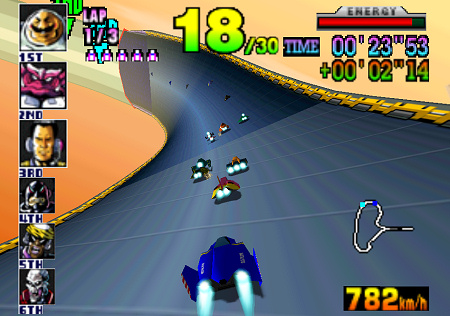
7 years after the first game in the series came F-Zero X, a 3D installment of the racing series with higher speeds, 30 vehicles on track at one time, 30 preset tracks as well as a mode which generates random tracks, a two player mode and more. With an almost comic-based style for the menu and character select screen, and a rock based soundtrack it's quite an update stylistically as well as in terms of gameplay.

The main mode is still Grand Prix mode, with 4 difficulty settings, 6 races in each grand prix and 4 preset race series as well as "X" mode which randomises the track for each race. There's steep learning curve in this mode, and you'll need to beat the grand prix on all of the different difficulties to unlock all of the vehicles and content in the game. Just like the first game you're given an Energy meter which reduces with damage, but this time boosting also depletes the meter.


With thirty different racers on track at any one time, the races in grand prix mode can get a little crowded at times, but overall it adds to the fun. Every racer earns points for their finishing position in the race, up to 100pts for first place and these are kept track of throughout Grand Prix mode. This is an improvement from the first game which only had target finishing positions in order to complete a Grand Prix. In later difficulty levels the AI can appear to be incredibly hard to beat, making it more difficult to finish 1st.

Other modes in the game include a much needed two player mode, time trial and practice modes, and a death race mode, which sees the player attempt to take out the other 29 racers. Unfortunately this isn't as fun as it sounds because taking out that amount of other vehicles is pretty monotonous, not to mention that it's difficult to not accidentally fall off the track in the time it'll take you to complete even one round of this mode.


Graphically the game isn't particularly detailed; both the tracks and vehicles are lacking anything besides their polygonal shapes. This doesn't detract from the gameplay, but with 30 vehicles to choose from, it can make them seem pretty samey. Other than that it's nice to see the franchise move into 3D, as the racing feels even faster. The soundtrack for the game features some rock versions of songs from the original as well as some new rockier songs; overall it's good in places and a little weird at other points.

As a sequel F Zero X is pretty impressive, featuring not only a much wider range of choice in vehicles, tracks, modes and characters but also taking elements from the first game and improving them. Graphical improvments and a slightly less steep learning curve are the only things I can think of to make this game better, otherwise its a true N64 classic.

Rating: 84/100
Grade: B


Game: F Zero: Maximum Velocity
Console: Nintendo Gameboy Advance
Developer: Nintendo
Release Date: 22nd June 2001

The first of three portable F Zero games on the Gameboy Advance, Maximum Velocity features gameplay more akin to that of the SNES installment than the N64 sequel with a return to Mode 7 graphical techniques and 2 dimensional vehicles. There are 5 races to each Grand Prix, with 4 classes to choose from, for a total of 20 tracks featured. 4 vehicles are unlocked from the start, with a further 4 unlockable by winning races, although this is the only game not to feature Captain Falcon.

With the return to the SNES style of gameplay comes the problem of losing control when hitting anything with your vehicle. Also as your energy meter depletes, you slow down considerably when compared to other games in the series, further hampering your chances of finishing the race in the required position. This added to the fact you have to press the L and R buttons to boost, which can be difficult whilst trying to steer makes for less enjoyable gameplay than in previous installments.


Graphically the game looks arguably worse than the SNES version, although I'd say its about even. The racers themselves have better a better 3D effect than in the first game, but the scenery around the tracks is pixellated and undetailed. Musically, Maximum Velocity isn't as good as the other games in the series, but it's bearable; there's some decent tracks in amongst the generally forgettable majority of the soundtrack.

Overall this feels like a scaled down version of the SNES title, 10 years after its release. The tracks are less enjoyable, the music and feel less classic, and there's hardly any improvements from it. Multiplayer is possible, however you need another GBA and copy of the game to link up and play. As with a lot of handheld installments of home console games, F Zero Maximum Velocity disappoints somewhat.

Rating: 61/100
Grade: D

At this point, I was going to do a review of F Zero GX, the Gamecube installment to the series, however as the disk won't read, that's it for now!