Showing posts with label Nintendo. Show all posts
Wednesday, 26 December 2018
Game Review: Animal Crossing: New Leaf
Game: Animal Crossing: New Leaf
Console: Nintendo 3DS
Developer: Nintendo
Release Date: 8th November 2012
Games from the Animal Crossing series are particularly hard to review against other video games. For a start players are encouraged to play in small amounts each day rather than the marathon sessions I'd spend on Yakuza games. Also the pace of the game is such that without a few months of gameplay, it's hard to experience enough events, progression and differences from previous instalments to give a fair score. I've been playing since June this year, logging over 70 hours pretty easily, almost as much as my favourite Gameboy Colour RPG; Harry Potter and the Philosopher's Stone.
In New Leaf, players assume the title of mayor, allowing them to change more about their town than ever before, in addition to new features and customisation options. One of the best new features is the town ordinance system, allowing players to choose one bonus from a list of four, to accommodate for late risers, early risers, those seeking cash or those trying to keep their town green. This is helpful since I used to play the game on my way to work, and the earlybird ordinance allowed me to interact with villagers earlier and sell off unwanted goods instead of waiting until I'd finished work to reboot the game.
Another fairly unique trait of Animal Crossing that I've observed over the years is player loyalty towards villagers; if you've had a certain villager in your town before, you'll want your favourites back again. Animal Crossing: New Leaf has lots of new villagers to choose from including a big selection of mice and rodents in addition to loads of the classic cast. It's also easier than ever to try and lure your favourites into town with the campsite providing a rotating list of villagers camping in your town whom you can invite to move in whenever you'd like. In this way I'm hoping to get Lily the frog before too long!
House expansions and paying off your mortgage are still the crux of the game, with more expansions and house decoration styles available than ever. It's possible to make a truly unique and themed house with the items available both in the game and designed by other players via QR codes. Paying off your mortgage must also be balanced with mayoral duties and paying for new things to be built in town, especially on the main street where there's tons of shops that'll start to appear if you play the game often.
Graphically the game is better than ever, still in its cartoon style but with the possibility to experience the world in autostereoscopic 3D. The music of Animal Crossing has always been a strong selling points, and with a new tune for every hour of play, special seasonal tunes, and all of K.K. Slider's songs this game is no exception. The relaxing music sets the scene for spending an hour or two just talking to your villagers or improving your town, providing some much needed stress relief as you play.
Overall you get as much out of Animal Crossing games as you put in, but with more things to do than ever, New Leaf is the best version out there currently. The Nintendo Switch is due to get an instalment of the series soon though, so it's possible this won't be true for long. Whatever happens though, players are able to choose a version of the game, and have their own unique experience, build bonds with their villagers and invest their travel time, quiet moments or whenever they play into something that gives back to them.
Rating: 88/100
Grade: A
Monday, 4 January 2016
12 Days of NESmas: Balloon Fight, Mario Bros., Donkey Kong Jr. and Pac-man (#11)
Game: Balloon Fight
Console: Nintendo Entertainment System
Developer: Nintendo
Release Date: 1984
Balloon Fight is a classic NES title which is almost instantly recognisable, and is incredibly easy to pick up thanks to its concept. In the main game, players face-off against opponents with their own balloons, in an attempt to collide with them from above in order to pop their balloons and eliminate them. Once popped, enemies parachute down to the nearest platform and if they're not intercepted begin to take off once again with another balloon. In this respect, the gameplay is somewhat similar to Joust, but it feels far easier to control.
Balloon Trip mode is also very interesting, presenting a one hit game over journey through obstacles in the same vein as the main game. This mode has been featured as a Warioware microgame and is at least as fun, if not a little more than the main game, even if it gets pretty tricky very quickly. One of the best things about playing Balloon Fight is that each time I lost a life, it felt like it was truly my error, rather than bad game programming or design.
Graphically the game looks nice in both modes, despite its simple character sprites and black background. The music of the game however is almost unbearable in the main mode, between the almost random sounding bleeps and bloops and sound effects there's no semblance of a tune, and it'd be better off without most of the distracting sound. The music for Balloon Trip mode suffers no such issue, and has great music with balloon pop sound effects which are maybe just a little too loud.
Overall Balloon Fight is a solid and enjoyable NES game which deserves much of the praise and recognition it has had over the years. With two equally enjoyable game modes, great controls and classic music in the balloon trip mode it's certainly one of the best games of its type.
Rating: 75/100
Grade: B
Game: Mario Bros.
Console: Nintendo Entertainment System
Developer: Nintendo
Release Date: 1983
Mario Bros. marks one of the earliest appearances of Mario in video games. It's a simple title where he faces off against various enemies and defeats them by bumping the ground underneath them, to flip them upside down before kicking them off screen. Some of the elements in the game influenced parts of Super Mario Bros, the classic platformer released just 2 years later.
The game is very much in an arcade style and presents its levels and bonus levels as such. There's a few different types of enemies which appear throughout the game levels, and can become enraged if not dealt with quickly. Mario also collects coins for defeated enemies; yet another snippet of game which was later turned into a Warioware microgame.
Graphically the game is very much in the style which we recognise today as "Super Mario"-esque, but obviously was yet to be coined and ingrained into the public conciousness at its time of release. The music is generally pretty good, and with the big deal that Mario went on to become, it's not hard to see why Mario Bros. is considered a classic NES game.
Overall while simple, the game does play very well with only a slight bit of refinement needed on Mario's jumping, so that his momentum carries over properly. Other than this though, it's one of the better arcade style platforming games, and is definitely easy to pick up and fairly addictive.
Rating: 68/100
Grade: C
Game: Donkey Kong Jr.
Console: Nintendo Entertainment System
Developer: Nintendo
Release Date: 1983
The original Donkey Kong was a fun, albeit short platformer which saw players controlling Jumpman, later known as Mario across three levels in order to rescue his girlfriend. Donkey Kong Jr. turned this concept on it's head as players control the titular character in a bid to rescue Donkey Kong himself from Mario's grasp. There are a total of four levels in Donkey Kong Jr., each of them featuring a single screen with vines to climb and platforms to jump across.
The main issue with the game is that the climbing and overall moving speed of Donkey Kong Jr. is so slow that three enemy attacks can be launched by Mario whilst climbing a single vine. His small crocodile minions are at least twice as fast as the player controlled character. The levels aren't particularly hard to figure out, but putting your plans into practice with the control as it is isn't so easy.
Graphically the game is simple as can be, and eschews the early NES style of a black background with simple shapes and sprites. There's simple mono style music behind gameplay, with the first level's soundtrack being bearable, the second and third levels not so much, and the final actually resembling better music, despite being super repetitive.
Overall Donkey Kong Jr. is somewhat of a disappointment compared both to its prequel and the masses of better games that it was succeeded by. In the NES era, it wasn't long before this sort of game had an unacceptably low level of content and so represents the earliest period of NES gaming.
Rating: 45/100
Grade: D
Game: Pac-man
Console: Nintendo Entertainment System
Developer: Namco
Release Date: 1984
Pac-man on the Atari 2600 was a hugely destructive blow to the game industry in America, with such a poor resemblance to the arcade original that millions of copies went unsold. Pac-man on the NES however is almost an arcade perfect port of the game, and plays really well. Everything from the way the game feels to how it sounds and looks is impressively similar to the original game.
Players make their way around the maze, collecting all of the power pellets and attempting to get a high score. There's a cutscene after every few levels which shows a plot of sorts, but really it's the arcade gameplay that players are after. Personally I've always found Pac-man somewhat repetitive after a while, but that's more of an issue with the game itself.
Graphically the game is almost identical to the simple but iconic stylings of the arcade version, with the instantly recognisable blue maze, coloured ghosts and fruit power-ups. There's not a lot in the way of music, but once again the sound effects are pretty classic and are reproduced well.
Overall if you're looking to play Pac-man on console, the NES version is as good a choice as any, since earlier versions didn't quite have the power to play like the arcades and later versions tend to overcomplicate what is a simple and enjoyable, if somewhat repetitive formula.
Rating: 72/100
Grade: C
Saturday, 26 December 2015
12 Days of NESmas: Urban Champion, Karateka, Kung Fu and Yie Ar Kung Fu (#2)
Today I'll be looking at some fighting games for the NES; most of these titles are pretty simple with only a few modes of attack, but some of these games laid the foundations for our modern idea of a fighting game.
Game: Urban Champion
Console: Nintendo Entertainment System
Developer: Nintendo
Release Date: 1984
Urban Champion is a one-on-one fighting game based on Game & Watch boxing where players fight an attempt to knock their opponent down a manhole by forcing them backwards across 3 screens. After winning a fight, the next fight will begin straight away and players will have earned a symbol at the bottom of the screen for winning. On average fights take around a minute or so to complete, sometimes less. After winning 145 fights, the player will be declared the champion, although why anyone would want to play for that long, I'm not entirely sure.
At their disposal, players have a heavy and a light punch. The first is more difficult to land, but does more damage and the second is easier to land but won't knock the opponent back as far. Players must choose carefully between these punches as well as practising a good defence themselves in order to win. It's a shame there's not more ways to attack, as after a while it's pretty repetitive. Every now and then a flowerpot is thrown out of a top window towards the fighters below, which will stun them if it hits.
Graphically the game isn't particularly innovative; the buildings behind the fights swap only in colour and name, and the two fighters are palette swaps of one another. Musically it's also pretty dull and while the game has been released on many virtual console type platforms, and is generally considered a classic NES title, there's really little substance to like about it.
Overall Urban Champion is a disappointment as a fighting game, with an obvious lack of attacking and defensive options, even for the NES, the same opponent each time, a repetitive concept and no real incentive to play through 145 fights other than to be crowned champion. The stamina system only really serves to stop obvious button mashing, but in doing so slows down any action that was there in the first place.
Rating: 28/100
Grade: F
Game: Karateka
Console: Nintendo Entertainment System
Developer: Jordan Mechner
Release Date: 1984
Karateka is an interesting fighting game; firstly it was developed by a single student of Yale University, secondly players make their way through the game towards the boss as fast as possible, stopping only to fight enemies with their karate before continuing, and lastly because a single defeat means starting all over again. The game can be finished in around 6 minutes if players are skillful enough to finish their fights quickly.
With each dispatched enemy, a short cutscene is shown as they come into range of the player's character. As far as I can tell there's an infinite amount of enemies who will come at you, until you reach certain points in the game, so the best strategy is to keep moving as fast as possible. Players can move into a regular stance which is best for running, or a fighting stance which allows them to not die instantly when hit. Attacks can be landed on the head, body or legs, and consist of punches and kicks.
Graphically the game has some nice 3D effects with its buildings and gates, but the backgrounds and fighters are very basic and lack detail. There's some pretty awful music that starts the game, but other than this it's only sound effects. Progressing through the game becomes a little harder as the skill level of enemy fighters increases, but there's a nice little bonus where players can damage a hawk, sent by the boss with well timed attacks and in turn do damage to the next opponent before they arrive to fight.
Overall Karateka has some good ideas, and the flow of enemies lining up to fight is fairly unique for the time. It can be frustrating when the game sends you back to the start, after a good run, or when getting hit in the standing position for an instant death. Having been developed by one person, it was never going to be the most polished game ever, but it's a good effort in many respects.
Rating: 45/100
Grade: D
Game: Kung Fu
Console: Nintendo Entertainment System
Developer: Nintendo
Release Date: 1985
Kung Fu has a fairly interesting origin story, as it was originally an arcade game called Kung Fu Master, which was then ported to home console as Spartan X, a tie in to the Jackie Chan movie 'Wheels on Meals' which had been retitled Spartan X in Japan, and was finally released as Kung Fu on the NES. While the game had no real ties to the film, as with most NES movie-tie in games, as long as it looked vaguely like anything that might have happened in the film, it could be licensed.
Players fight their way through five floors of a building using punches and kicks, with the ability to crouch and jump if needed. Several different types of enemies stand in their way including knife throwers, enemies who grab on and drain health, and on even numbered floors, falling pots, dragons and other fantasy style creatures. At times the game can be a little challenging, but the controls are pretty great, and overall it's a fun, if slightly basic concept.
Graphically the game isn't the most complex thing ever, and about 1/3 of the screen is taken up with the player and boss health bars, overall progress meter, lives, scores and time remaining, but nonetheless it works well enough. There's some simple music behind gameplay and it works well with the Beat 'em Up style of the game as the player makes their way through the building defeating enemies.
Overall Kung Fu is a tight game control and concept-wise, featuring a range of enemies and enough attacks to implement at least a little strategy. There's not too much difficulty in the initial stages, and things only really get harder on the even numbered stages with falling pots and other hazards to deal with. For the NES this is a pretty enjoyable and replayable game.
Rating: 60/100
Grade: D
Game: Yie Ar Kung Fu
Console: Nintendo Entertainment System
Developer: Konami
Release Date: 1985
Yie Ar Kung Fu is a one-on-one fighting game which pits players against 5 opponents, each with a different style and surprisingly good AI. Players have use of kicks and punches which can be used in conjunction with jumping and crouching as well as jumping off walls and over their opponents in order to win. While the controls can be a little temperamental, when they do work it's a pretty smooth experience and definitely one of the better fighting games for the NES, and something that was influential to later fighting titles.
Enemies have a range of attacks, depending on the level being played; in the first round there's a bo staff wielder, later there's a guy who shoots fireballs and even someone armed with an extendable chain weapon of some sort. This is a great contrast from games with multiples of the same enemy or simple palette swaps.
Graphically the game is pretty clear with some nice detail on the environments. The fighters have distinguishable features, and are animated nicely. There's some generic 'asian fighting' sounding music, but after a while it seems to accompany the game well enough. Getting to the end of all 5 stages is fairly tough and should require a few tries at least, but it's more rewarding than most games of its time, though the game simply loops once players win the last fight.
Overall Yie Ar Kung Fu impressed me as a fighting game with its range of player movement, attacks, enemy variation and programming and general appearance. Perhaps if this much effort had been put into all the fighting games of the day, the genre in the early-to-mid 80's wouldn't have been so hit and miss.
Rating: 62/100
Grade: C
Wednesday, 28 October 2015
N64 Racing Double Header: Re-Volt vs Wave Race 64
Game: Re-Volt
Console: Nintendo 64
Developer: Acclaim Studios London
Release Date: 31st July 1999
While Micro Machines pioneered the genre of tiny cars racing around huge everyday household environments, there were more than a few challengers and imitators in that field also. Re-Volt seems to me to be somewhere inbetween the two labels, with enough differences to have merely been influenced by earlier games and with enough similarities to land it in the same pile as other R/C racers and toy car games.
In the Bronze Grand Prix players race around the streets of a neighbourhood, a supermarket, a museum and a botanical centre. While there's not much detail in any of the environments it's pretty obvious as to where the races are meant to be taking place, and really the slightly confusing directional nature of some of the tracks is far more of a concern. This is compounded by the fact that there are 2 or 3 different variants of each track featured in the game, and each of them feature many crossroads at which players must remember which is the right direction (though there are arrows to direct players, there's enough going on elsewhere on screen to make them easy to miss).
There's a fairly big selection of cars to choose from which increases as players beat each grand prix, but the variety between cars is limited as most simply look like remote control vehicles, with slightly different handling and acceleration stats. This being said, the handling of all vehicles feels pretty much the same; they stick to the floor and turn in the way you'd expect a remote control car to. The racing action can be hard fought at times, but as players get better at the game, there is a tendency to leave the AI cars behind.
Also included in the game alongside the Grand Prix mode is a track editor, as well as some other racing modes that are fairly similar to Grand Prix. There's a good amount of variety and things that can be done with the track editor, and it's fairly easy to use. The only downside is that a memory pak is required to save any tracks that are created, and any progress in the game as a whole.
Graphically the game isn't the best; this is evident both before and after comparison with the Dreamcast version of the game. As a late N64 game, I'd have expected better from it, but many issues including fuzzy textures and a poor draw distance tend to hinder the enjoyability somewhat. Soundwise, there's electronic music playing behind the racing, but nothing that really stands out or contributes to the overall experience of the game.
As a game, Re-Volt on the Nintendo 64 has the bare bones of a fun title; the racing can be competitive at times, and the tracks have interesting real world inspirations, but there's always a sense that it could be better. I'd like to check out the Dreamcast version at some point, because it seems as if it holds more promise, but for now I'd steer clear of this average title.
Rating: 61/100
Grade: D
Game: Wave Race 64
Console: Nintendo 64
Developer: Nintendo
Release Date: 1st November 1996
Unlike most conventional racing games, Wave Race 64 takes place on water and sees players riding jetskis around preset courses, on the correct side of buoys against 3 other AI competitors to score points and eventually win the championship. There are 4 difficulty modes, Normal, Difficult, Expert and Reverse, Normal mode has 6 races, with one added for each difficulty up to Expert which has 8, as does reverse, though all courses are backwards.
One of the most annoying aspects of the game is that whilst there's a choice of 4 jetski riders to choose from, one of them is undoubtedly better than any of the others, and must be tuned to his optimum setting via fiddling with the tightness of his grip. There's honestly no reason to use any of the other riders, unless you're playing in stunt mode where there's another clear favourite from the four.
Racing action is fun, and arcade like; players are allowed 5 mistakes before they're disqualified for going the wrong side of buoys. The power meter builds up for each buoy players go the correct side of, and other than this it's all out racing action. There's a danger of falling off the jet ski, with too harsh of a collision with anything but for the most part, hitting objects and scenery is avoidable.
There's a good variety of tracks, and with each increase in difficulty level, slight changes are made to each track layout, to keep things fresh and interesting. The stunt mode offered by the game isn't as good; players ride their jetski through hoops in order to earn points, and can do various stunts with combinations of buttons. Unfortunately there's not very many stunts available to do, and overall the whole experience feels like an add on, rather than a fun and alternative mode to try.
Graphically the game looks great for the time of its release, and there's some nicely rendered scenery and water effects. With the fast pace of the game, and the high intensity of the racing action, the visuals hold up well. Musically the game's funky 90s soundtrack adds to the experience and fun loving extreme sports vibe, fitting the action well.
Overall Wave Race 64 is a fun and refreshingly different racing game that despite its flaws manages to embody the era of gaming that it came from, both in visuals and audio. Multiplayer is obviously another advantage, with the ability to fight it out with up to 3 other friends for the title of jet skiing champion.
Rating: 75/100
Grade: B
Monday, 28 September 2015
Game & Watch Gallery Double Header: Game Boy/Advance
Game: Game Boy Gallery
Console: Nintendo Game Boy
Developer: TOSE
Release Date: 27th April 1995
The first game in the Gallery series, but not officially titled "Game and Watch" Gallery, Game Boy Gallery offers players a choice of 5 classic Game and Watch games, with A and B modes and classic/updated sounds for each. While fairly basic, it's a nice way to check out some of the games from the Game and Watch series of handhelds without having to get hold of them. Since all of the games are based on the LCD handhelds, gameplay is fairly simple and limited to the directional buttons in many cases.
Ball
Ball is a very simple Game and Watch title, and in fact the very first one to be released in April 1980. Players use the left and right buttons to direct a juggler's arms between 3 set on screen positions as he juggles balls in consistent arcs. The ball nearest to the juggler moves faster than the one in the middle, with the one on the outside moving the slowest of the three. This means that players must consider which ball will need to be caught and thrown back up first.
Both game A and B are fairly easy to manage with speed increases being of little challenge overall. The music featured as the updated soundtrack is fairly interesting, with the original sound effects only being triggered each time a ball is caught. The game ends when a ball is dropped and any high scores are registered.
Vermin
The third Game and Watch handheld to be released was Vermin, which challenged players to move left and right, positioning their hammer over holes where moles are about to pop up, and giving them a whack once they do. On Game A there are 4 spots where the moles can appear and gameplay is fairly slow to start with, and on Game B there are 5 spots where the moles can appear, with an increased gameplay pace.
While it's nothing technologically spectacular, this feels more like a brain training/multitasking type of game, keeping an eye on the upcoming moles whilst whacking the most recent one to surface. It's more fun than Ball, and has a fun updated soundtrack, with basic sounds if the original soundtrack is selected.
Flagman
Flagman was the second Game and Watch handheld to be released and is a fairly simple electronic version of Dimmo/Simon Says. In Game A, a pirate holds up 4 different flags relating to the 4 directions of the d-pad. Each time the player gets the sequence correct, a move is added to the end of the sequence. In Game B, there's a fifth and sixth flag that can be added, courtesy of other characters onscreen.
Unlike Ball and Vermin, this is an example of an electronic game that can easily be played elsewhere, and could had been even at the original time of release in 1980. It's pretty fair to say that this is a less specialised version of that game, and as such the only real addition is the music added in the updated soundtrack.
Manhole
Manhole was the sixth Game and Watch game to be released as a handheld, and challenges players to aid pedestrians in walking over four gaps by bridging them at the correct time. As the game continues, multitasking becomes important, with three or four pedestrians on screen at the same time, requiring a huge amount of multitasking as each pedestrian requires 2 instances of being helped by the player.
Game A is a slower and less complex version, and Game B is faster and more difficult. The updated music for this particular game isn't great, and I much preferred the simple sound effects of the original game. In terms of gameplay, Manhole is pretty fun for a Game and Watch title, but none of the early games show a huge amount of replayability beyond high score chasing.
Cement Factory
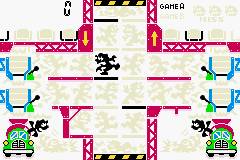
Cement Factory is a later Game and Watch title, which features more complex gameplay than any of the previously mentioned titles and better resembles a video game on the whole. Players move between platforms using the lift, being careful not to fall and lose a life, and pull levers to release cement to a lower level of the factory and ultimately into trucks. If the cement levels builds up too much in any of the four storage tanks, then a life is lost.
Game B is a faster version of Game A, and compared to the other games on this collection, Cement Factory is the most fun and challenging. It requires players to multitask and pick the correct moment and sequence in which to do tasks. Once three lives are lost, the game is over.
Overall Game Boy Gallery isn't a particularly technically impressive game, but that's almost to be expected for a collection showcasing technology that was already 15 years old at the time of release and is now approaching 35 years of age. It gives players the chance to play Game & Watch handhelds without having to own the consoles themselves, which can be costly thesedays, and the updated sounds and visual borders (if used with a Super Gameboy on the SNES) are a nice addition.
Rating: 59/100
Grade: D
Grade: D
Game: Game & Watch Gallery Advance
Console: Nintendo Game Boy Advance
Developer: TOSE
Release Date: 28th October 2002
The fourth in the Game and Watch Gallery series, and the first on the Game Boy Advance, Game & Watch Gallery Advance showcases 6 classic Game & Watch titles, each with a classic and modern version, as well as a 2 player or Hard Mode of each. Alongside the games there's a Gallery/Museum option which allows players to unlock and play some other classic Game & Watch titles with the stars they've earned in the main game.
Boxing
Classic Boxing features 2 fighters, with their health bars at the top of the screen and a number representing their total health. Each time a bar is knocked from a fighter's health the total health goes down by one. Each time the bars are depleted, 3 points are knocked from the fighter's health and they're pushed back by one step. If a fighter's health bars are fully depleted whilst against the ropes, then 6 points are taken from his total health. Once the total health reaches 0, the fighter must be knocked down whilst against the ropes for an opponent victory.
While this sounds very technical, the reality of gameplay is literally hammering the punch button. Players needn't even pay attention to the screen to win matches. I managed to fight my way to 20 knock outs without even really trying at all. Whilst the difficulty increases incrementally, 20 KO's is enough to earn 5 stars on the main menu, and isn't a challenge at all.
In modern mode, Boxing features fights against 3 opponents, Wiggler, Boo and Waluigi. Players control Luigi and attempt to land a hit on their opponent and take one of the hearts from their health meter at the top of the screen. Once all 5 hearts are gone, the player whose meter has been depleted falls back against the ropes, and both players meters are refilled. Play resumes and if the player against the ropes loses all their hearts again, they are defeated. If they manage to beat the other boxer then play moves back to the centre of the ring.
Unfortunately, being based on the Game and Watch version, there are only two punches which can be thrown, a high and a low hit. Button mashing seems to be the easiest way to land punches, although different moves seem to work differently depending on the opponent. There's very little challenge to this minigame, and the modernised update only really adds better graphics and different fighters to the mix.
Fire
Fire was the 4th Game & Watch handheld released, and like those before it only featured the right and left directional buttons for input. Players were challenged to save escapees of a building fire and bounce them to an ambulance on stretchers. As the game continues more and more escapees tumble out of the building at an ever increasing rate, meaning that players must multitask and keep their attention on which patient needs bouncing to the ambulance next.
A little challenge is added by the fact that the patients bounce slightly less high on their second ascent, so the timings aren't symmetrical. Game B is a faster and more advanced version of Game A, but other than this there's no real difference. As a game, Fire works well with its simple concept, but can easily become monotonous.
The updated version of Fire features different characters from the Mario series in addition to the different bounce heights of the previous version. Toad is lighter than Yoshi, who is in turn lighter than Donkey Kong Jr. There are also power-up eggs which contain either a score bonus or a bomb, the latter of which must be dropped before it blows up the carriage, waiting to save the escapees of the fire.
Just like the original version, Mode B starts players off with a more complex set of patients to transport. The updated version is one of the more difficult games on the collection, due to the amount of multitasking and judgement needed with the different types of character to be transported. Annoyingly, even with a High Score of 251, the game rated my performance as 1 star out of 5, which I thought was a bit of an insult.
Rain Shower
Rain Shower was a Game and Watch handheld released in August 1983 at a time when Nintendo were releasing one new Game and Watch console a week, While this didn't last long, it's interesting to consider how many things the company must have had their minds on at once during this time frame. The objective of Rain Shower is to stop laundry on the washing line from getting wet by adjusting four separate lines left and right as rain drops fall. In terms of control, players use the d-pad to navigate the onscreen character into place before pressing the action button to swap the position of the laundry, between two presets.
While Rain Shower is a fairly complex game when compared to some of the others, the multitasking feels less enjoyable as its easy to miss a single raindrop headed for the laundry and lose a life, while distracted by another drop. Game B worsens this by starting at a higher difficulty level. I can't honestly say I'm a big fan of this particular Game and Watch as it uses the basic concept of some other Game and Watches (mainly Helmet) in a new setting.
The updated version of Rain Shower doesn't even really fit the name; Bowser throws items down towards characters on swings below, and its Mario's job to move the ropes and protect them from being hit from above. The game suffers the same multitasking issue as the original and if anything is more difficult to keep track of due to the coloured visuals. As time progresses more characters come and sit on a swing, giving Mario an even more complex task to do. The music provided with the updated version is bearable, but the game is less so.
Mario's Cement Factory
Essentially the same as Cement Factory, featured earlier in this review, on the Game Boy Gallery, the classic version of this game plays and feels very similar with slightly updated colour graphics for the industrial setting and equipment.
The updated version of Cement Factory plays very differently to the older versions. While the main concept is the same, Mario is allowed to fall between platforms without consequence as long as he doesn't touch the top or bottom of the screen. This makes the game far easier on the whole, and allows players to focus more on their movements and keeping track of which containers are filling up. As a concept this is probably one of the best games on this cartridge, as there's far more complexity than anything featured so far. Strangely there's no background music featured in either version of the game, which is disappointing even if this does make it easier to hear the "full" sound effect for the containers.
Donkey Kong Jr.
The original version of Donkey Kong Jr. (which may have been better as an actual Game & Watch handheld) seems to me to be borderline unplayable. With so many outlines for Donkey Kong Jr's positions, it's hard to tell which is the next to progress to, and what options are available. Add this to some difficult obstacles, and you've got a frustrating and confusing game which really needn't be. This seems to be an example of technology holding back the playability of the game, except that as it's been remade on Game Boy Advance, they could clearly have toned the multiple Donkey Kong Jr.'s down a little, and made the route more obvious.
The updated version of Donkey Kong Jr. is far better and allows players to rescue Donkey Kong over a variety of levels (at least 3), with a slowly increasing difficulty curve and a much simpler movement interface whilst retaining the positional movement of the Game and Watch original. The music is also fairly enjoyable, which adds a sense of the experience being much closer to a real video game rather than just an LCD handheld.
Donkey Kong 3
Donkey Kong 3 (at least the Game and Watch version) features Mario and Donkey Kong facing off by filling tanks of water and shooting bubbles at each other, which send what appear to be mice towards the other player. Being hit by a bubble doesn't affect the player, but if one of the mice reaches their side of the screen, then a life is lost. Sucessfully getting a mouse to Donkey Kong's side of the screen results in a points bonus and the positions resetting.
Much like Donkey Kong Jr., the sheer amount of outlines on the screen mean that making sense of what's happening is difficult. The mice also swap around what level they're on constantly, making it anyone's guess where they're going next, and consequently where to shoot.
The updated version of the game fares much better in terms of being able to see what's happening. The mice have been replaced with a fireball and a Boo. Unfortunately these two also move around quite a bit, and the best strategy seems to be completely refilling the water tank and then shooting it all at the middle, assuming one of the two items are in that lane. Overall this one's some fun, though it could definitely have been better.
With all the main games reviewed, I should also mention the fact that there are 9 bonus original Game and Watch games to play. These are unlocked by gaining stars in each of the featured Game and watch games, though it's often difficult to earn any stars due to the high boundaries set by the game. Since you'll need 80 stars to even play the first unlockable bonus Game and Watch, there's little point including them as a feature, since it's fairly obvious that their inclusion is simply to give players a reason to continue playing what appear to be fairly boring choices and revamps from the Game and Watch catalogue.
On the whole, Game and Watch Gallery Advance doesn't seem to have even one title that's completely worth playing; classic or updated. While it's a nice throwback to the handheld consoles, and the updated versions often do improve on the originals, there's no real need to return to what appear to be fairly bland and simple games.
Rating: 60/100
Grade: D
Sunday, 30 August 2015
Game Review: Game & Wario
Game: Game & Wario
Console: Nintendo WiiU
Developer: Intelligent Systems
Release Date: 23rd June 2013
I am a huge fan of the Warioware Series, its microgames and general humour. Having played a short demo of this game at MCM London Expo, I was fairly confident that it would be pretty fun upon release. Unfortunately, as much as I would like it to be a great game, it isn't. Whether or not it's under the Warioware banner is debatable; certainly it's not in name, and only features microgames in one of it's 16 minigame segments, but even without the expectation associated with the Warioware series, the game feels like little more than a misguided tech demo.
Many gamers will recall Nintendoland, released alongside the WiiU as its pack-in game, featuring a selection of Nintendo based minigames, each showing off a different function of the WiiU gamepad. In many ways the overall impression given by Game and Wario is similar to this; its 12 single player stages and 4 multiplayer stages feature an array of ways to hold and interact with the gamepad; some clever, others not so much. The problem is that unlike Warioware: Smooth Moves on the Wii, there's less of a fun, party game atmosphere.
I don't want to simply list each stage and compare flaws between them, since most problems are common to the game as a whole, however I will provide a few examples of stages featured in the game. In Mona's game 'Shutter', players must search for specific targets to photograph on their tv screen before taking a picture of the target with the gamepad. As with most stages in the game, there are 5 different levels for players to try, progressing in difficulty as players continue. Patchwork features Kat and Ana, challenging players to piece together knitted puzzle pieces to make shapes. This is a contender for worst minigame, but there's no shortage of options.
The better minigames include Pirates, Wario's minigame which is rhythm based and fairly fun once the gameplay has been mastered, Kung-fu, which sees Young Cricket jumping across platforms towards Master Mantis, using the tv and gamepad for different viewpoints, and bowling. Which is literally bowling, but it's in my top 5 minigames simply for not having too many faults.
The game I take most issue with, however is Gamer, featuring 9-Volt and 18-Volt. The premise is simple, stay up late and complete your videogame, whilst pretending to be asleep when 9-volt's mum enters the room. This game features microgames from the Warioware series as the videogame 9-volt is playing (much like previous Warioware games have done), and was the minigame which I played during the demo at MCM. Having advertised the game in its demo as featuring microgames, I was fairly surprised to find that this was the only one actually sporting them, and reused ones at that.
It seems to me that either this is a game, entirely unrelated to the Warioware series which was meant to serve as a tech demo for the WiiU gamepad, released too late to do so and thus Warioware themed so as to avoid having to release it as Nintendoland 2. Or worse it's meant to be part of the Warioware series (I mean it does feature all the same characters, and a similar concept) but has taken the series in a new direction of minigames, rather than microgames. If this is the case, the then latter is far worse but the former isn't exactly good for my opinion of Nintendo.
With every newly completed stage, players earn coins which can be exchanged for minigame/collectible prizes, but it's also clear that this gimmick is an attempt at infusing some replayability into the game. Without collectibles and an incentive to continue it'd be fairly easy to stop playing after unlocking and trying each minigame. Having said that, most of the minigame and collectible prizes are pretty rubbish anyway so there's little point unlocking them all.
Graphically it's unclear what overall style the game is going for with cartoon and 3D elements mixing together in a far less coherant way than Smooth Moves. Musically the game is alright, but doesn't seem to feature as much of the instantly memorable tunes that other games in the Warioware series have done. Overall Game & Wario is a fairly poor mish-mash of games, in the same vein as Nintendoland with Wario's face slapped on the front to increase sales. Perhaps young gamers who aren't expecting the Warioware legacy to be continued in the game might find a little enjoyment, but I'll stick to the classics.
Rating: 65/100
Grade: C
Friday, 3 April 2015
Game Review: Pokemon Shuffle
Game: Pokemon Shuffle
Console: Nintendo 3DS
Developer: Genius Sonority Inc.
Release Date: 18th February 2015
Pokemon Shuffle is a free-to-play downloadable game for the Nintendo 3DS, released just a few months ago. The aim is to progress through tile matching puzzles in order to unlock new stages and catch Pokemon, though there's no real battling or evolution as in the main series of Pokemon games. While new Pokemon were recently added, and there's often special or event Pokemon to be caught, catching them all is only a self-imposed aim, and capturing Pokemon is only necessary for progression so far as having a range of different types of Pokemon will help players to deal more damage.
Each normal stage features a wild Pokemon, whose health must be drained in order for a chance to catch them. Health is drained by matching 3 or more Pokemon tiles on the game screen, which disappear when matched and allow the tiles above them to drop down into their place and possibly create another match, thus starting a combo. Some Pokemon can mega-evolve, lending a special ability to increase damage, or the chances of damage in future. As players beat stages they will progress through differently themed areas, though there seems to be no link between the pokemon in any one area.
![]() |
| (The course of progression through the game's stages) |
Of course the game is free to play and because of this, players are assigned hearts which represent one chance at playing a stage. Each heart takes 30 minutes to replenish, up to a maximum of 5 without purchasing supplementary jewels. Coins are the currency of the game and can be spent on items to increase the chances of winning a battle, or capturing a Pokemon. Players are rewarded with 100 coins for completing a normal stage the first time, and 30 for each time after that. Special event completions often yield more coins. Jewels are earned via special events, or beating Mega Pokemon trainer battle stages, other than these methods of acquisition, they must be purchased from the eshop.
While this may sound like a fairly restrictive system, Pokemon Shuffle isn't the type of game that I'd play for hours on end, it's much more like an Animal Crossing type of game, where I'll play for 20-30 minutes a day (thus letting my hearts reset to 5 each time). While it'd be handy to have more gems, hearts and coins, there's nothing stopping players from progressing and catching all of the Pokemon they encounter without paying a single real world penny, so there's no danger of this being a pay-to-win title, especially as there's no way to "win" as such anyway.
Graphically the game doesn't make any use of the system's 3D capability, and hardly makes use of its capacity for presenting highly detailed graphics, opting instead for fairly bland and generic backgrounds, with cartoon sprites for each pokemon involved in the battle. Musically the game features a range of tunes which fit well with gameplay, and the series as a whole, but won't leave too much of an impression on you, once all is said and done.
Overall Pokemon Shuffle is the best type of free-to-play game; addictive, fun and unrestricted in terms of being able to play without contributing money to buy in game currency. While the gameplay is fairly basic, and the entire game would be far worse without the Pokemon theme, it's a passable attempt at a game of this type which has charm and interest.
Rating: 67/100
Grade: C
Subscribe to:
Posts (Atom)