Showing posts with label CPC. Show all posts

Sunday, 20 March 2016

Amstrad CPC Quadruple Header: Ghouls, Defend or Die, Covenant and Jack and the Beanstalk


Game: Ghouls
Console: Amstrad CPC 464
Developer: Micro Power
Release Date: 1985

Usually with games released around 1985, if it looks like Pac-man, and it sounds like Pac-man, it's pretty much Pac-man. Ghouls breaks this rule somewhat, as despite its main character sharing an awful lot of similarities with Pac-man (being yellow, the same death animation, eating pills and power pills to kill ghosts), it's actually more of a Mario-esque feeling platform game. The goal is to get past all of the obstacles and to the top of the screen.

Unfortunately Ghouls has one huge flaw which makes it nearly unplayable; every move has to be pixel perfect to avoid death. The controls are incredibly specific when it comes to inputs, so much so that in 20 attempts, I couldn't beat the first level despite topping the high score table of the game. The issue seems to be that even jumps which seem to land on the edge of a platform can phase through them, and the main character cannot fall very far at all without dying.


Graphically the game is pretty simple; though the main character is Pac-man with legs, the rest of the onscreen sprites are a little more original and I suppose that deserves some credit. Musically there's some menu music, and Game Over music but nothing save for sound effects in the game itself. These sound effects are reminiscent of Pac-man, and I ended up wondering why the developers didn't go for a more direct clone, as it's clear they were influenced by the Namco title.

Overall Ghouls is one to avoid; it's controls just aren't good enough to get a feel for the main character's movement. 9 times out of 10 I snagged the red plant on the first platform, resulting in a death, and the few times I didn't the balloon ghost came to get me, or the awfully tricky moving platform enemy that you can stand on some parts of but not others ended my turn.

Rating: 9/100
Grade: F


Game: Defend or Die
Console: Amstrad CPC 464
Developer: Alligata Software
Release Date: 1985

Defend or Die can easily be described as a wave based space shooter. Players control a ship and are rewarded for shooting aliens which inhabit the level. There are 6 different types of aliens which can be seen above, and players must shoot a certain number of them before moving onto the next level. The player's spaceship speed is incredibly fast, and much of the navigation must be done using the radar on-screen.

The initial enemies aren't too hard to take out with the ship's built in guns, but by the time it comes to the Mutants and Bombers of wave 2, it's almost impossible not to get hit. The Mutants can move at the same speed as the ship, making its maximum speed seem stationary and thus creating a difficult situation for players to manoeuvre out of .The bombers spread bullets when they are destroyed and so are equally dangerous.


Graphically the game is pretty basic, with sprites reminiscent of Space Invaders from a few years earlier, and much of the screen filled with simply black background. While the game loaded to a musical melody, there are only shooting sounds to accompany gameplay, and these are pretty much white noise.

Overall the ship moves far too quickly compared to the landscape and the enemies become rather powerful too quickly to let players have much fun. The game seems to play decently other than these issues though, so it's a shame it wasn't a tad slower, with some initial enemies to train players in how later levels would work, rather than being thrown in at the deep end.

Rating: 30/100
Grade: E


Game: The Covenant
Console: Amstrad CPC 464
Developer: PSS
Release Date: 1985

With easily the best title screen I've seen for it's French release (the UK just got a blue screen with the title) The Covenant is a space exploration game, not entirely dissimilar to Metroid. There's a large sprawling map with lots of chambers and places to explore which scrolls as players explore and unlock new parts of it. In each chamber there's a monster which must be subdued whilst outside of the player ship and then captured inside of it. Once all the current area's monsters have been caught, a piece of the covenant is unlocked on the pause screen and players can move on.

The feel of movement in the game is very floaty; both the ship and the player character fall very slowly through the air. The exploration gameplay is slow and calculated, and although much of the terrain looks similar, there's a real sense of exploration and adventure with the game feeling far bigger than the majority of CPC titles.


Graphically the colours featured in the game remind me of Sabre Wulf for Commodore Plus/4; the bright shades evoking tropical plants. It's interesting to note how large the player's sprite is on the screen as a whole - this can make avoiding enemies and other types of damage fairly difficult, though there is a life gauge refill point situated in each part of the map. Though there's no music, there are other sound effects and the dominant feel is one of wonder at the scope of the game, for the era.

Overall Covenant is a very interesting game, and perhaps one of the most content rich of the Amstrad CPC line up. While the game does get a little harder later on, there's the possibility of saving (very impressive for the era), and uncovering the pieces of the covenant gives players an idea of how far along in the game they are. The obvious parallels with Metroid are impressive, especially on an inferior system to the NES.

Rating: 66/100
Grade: C


Game: Jack and the Beanstalk
Console: Amstrad CPC 464
Developer: Thor Software
Release Date: 1985

With some of the worst menu music I've ever heard, Jack and the Beanstalk didn't give a great first impression. It's a simple platformer with various screens which tell the story as Jack climbs the beanstalk and makes his way to the giant's house. Unfortunately it's also very clunky with a poorly implemented control scheme which sees jump and shoot mapped to the same key.

Enemies are tricky to avoid, and shooting them with the gun is somewhat of a waste of ammo, as Jack has a limited number of bullets. The second screen has a 3D effect going on which is really weird and the entire game seems fairly hastily put together based on a fairytale. Constricted by the events of the story, but feeling no need to depict them in particular accuracy, the game fails to be fun, or an accurate retelling of the story.


Graphically the game looks almost cartoon like, with a visually pleasing 8-bit style. It's a shame that the movement within the game is difficult to get used to and the controls must be relearned with each level change as different ideas are attempted. Aside from the awful menu music, there are sounds here and there which also assault the ears. Whoever was responsible for the sound design in the game did a terrible job.

Overall Jack and the Beanstalk isn't a game that I'd be willing to play based on it's concept, gameplay, music, or controls. The graphics are okay, but also vary from level to level. The control issues that plague the game and lack of tangible platforming enjoyment make this hard to persevere with once players start losing lives.

Rating: 26/100
Grade: F

Sunday, 20 December 2015

Amstrad CPC Double Header: Oh Mummy and Bad Cat


Game: Oh Mummy
Console: Amstrad CPC 464
Developer: Gem Software
Release Date: 1984

Upon initial inspection Oh Mummy seems like a very simple game for the CPC. Players make their way around a grid with 20 squares, and once a square has been completely encircled its contents are revealed. These can range from nothing, to treasure, a key to escape the level, a mummy which must be found before exiting the level, an immunity scroll or worst of all a guardian mummy which will make its way out of being trapped and follow the player around. As the levels progress, the guardian mummies follow players, leading to there being rather a lot on the fifth and final level of each pyramid. 

Players control a member of the excavation party, of whom there are 5 to start, moving around the maze in order to collect the mummy, key and any treasure they can. Contact with any of the guardian mummies in the level will result in the loss of an excavation party member unless an immunity scroll has been discovered on that level, in which case players get one free pass to get rid of a mummy without reducing their party. The game is scored on points for completing levels and collecting treasure, with 5 levels per pyramid and the difficulty level increasing with each pyramid. 


The speed and difficulty level of the game can be adjusted, which is a nice feature since things can get a little easy at times. The game runs at a great speed considering its on Amstrad CPC, and its generally pretty enjoyable. The music isn't great with a single short backing song that repeats ad infinitum until players turn the volume level down on the CPC, but the sound effects are bearable at least. 

Overall I had a lot more fun with Oh Mummy than I thought I would; there's a good amount of powerups featured in the game which affect the strategy needing to be used in each level, and since the guardian mummies carry over from level to level, players must also consider whether or not to explore in order to find the immunity scroll and reduce the overall number of them by one per level, or chance fighting more in the later levels. Good stuff!

Rating: 65/100
Grade: C


Game: Bad Cat
Console: Amstrad CPC 464
Developer: Go!
Release Date: 1987

Bad Cat is a strange game, even for the late 80s. Without reading the box, you'd have nearly no clue as to what's going on in the game. The box says; 'Seoul prepares for the Olympic Summer Games. The dignitories [sic] and celebrities prepare their speeches and wait for the huge crowds expected to attend. Beware, there are still the straying city-dweller cats - despised by all. The infamous cats are well known for they are planning their own competitive games. Will Bad Cat live up to his name?'. To be fair that description doesn't help all that much either, but together with the game we can probably work out what's going on.

Players start on the screen featured below; needing to jump over 3 water gaps to progress to the next section of the level. Once they reach the right hand edge of the screen the tape loads the next section for about a minute or so. This continues as players pass each set of obstacles and can mean that at least 6 separate sessions of loading occur in the entire section. After this there's a part with a city map where bad cat must drive, avoiding obstacles to a destination, at which he competes in an athletic event of sorts. These vary in quality, the amount of time they take and difficulty.


I'm not entirely sure what the overall goal of the game is; whether we're playing as the despised city cats and trying to stop the Seoul Olympics from being held, or whether we're trying to redeem all of cat-kind by winning their version of the Olympics. The messages to the player on each part are fairly humourous though; The water is wet? Thanks, Sherlock! Graphically the game is pretty poor, somewhere between Atari 2600 level and NES, and there's not too much to enjoy in the way of music and sound effects.

Overall Bad Cat is more of a confusing experience than anything with an array of different controls for each part, no real instruction, a poorly explained story and very basic graphics. What can be played is definitely a game of sorts, but between the massive amount of loading from the tape, and trying to work out what needs doing in each section, there's not much gameplay or enjoyment to be had.

Rating: 33/100
Grade: E

Tuesday, 24 November 2015

Amstrad CPC Double Header: Killer Gorilla and Chuckie Egg


Game: Killer Gorilla
Console: Amstrad CPC 464
Developer: Micropower
Release Date: 1984

Looking at the title of Killer Gorilla, I did wonder for a moment whether it might be even slightly similar to Donkey Kong. After all, with its year of release and the shameless copying that went on back in the 80s on home computer style games consoles, I wouldn't be surprised. As soon as the first screen loaded, I knew that I was correct, and that I'd be judging them game solely on how well it played compared to Donkey Kong. After all it's almost a complete port of the game, with extremely similar levels and concepts.

There's good control and on the whole it's very playable compared to some other CPC titles. The main character jumps very similarly to Jumpman in the original game and this helps with precision control whilst navigating through levels. I play my CPC games with a Master System controller if possible, so that may have helped also, but it's way easier than using the keyboard.


Graphically the game is slightly more basic than Donkey Kong on the NES or in arcades, but that's to be expected. It still bears visual similarities to the original and the simplicity of the game as a whole makes it easy to progress, but some of this is due to the fact that they've clearly copied an already successful video game. The music is far less enjoyable than what's featured in the original DK, but the soundchip of the CPC is far inferior to the NES it seems.

Overall for a port/clone game Killer Gorilla is pretty nice; it plays about as well as Donkey Kong and features the same sort of levels, I gave Donkey Kong on the NES a 30.7/100, so it's only fair that this game receive a slightly lower score, but it's almost as good. 

Rating: 30/100
Grade: E


Game: Chuckie Egg
Console: Amstrad CPC 464
Developer: A'n'F
Release Date: 1985

Chuckie Egg is a fairly simple platformer, conceptually. Players control a little man (presumably the title character) who runs, climbs ladders and jumps around collecting eggs from platforms whilst avoiding blue hens of some sort. There's a large yellow duck which is caged in the top left corner of the screen until players reach level 9 which is the same as level 1, only now they're pursued by the duck instead of having to avoid hens. If players can make it through all 8 levels again, they'll be greeted with playing against the hens and the duck, and these increases in difficulty continue up to level 40 which technically is the last unique level in the game. 

Things can become fairly tricky around level 5 or 6, but the game is generally great fun. Although some versions were released without "realistic physics", the Amstrad CPC version was lucky enough to have been programmed with these, meaning that the control is spot on, and gameplay is fun and addictive. This is one of the best 8-bit games I've ever picked up, controlwise and thanks to most 8-bit games being somewhat lacking in the graphics department, good control goes a long way towards making a classic 8-bit title. 


Graphically the game is simple, like most CPC titles, and the colours are lurid and very much typical of the era. There's not much in the way of music, save for a tune which plays once a life is lost, but the walking and jumping sound effects are classic arcade style and make up for the lack of other sounds nicely. 

With up to 4 player support (turn taking, of course), Chuckie Egg is a game that I'd actually consider showing friends in the modern day, as there's skill, strategy and timing elements and getting further into the game is fun and addictive, to the point where I played it for far longer than most CPC games get when they're reviewed. 

Rating: 71/100
Grade: C

Wednesday, 16 September 2015

Pinball Games Quadruple Header

A while back I posted a Pinball Games Roundup, but since then a few more pinball games have come to my attention. I'll be playing them in chronological order of release;


Game: Pinball Wizard
Console: Amstrad CPC 464
Developer: Sagittarian Software
Release Date: 1985

Pinball video games released in the 8-bit home computer era are never going to be perfect; even NES pinball isn't all that, since it was particularly hard for programmers of the time to code a smooth running pinball table with a good amount of interactive features and ways to score points with the amount of tape/cartridge space available.

Pinball Wizard seemingly chose to have smooth running gameplay over an abundance of feature on the table. The only real point of interest are the Hi/Lo switchers, which change the amount of points awarded for hitting bumpers on either side of the table. The letters at the top which spell Sagittarian give a bonus when they're all illuminated, and other than that the idea is to keep the ball in play for long enough to score points. The user manual says "With practice, scores over 20,000 can easily be achieved!". Which is fair enough, though scoring 1,000 points is hard enough and takes only a minute or so to do.


Graphically the game's choice of colours was limited by the CPC, but still is difficult to look at for too long. The table itself is pretty bare and reminded me of NES Pinball. Sound effects are lacking and there's no real excitement to gameplay. The only real redeeming feature is that the ball speed can be adjusted and the game runs smoothly no matter which speed is selected. It's not enough to make it particularly notable, or enjoyable though.

Rating: 37/100
Grade; E


Game: Dragon's Fury
Console: Sega Mega Drive
Developer: Technosoft
Release Date: 1992

Listen to the game's OST as you read! (it's pretty awesome)

Originally released for the Turbografx 16 as Devil's Crush, Dragon's Fury features pentagrams and other eerie occult themes throughout its main table's three sections, its six bonus tables and the final battle. Gameplay is fast paced and there's lots to do on each section of the table. The overall objective is for players to clear all of the bonus tables in order to face the final battle and beat the game. To reach bonus tables players must clear objectives on the main table, such as transforming the face in the middle from a maiden to a serpent and hitting the ball into the serpent's mouth.

The difficulty level of the game is medium on the main table as its pretty easy to reach bonus tables and have a fulfilling turn, but the difficulty of bonus levels and the final boss are far higher, almost as if they were specifically designed to cut short any attempt to beat the bonus stages. Once all 3 balls have been lost by the player, a final chance is given for an extra ball if players can match the last digits of their score with a bonus counter. This is a nice feature and adds an extra chance around 50% of the time (if players are skilled at stopping the bonus counter).


Graphically the game features dark and eerie colours throughout its levels, with some brighter visuals in its bonus levels. There's a lot of occult iconography and monsters on the main table, with an array of different characters making up the bonus level bosses. Musically the game is great and the scene is definitely set by the fast paced horror/classical influenced soundtrack. The sound effects are minimal and take second place to the music in the mix, which allows players to enjoy the soundtrack.

Overall Dragon's Fury is a lot of fun as a pinball game on the Mega Drive, if a little frustrating to actually progress in. The table is particularly interesting and its bonus tables are fun, if a little small compared to the main table. The theme of the game is probably its main draw, but it works well as a pinball game and has something to offer both casual and more serious players.

Rating: 73/100
Grade: C


Game: Crüe Ball
Console: Sega Mega Drive
Developer: Electronic Arts
Release Date: 1992

Listen to the game's OST as you read!

The band Motley Cr
üe and pinball don't seem like the most natural combination, but somehow EA were inspired to make a pinball game based off the band. Players work their way through 9 "volume levels" which change the layout of the table, and relative difficulty. The game features many themed elements such as knocking down the words Rock and Roll, or Headbanger for bonus points, and in later levels there are guitar amps which can be knocked down also.

The game features three songs by Motley Crüe, as well as music for each of the 9 volume levels. with the soundtrack composed by Brian L. Schmidt who wrote music for Mutant League Football as well as a few other Mega Drive games. The gameplay is fast paced and particularly easy on the first volume level, allowing players to get acquainted with the feel of the game. In some levels, the ball bounces back up into play if it falls down the edge of the table, unlike many other pinball games. Another interesting feature is the choice to use 4 balls instead of the usual 3. 


Graphically the game is bright and interesting, featuring an electronic theme alongside the musical one. The table has plenty to do, as it's split up into 3 sections, and the middle section changes with each volume increase. Progression to higher volume levels is fairly easy and the game only gets harder from around volume level 5. Musically the game features many high energy tracks to accompany gameplay, and this works well to deliver an exciting experience for gamers.

Overall Crüe Ball offers a fun and engaging pinball experience, even for those who aren't particularly skilled at pinball games. The band's endorsement could be a selling point for fans, but the gameplay is a far bigger aspect for me. There's some fun bonus levels to be accessed and the controls are particularly responsive. 

Rating: 80/100
Grade: B


Game: Pokémon Pinball: Ruby & Sapphire
Console: Nintendo Game Boy Advance
Developer: Jupiter Coporation
Release Date: 26th August 2003

The second game in the Pokémon Pinball series, the Ruby and Sapphire edition adds many Pokémon from the 2nd and 3rd generation to bring the overall total up to 201 catchable Pokémon. The concept and many features of the table are much the same as the first game, but with better graphics, overall gameplay and pinball physics, this game is an improvement in almost every sense. Players choose from the Ruby table or the Sapphire table at the beginning of the game, and normal or slow ball speed. The main objective of tables is to catch Pokémon by initiating one of the many catching bumpers on the table. An example of these would be hitting a Cyndaquil 4 times until an egg falls down from above and hatches, or getting your Pokéball inside a Wailmer.  

On both tables there's a mart at which to buy items, and bonus games which earn players points and coins once completed. Players can catch up to a maximum of 3 Pokémon in any one area (displayed at the centre of the table) before needing to hit the travel bumper 3 times and launch the Pokéball into the travel hole to move onto a new area and begin catching more Pokémon. The aim of the game overall is to fill the Pokédex and own one of each Pokémon in the game. 


Graphically the game features bright and cartoon style graphics as we've come to expect from the Pokémon franchise. The animations and movement of sprites and the Pokéball itself are on par with the rest of the Pokémon series, and unlike the first game, the ball physics are a lot more predictable. The music featured in the game fits well with the rest of the Pokémon series, and is a good accompaniment to gameplay.

Overall Pokémon Pinball: Ruby & Sapphire is an improvement on almost every aspect of the original game, and has far more replayability thanks to this. The tables have an array of features and things to do, and for any Pokémon fan, there should be more than enough excitement.

Rating: 80/100
Grade: B

Sunday, 10 May 2015

Amstrad CPC Review: Roland Series

The Roland series is a strange one; concieved as a mascot for the Amstrad CPC, the 8 games bearing his name were all released in 1984, generally have very little relation to one another and appear to feature different protagonists graphically. This is because the games were developed before the mascot, and his name attached afterwards. As a result, it can hardly be called a series of games at all, but I have 3 titles bearing the Roland name for my Amstrad CPC, and I'd rather get them all over with together. I decided to play them in an order that made sense as a short story, rather than going by release date, as specifics were hard to find.


Game: Roland Goes Digging
Console: Amstrad CPC 464
Developer: Gem Software
Release Date: 1984

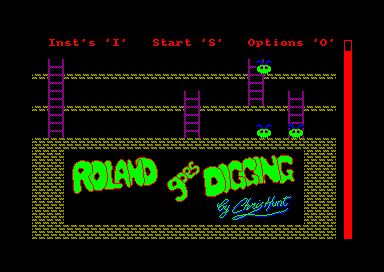
With the definite feel of a 1980s arcade game, Roland Goes Digging is an intuitive and easy to learn game. Players must dig holes in order to trap and subsequently kill a bunch of aliens who have invaded a building site. The motive we are given for doing so is that Roland is strapped for cash, and this is a means of earning money for him. Once every alien has been trapped and killed, the next level begins with a greater number of aliens.

Holes are dug in 3 button presses, and aliens trapped in half-dug holes become angry before escaping and moving faster than they were able to previously. Aliens who have been trapped in a hole, but not killed whilst unable to move also become angry in the same way. Roland can fall down holes he has dug without taking damage, and fill them back in once dug. If he touches an alien, however he loses a life, and after 5 deaths it's game over.


Graphically the game isn't much to look at; Roland's face is bright red for some reason and the aliens appear to be ovals with wings and red circles for eyes. That said, the Amstrad CPC's graphical capabilities are quite low anyway. Musically the game features an arrangement of "Hi Ho" from Snow White and the Seven Dwarves behind gameplay which isn't the worst thing ever, but isn't exactly original either.

Overall the game plays decently though a fair amount of time is spent waiting for aliens to fall into your holes, since they seem to wander randomly. Although the first few levels can be cleared fairly easily by isolating Roland on a platform and digging holes around it, later levels depend on the arrangement of ladders for their difficulty; still, this is a playable little arcade style game.

Rating: 42/100
Grade: E


Game: Roland In The Caves
Console: Amstrad CPC 464
Developer: Indescomp
Release Date: 1984

Having dug too far (at least that's how I imagined it) Roland finds himself in the caves, transformed into a bug with incredible jumping powers. To escape, he must jump from ledge to ledge, and find the exit whilst avoiding being caught by a pterodactyl and flesh eating plants. With a hugely powerful jump, Roland is able to fling himself around the caves either to the left or right, adjusting the difficulty by the length of button press on the keyboard.

The real issue with the game is that it's difficult to tell how much power to put into a jump and in which direction to travel. The pterodactyl is merciless in its pursuit of Roland and gives him no time to think about his route out. Playing the game for a short while resulted in a great many deaths for Roland, a little progress towards escaping that I found difficult to recreate on subsequent turns and exactly 0 points scored overall.


Graphically the game is colourful at least, with various features to its cave but there's very little to see due to the overall size of the playing area. Roland is a tiny purple bug in this instalment of the series, and the pterodactyl is the only other real character sprite. Musically the game uses "La Cucaracha" this time as a theme, which works arguably less well than the previous game's music.

Overall Roland in the Caves is difficult to progress with, hard to control and not even worth your time. It seems fairly hastily developed, lacking in features and ideas and devoid of much imagination, even for the time it was released. It's the kind of game that you only see on such early systems because at least they had an excuse.

Rating: 3/100
Grade: F


Game: Roland On The Ropes
Console: Amstrad CPC 464
Developer: Indescomp
Release Date: 1984

Possibly the most conventionally game-like of my Roland games collection, Roland on the Ropes features the titular character exploring a maze like arrangement of caves in search of treasures as he dodges attacks from ghosts, chameleons and other monsters. The game controls like a regular platformer for the most part; up is used to jump and the fire button is used to operate Roland's gun until it runs out of bullets.

This being said, the level layout is more akin to a maze than levels in most platform games with several dead ends and platforms to jump up to. The only real use for the jump function is to avoid small enemies on the floor, though this is difficult to pull off without taking damage. In fact it's hard to even progress to the next screen of the maze without losing all of Roland's health as ghosts are in abundance and are able to make their way through walls and other obstacles with ease.


Graphically the game is far better overall that either of the previous releases, and Roland actually looks as if he might be human. There's some nice detail on the blocks in the cave, and the enemies are easy to identify even if they're not easy to avoid. Music has been left out of the game in favour of sound effects, which seems to be a good decision overall with the longer format of this game, and the amount of times a musical theme would have to repeat within a turn.

Overall though Roland on the Ropes is fairly frustrating as the number of traps, dead ends and enemies far outweighs the amount of power-ups and exits, meaning that player's chances of progressing are greatly diminished. The game does feel as if it has potential though, and plays far more like later titles than the other two games I've reviewed.

Rating: 26/100
Grade: E

Thursday, 27 November 2014

Amstrad CPC Quadruple Header: Pipeline 2, Side Arms, Bridge-It and Skate Rock


Game: Super Pipeline 2
Console: Amstrad CPC 464
Developer: Taskset
Release Date: 1985

As Mario seemed to have no intention of doing much plumbing in 1985, Foreman Fred came to the rescue, braving the depths of the sewers to ensure that Sheik Aleg's barrels are filled. Unfortunately for him, the tools from the workshop seem to have gone bezerk and are attacking both the pipes and Fred himself. Contact with the tools will cause the player to lose a life and any pipes that are attacked will spring a leak, which will need to be fixed by Fred's assistant, Will who needs to be guided to the leak in order to start fixing it.

Players can travel both on top of and up and down the pipe which carries water, and it's usually best to try and get a good line of sight on the attacking tools, and enemies. While most tools are defeated when shot once, there's a scorpion which can only be defeated by a shot from behind or sacrificing Will, and a screwdriver which seems to be invincible and can only be defeated by sacrificing Will.


Graphically the game has a cartoon style of sorts, and the characters featured are colourful and easily recognisible, although when enemies and tools are positioned behind a pipe, it's near impossible to tell and tends to result in many frustrating deaths. The music of the game is pretty good for the era, and accompanies the game well. The sound effects are basic, but work decently towards giving the player audial feedback.

Overall Super Pipeline 2 seems to be a decent concept which wasn't all that well executed because of the standard of hardware in 1985. Perhaps on the Mega Drive or Super Nintendo, the game might have had some sort of enemy indication through the pipes, but as there isn't one, it makes the game far harder to play. If you're into fairly difficult puzzle/platforming games then this might be an afternoon's entertainment though.

Rating: 22/100
Grade: F


Game: Side Arms
Console: Amstrad CPC 464
Developer: Capcom
Release Date: 1987

Once before in a review, I played the arcade version of Side Arms, and gave it a score of 45/100 due to its extreme difficulty. A year later than its arcade release, Side Arms came out on home console and the Amstrad CPC was lucky enough to get a port. While the game is vastly different from its arcade counterpart there are some redeeming features, and compared to other games on the CPC it's pretty enjoyable.

In this version of Side Arms, you play as an astronaut on their way through space, taking potshots at various enemies that come your way. There's not a lot of them around, though and often it's a little boring to just drift though space until the next one comes. A variety of weapons and powerups are included such as a spreader gun, laser shooters which rotate around the player and a laser weapon.


There are various levels to the game although it's pretty hard to get much further than the second. Depending on what powerups you currently have, the game can be pretty easy, but without them it's pretty difficult not to get hit. Graphically the game looks pretty good for the Amstrad CPC, although it was later on in the console's lifespan, so you might expect that. Musically the game is very good and the soundtrack is probably my favourite part, although its a shame that you can't hear it over the shooting sound effect most of the time. Overall this is pretty fun to play, although its not really up to the standard of space shooters on the NES.

Rating: 46/100
Grade: E


Game: Bridge-It
Console: Amstrad CPC 464
Developer: Epicsoft
Release Date: 1984

There's really not a lot to say about Bridge-It. The game was one of the first games released for the Amstrad CPC and is easily one of the worst. Players are first met with an options screen asking how they'd like to define the controls, or use a joystick, the level of play and how many lives they'd like. Once these have been decided, the game's main screen flashes up and play begins almost instantaneously (which leaves players with very little time to react).

The object of the game is to guide all of your men to a building on the other side of the river, over 4 bridges which are usually in the up position. Players must lower bridges for the men to walk over before they get to them, so that they don't fall into the water. No more than 2 bridges can be lowered at once, and once one bridge is down, the other will come back up very quickly, meaning that it's almost impossible, if not absolutely impossible to guide all of the troops back to the other side.


Graphically the game seems fairly poor, almost resembling an Atari 2600 or Intellivision game from the previous generation. There's almost no detail, and the men seem to fall before they even get to the bridges. The soundtrack seems to be the game's worst feature though, with out of tune versions of songs such as Jingle Bells being your only accompaniment to the mass bridge jumping exercise.

Overall this game is almost unplayable; there's very little to do or control, the bridges are unresponsive and difficult to move in the correct way, the graphics and soundtrack are incredibly poor, and there's no hope of getting even half the men across the bridge, not that it matters, since there's no targets or clear levels to the game.

Rating: 2/100
Grade: F


Game: Skate Rock
Console: Amstrad CPC 464
Developer: Bubble Bus Software
Release Date: 1987

Released in the same year as Side Arms, and far less exciting; Skate Rock is comparable to Paperboy in its gameplay. The goal is to pass through checkpoints while skating through the streets under a time limit. It also controls a little like Paperboy; the up button raises the player's speed, right and left turn, and down slows the player. Strangely though the skater travels sideways most of the time, so everything feels 90 degrees away from what it should be. Aside from this the controls are fairly responsive, even if the skating action feels painfully slow sometimes.

Jumping is programmed strangely; instead of an ollie, the skater will jump straight upwards, which can cause problems if players are not expecting that sort of motion. Checkpoints are dotted about the streets; sometimes in the road, sometimes on the pavement, and there are various obstacles that must be avoided such as pedestrians. Some of these have rather random patterns in later levels, making them hard to avoid, but the speed of the game is slow enough to be able to deal with them.


Graphically the game isn't much better than an Atari 2600 game, or something on the Commodore Plus/4; it doesn't look bad, but it's not revolutionary either. The theme tune which plays on the game's menu is enjoyable to a degree, but there's no ingame music which is a shame. Overall this is a fairly boring skating title which doesn't have a lot to do, even for the time of its release.

Rating: 26/100
Grade: F

Saturday, 1 November 2014

Amstrad CPC Multiplat Triple Header: Bionic Commando, Double Dragon and Turbo Outrun


Game: Bionic Commando
Console: Amstrad CPC 464
Developer: Software Creations
Release Date: 1988

Bionic Commando is the only game in this series of reviews which I haven't been able to play on another console. As such I've nothing to compare it to, but that doesn't matter too much as you'll see. Players control a Bionic Commando with one limb able to shoot and another able to project a telescopic grabbing arm, to aid with platforming. This is a good concept and allows players to reach platforms in any of the 8 joystick directions, as well as shoot enemies who are in their way.

Making their way through levels, players must avoid or kill enemies and find the exit, at which point the next level will begin to load. While the levels aren't difficult, it does take a little bit of effort to figure out where you're meant to be going. There are 5 levels in total, which slowly escalate in terms of difficulty although they never reach a level that's too hard. Controlwise the game works pretty well; it's a little slow like most games on the CPC, but the platforming and shooting concepts are there.


Graphically the game is one of the worst I've ever seen. The player character's sprite is transparent with a black outline, meaning that it easily blends in with anything behind it. At times it's almost impossible to see what's happening onscreen due to the combination of bright clashing backgrounds, and abundance of black outlines. Soundwise there's not a lot to enjoy; the shooting sound effect is pretty standard for the time.

Overall this'd be the classic argument for gameplay mattering more than graphics, if only the graphics didn't get in the way of being able to play the game properly. If you can endure the difficulty of picking out which black line is yours then Bionic Commando has more enjoyable gameplay than some other CPC games, but otherwise I wouldn't bother.

Rating: 27/100
Grade: E


Game: Double Dragon
Console: Amstrad CPC 464
Developer: Binary Design
Release Date: 1988

There are two versions of Double Dragon on the Amstrad CPC. One of them has rather crude Atari 2600 looking graphics, and moves similar to the arcade version of the game. The other version is the one I have. An early indication that the game might not be too good is the fact the there's only one fire button to assign. This means that there's literally only one attack available, a simple punch in the direction that the player is facing.

What's more, the hit detection on enemies is absolutely awful. As a general rule, any punch that looks like it's going to hit will miss, and vice versa. Players can be standing in the same place as an enemy and still hit them, but when a little less than an arm's length away, punches will miss most of the time. Not only this, but regular enemies take between 5 and 12 hits to defeat, meaning that players have to continually press the attack button whilst waiting for enemies to become un-stunned so that they can be hit again.


Graphically the game is pretty poor and looks as if it could have been made in Microsoft Paint, with the amount of detail that's included. As the hit detection is so faulty, it hardly matters how difficult it is to see what you're doing, because even if you could the game wouldn't allow legitimate punches anyway. Soundwise there's hardly anything to comment on; punches sound weak and any other sound effects are fairly standard for the time.

Overall this version of Double Dragon for the Amstrad CPC is one of the worst ports of a game I've ever played. The controls are slow and unresponsive, meaning that it's almost impossible to progress much further than the first few enemies. Luckily you wouldn't want to thanks to the unimpressive graphics, sound and range of attacks.

Rating: 3/100
Grade: F


Game: Turbo Outrun
Console: Amstrad CPC 464
Developer: U.S. Gold
Release Date: 1989

As a big fan of the Outrun series, I thought it'd be interesting to see how the game played on a severely underpowered console. Just like Turbo Outrun on the Sega Mega Drive, the game's checkpoints follow a route through America, from New York to Los Angeles. On the way, players can use the new turbo system to reach higher speeds than normally possible, as well as upgrading their car's engine, grip and turbo system at various points along with way.

Although the framerate is incredibly low (mostly due to the processing power of the console), the game controls fairly well. Steering is relatively easy, and there's no need to worry about most of the other cars on the road as a lot of them can be passed through without any loss of speed. While this could be used as a negative aspect to the game, it'd be extraordinarily difficult to avoid hitting any other vehicles in later stages.


There's not a lot of identifying features to the stages in the game, although they're based in various American cities. Some are blanketed in snow, while others are just bland expanses, only really differing from other locations in colour scheme. Between checkpoints the tape which the game is on must be restarted, and players are told to wait while the next stage loads. This takes about as long as stages themselves, which can be frustrating.


Graphically the game is very pixelated and hardly ever looks good, but it's recognisable as an Outrun game. Musically it's a shame that versions of the original Outrun music couldn't be included, but the song that accompanies gameplay is enjoyable, even if there's no variation between stages.

Overall Turbo Outrun on the Amstrad CPC is an enjoyable game, despite its shortcomings. I managed to complete it on my first playthough, meaning that it's definitely easier than versions of Outrun games on Sega consoles; it's functional however, and that's more than can be said for quite a few Amstrad CPC games. For those who couldn't experience a better version, this is a playable option.

Rating: 54/100
Grade: D

Friday, 3 October 2014

Amstrad CPC Movie Tie In Triple Header: Robocop, Ghostbusters II and Aliens


Game: Robocop
Console: Amstrad CPC 464
Developer: Ocean
Release Date: 1988

The first of today's four movie linked games for the Amstrad CPC is Robocop. Presented as an on-foot side scrolling shooter, I did begin to wonder just how much of the film the game's designers had seen. The first level requires players to get to the end of the street on the right hand side, past on foot enemies with chainsaws, guns and martial arts skills as well as enemies hanging from windows with more guns.

As the player progresses, there are powerups for health and different types of shot. The normal bullets take two hits to kill enemies, red bullet take one, the triple shot can take out more enemies at a time, and the blue bullets remain a mystery as I wasn't able to get very far into the game. Inbetween the first and second street levels there's a first person style challenge to shoot a hostage taker and save the woman he has taken hostage.


The controls are fairly smooth; moving and shooting feel good and the option to crouch is nice to avoid some enemy shots. A glaring omission from the game however is a jump function, as enemies can also crouch and shoot, leaving players with no means of dodging the attack. Perhaps a punch function would also have been useful to deal with the martial artists.

As far as the level design goes it seems to be fairly boring with similar shop fronts passing by, and a completely straight street to traverse from left to right. Once level two is reached, enemies on motorbikes begin to assault the player also, without any means to dodge them. This makes any further progress very difficult and made me give up on the game after a while.


Graphically the game is nothing special; it's blocky and generally unappealing in both styles of view. There are some items which appear to be in the foreground which players cannot collect, also. The music for the game is pretty enjoyable but its included at the expense of sound effects which gives the overall mood a strange direction.

Overall Robocop is a bland and overly difficult game with control issues, a lack of variety and seemingly little relation to the film. For a game coming out in 1988, that'd have been competing with the NES and Master System, there's little excuse for such design errors.

Rating: 32/100
Grade: E


Game: Ghostbusters II
Console: Amstrad CPC 464
Developer: Activision
Release Date: 1989

Ghostbusters for Amstrad CPC comprises of 3 stages, each of which are I assume from parts of the movie. The first sees players lowering their character down into a sewer, avoiding ghosts and other monsters to reach the bottom unharmed. The second follows the Statue of Liberty down Broadway as they try to reach the museum, where the final stage is held, rescuing Oscar the Baby and defeating Vigo the Carpathian.

The first stage is very difficult to control, the player's momentum doesn't seem to behave as it should, and it's difficult to multitask between watching the courage meter (which drops each time a ghost is touched), collecting parts to get a slime sample at the bottom, and avoiding all of the monsters and ghosts. If players manage to beat this stage, then the second stage is arguably harder; while the controls are a little better and it plays like a space shooter, there's very little margin for error, and the strange slime replenishment system that's used makes it difficult to progress. I didn't manage to play the last stage due to the game's difficulty, but if I had it'd have probably been as hard.


Graphically the game isn't bad, although it's in the typical Amstrad CPC style with rather blocky and blurred sprites when compared to NES graphics. The story cutscenes before each mission are stills from the movie with an orange filter that look honestly horrible. Musically the game does a good job with the movie's theme, and songs inbetween levels, but there's a distinct lack of music to accompany gameplay leaving just the lacklustre sound effects.

Overall Ghostbusters II offers some difficult but passable gameplay across its 3 levels, but it's nothing particularly memorable. While the space shooter style of level 2 is good, it lacks most of the features that make space shooters enjoyable and so falls short of dedicated titles. There's a good amount of variety across the game as a whole, but that's not enough to save it from being far too hard.

Rating: 46/100
Grade: D


Game: Aliens
Console: Amstrad CPC 464
Developer: Electric Dreams
Release Date: 1986

The final movie tie in for this review is Aliens, which is presented as a first person shooter style game. Players can take control of any of the 6 main characters at will, and explore rooms via doors with them. If there's an alien in the current room, a sound will play and players have a short amount of time to kill it before it gets them and kills off one of the 6. Once all 6 main characters have been defeated the game is over.

The aliens come in attack waves, which get stronger as the wave number increases. Alongside this, different types of aliens will appear such as face-huggers and queens. A record of how many aliens of each type have been killed, and the wave number is kept on the pause screen. The controls for the game are fairly simple, with the directional and fire buttons being used as you'd expect, the space bar used to enter doors, and the first letter of each character's surname used to switch to them.


Graphically the game is basic, but the visuals fit well with the overall aesthetic from the movie. While it'd have been nice to see a little more detail in each room (they start to get repetitive after a short time), the limitations of the system were probably to blame. The music featured in the game is enjoyable and gives a sci-fi feel to the action.

Overall while Aliens is a pretty simple title, the gameplay is pretty fun and allows players to re-enact at least the alien killing parts of the film. Exploring rooms can get a little tiresome after a while, especially if all of your characters end up in the same place, or get lost, but this doesn't happen too often. Because of its great soundtrack and generally enjoyable play, Aliens has to be my pick of the movie tie ins in this review.

Rating; 61/100
Grade: D